Two excellent reflections on ethics in relation to Google’s AI principles

Holly from the UK TV programme Red Dwarf

Two excellent pieces by Anab Jain and Lucy Suchman that I recommend you read if you’re interested in studying technology (not just AI) that reflect upon Google’s announcement of its ‘AI principles’ and its apparent commitment not to work on the US Government’s “project Maven”.

Here’s a couple of quotes that stood out, but you should definitely read both pieces:

Corporate Accountability – Lucy Suchman

The principle “Be accountable to people,” states “We will design AI systems that provide appropriate opportunities for feedback, relevant explanations, and appeal. Our AI technologies will be subject to appropriate human direction and control.” This is a key objective but how, realistically, will this promise be implemented? As worded, it implicitly acknowledges a series of complex and unsolved problems: the increasing opacity of algorithmic operations, the absence of due process for those who are adversely affected, and the increasing threat that automation will translate into autonomy, in the sense of technologies that operate in ways that matter without provision for human judgment or accountability. […]

Tackling the Ethical Challenges of Slippery Technology – Anab Jain

The overriding question for all of these principles, in the end, concerns the processes through which their meaning and adherence to them will be adjudicated. It’s here that Google’s own status as a private corporation, but one now a giant operating in the context of wider economic and political orders, needs to be brought forward from the subtext and subject to more explicit debate.

Given the networked nature of the technologies that companies like Google create, and the marketplace of growth and progress that they operate within, how can they control who will benefit and who will lose? What might be the implications of powerful companies taking an overt moral or political position? How might they comprehend the complex possibilities for applications of their products? […]

How many unintended consequences can we think of? And what happens when we do release something potentially problematic out into the world? How much funding can be put into fixing it? And what if it can’t be fixed? Do we still ship it? What happens to our business if we don’t? All of this would mean slowing down the trajectory of growth, it would mean deferring decision-making, and that does not rank high in performance metrics. It might even require moving away from the selection of The Particular Future in which the organisation is currently finding success.

Ocado automated fulfilment centre & automation promo videos

A warehouse worker and robot

Ocado, online groceries delivery service in the UK, some time ago pivoted into providing automation solutions for other retailers. They have a division, or separate company, called Ocado Technology, which offers other retailers systems for fulfilment centre automation: “Ocado Smart Platform” [buzzwords ahoy!]. So, while the above video is interesting, insofar as it demonstrates yet another not-exactly-hospitable factory-like code/space, what is perhaps more interesting is that this system seems to have been developed not only to fulfil Ocado orders in Wiltshire/Hampshire but also as an advert for what Ocado technology does. See this report from Reuters: Ocado’s robot army courts global food retailers.

Ocado have promoted previous automated systems through videos too. The same claims about ‘machine learning’ and so on were made about a fulfilment centre system that looks a lot more like an airport baggage sorting system around five years ago.

I’ve become mildly obsessed with these videos of automated factories and fulfilment centres – they have become a sort of genre unto themselves. There are clearly ways in which promotional videos–made by the equipment/tech firms responsible for creating the systems or the firm implementing them–get translated into video news stories. Likewise, there are ways of talking about the ‘robot’ nature of these things. All of this demonstrates our ongoing negotiation of norms of understanding, describing and rationalising the technology, it’s implementation and what it may or may not portend for work and so on. If you’ve read this blog in the last year you may remember I talk about this stuff as the formation/formalisation of an ‘automative imagination‘.

As a sort of throw-away aside – the displacement of labour involved by Ocado’s, and others’, systems of automation may well be important too. If you ramp up the capacity to ‘fulfil’ orders in the distribution centre then you need to expand the capacity to get them delivered. We don’t have driverless vehicles on our roads, yet, so this possibly means fewer pickers and packers and a lot more delivery drivers.

Digital work and automation link dump

Charlie Chaplin in Modern Times

Ok. Whilst I was not blogging I kept finding things through twitter and reading blogs that I find interesting. I kept thinking “oh, I ought to write something about that”… the thing is, I haven’t had the time and I don’t have the time now. So… I’m going to do a sort of annotated link thingamajig so that I don’t lose these things (I have over 45 tabs open in Chrome on my phone, this is unworkable) and also to share and to maybe invite other people to comment on this stuff..?!

The future of work, a history by Kevin Baker – A relatively long piece of writing that charts a history of American worrying about the replacement of the human worker with machines. Some interesting historical details that help contextualise some of the alarmism today. What I like about this is that the piece ends by reminding us all that there are choices to be made, which are political, but it also highlights how inescapable forms of determinism are (as Sally Wyatt so expertly tells us).

Tech culture, unions and the blind spot of meritocracy by Wendy Liu in Technology and The Worker (#2) –an interesting piece by Wendy Liu that documents a conversation with Xavier Denis a former engineer at Shopify about what working in the US tech. market is like – the sorts of working conditions, norms and management practices.

Automation, skills use and training by Ljubica Nedelkoska and Glenda Quintin (OECD) — A report that builds upon and that authors claim improves assessments of the potential for the automation of particular kinds of work. “Beyond the share of jobs likely to be significantly disrupted by automation of production and services, the accent is put on characteristics of these jobs and the characteristics of the workers who hold them.” This contributes to the ongoing arguments around the likelihood or not of job/role/work automation.

What can machine learning do? Workforce implications by Erik Brynjolfsson (MIT) and Tom Mitchell (Carnegie Mellon) in Science – A short-ish “Insights” article that makes some fairly grandiose and sweeping claims about the ‘impacts’ of automation on the workforce (with an American focus). Some references are made but if you follow them up it seems to me that the statements they are used to support make fairly big leaps. This, in contrast to the OECD report, is a stoking of the now brightly burning fire of the imaginings of automation.

The Guardian view on automation: put human needs first – A Grauniad editorial that passes comment on the above OECD report. It’s interesting to see the reception, interpretation and sometimes misrepresentation (I don’t think that’s what the Graun are doing here) of these academic economic reports. This plays into the general, normative, discussions and senses of the risks and/or realities of automation (this is a part of what I want write a book about).


BBC Click offer a Twitter-length version of ‘what it’s like to work with robots’.

Dr Easy.

Shynola re-imagine/visualise the opening section of Matthew De Abaitua’s novel Red Men – a PKD-like imaginative exploration of the emergence of AI.

The Incomplete Vision of John Perry Barlow by April Glaser (Slate) – Reflecting upon Barlow’s “Declaration of the independence of cyberspace” and the rise of EFF following his death earlier this year. Fits nicely with Fred Turner’s work examining the hippy-libertarian nexus of Silicon Valley moguls. In many ways this gets at some of the ideological foundations and/or misgivings of automation talk.

Face Recognition Glasses Augment China’s Railway Cops by Bibek Bhandari (SixthTone) – An article about the alleged deployment of facial recognition through AR glasses for Chinese police. Predictable comparisons to “Black Mirror” and other forms of dystopianism.

The Ethics Advisory Group of the European Data Protection Supervisor Report on Data Ethics (2018) [PDF] – On the back of the GDPR and contemporary debates around privacy in light of perennial controversies with Facebook and others the Ethics Advisory Group published a report claiming that: “The objective of this report is thus not to generate definitive answers, nor to articulate new norms for present and future digital societies but to identify and describe the most crucial questions for the urgent conversation to come.” The report is written by J. Peter Burgess, Luciano Floridi, Aurélie Pols and Jeroen van de Hoven.

The network Uber drivers built by Alex Rosenblat – an article that addresses some of the ways that Uber drivers have collectively organised in order to manage working with a quasi-automated system in which the policies are not necessaerily in the best interests of the worker.

Artificial Intelligence Technology Strategy (Report of Strategic Council for AI Technology) ( a Japanese government report) [PDF] – A 25 page report written for the Japanese government. It’s fairly dry and dense and has some crazy Powerpoint-style diagrams but it is sort of interesting as a documenting of an apparently strategic governmental approach to “AI”.

Why the Luddites matter : Librarian Shipwreck – A good blogpost on who the Luddites really were and framing them as an interesting means of getting at how popular understandings of technology might be found wanting.

Sci-Fi doesn’t have to be depressing: welcome to Solar Punk by Tom Cassauwers – What if we don’t write dystopian science fiction but build imaginary worlds based on positive and affirmative uses of technology? That is the premise of what is called ‘Solar Punk’, as outlined here by Tom Cassauwers – who charts the movement with Sarena Ulibarri, an editor who is a key proponent of the sub-genre.

Our driverless future on CNN Money – a video feature on driverless cars with four episodes and a couple of additional videos. There’s some interesting interviews and it’s not all boosterism. It’s sort of emblematic of the current discourse on automation. If nothing else this is probably useful for teaching purposes as there are some clips that nicely sum up some of the key questions being asked.

Automating inequality – Virginia Eubanks and interlocutors [video]

Still from George Lucas' THX1138

This Data & Society talk by Virginia Eubanks on her book Automating Inequality followed by a discussion with Alondra Nelson and Julia Angwin is excellent. This seems like vital empirical analysis and insights that flesh out what is, perhaps, frequently gestured towards by ‘critical algorithm studies’ folks – ‘auditing algorithms’, analysing what’s in the black box, how systems function and what is their material and socio-economic specificity and what then can we learn about how particular forms of actually existing automation (and not simply abstract ideals) function.

Eubanks talks for the first 20-ish minutes and then there’s a discussion that follows. This is really worth watching if you’re interested in doing algorithm studies type work and in doing ‘digital geographies’ that don’t simply lapse into ontology talk.

A reminder: CFP > New Geographies of Automation? RGS-IBG 2018, Cardiff

Still from the video for All is Love by Bjork

A friendly reminder and invitation to submit ideas for the below proposed session for the RGS-IBG annual conference in late August in Cardiff.

My aim with this session is to convene a conversation about as wide a range of tropes about automation as possible. Papers needn’t be empirical per se or about actually existing automation, they could equally be about the rationales, promises or visions for automation. Likewise, automation has been about for a while, so historical geographies of automation, in agriculture for example, or policies for automation that have been tried and failed would be also welcome.

There all sorts of ways that ‘automation’ has been packaged in other rubrics, such as ‘smart’ things, cities and so on, or perhaps become a ‘fig leaf’ or ‘red herring’ to cover for unscrupulous activities, such as iniquitous labour practices.

I guess what I’m driving at is – I welcome any and all ideas relevant to the broad theme!

New Geographies of Automation?

Please send submissions (titles, abstracts (250 words) and author details) to me by 31st January 2018.

This session invites papers that respond to the variously promoted or forewarned explosion of automation and the apparent transformations of culture, economy, labour and workplace we are told will ensue. Papers are sought from any and all branches of geography to investigate what contemporary geographies of automation may or should look like, how we are/could/should be doing them and to perhaps question the grandiose rhetoric of alarmism/boosterism of current debates.

Automation has been the recent focus of hyperbolic commentary in print and online. We are warned by some of the ‘rise of the robots’ (Ford 2015) sweeping away whole sectors of employment or by others exhorted to strive towards ‘fully automated luxury communism’ (Srnicek & Williams 2015). Beyond the hyperbole it is possible to trace longer lineages of geographies of automation. Studies of the industrialisation of agriculture (Goodman & Watts 1997); Fordist/post-Fordist systems of production (Harvey 1989); shifts to globalisation (Dicken 1986) and (some) post-industrial societies (Clement & Myles 1994) stand testament to the range of work that has addressed the theme of automation in geography. Indeed, in the last decade geographers have begun to draw out specific geographical contributions to debates surrounding ‘digital’ automation. From a closer attention to labour and workplaces (Bissell & Del Casino 2017) to the interrogation of automation in governance and surveillance across a range of scales (Amoore 2013, Kitchin & Dodge 2011) – the processes and experiences of automation have (again) become a significant concern for geographical research.

The invitation of this session is for papers that consider contemporary discussions, movements and propositions of automation from a geographical perspective (in the broadest sense).

Examples of topics might include (but are certainly not limited to):

  • Promises of ‘smart’ and ‘intelligent environments
  • Identity, difference and machines
  • ‘Algorithmic’ places/spaces
  • Activism for/against automation
  • Autonomous weapons systems
  • Robotics and the everyday
  • Techno-bodily relations of automation
  • Working with robots
  • AI, machine learning and cognitive work
  • Automation and bias
  • Sovereignty, law-making and automated systems
  • Automated governance and policing
  • Boosterism and tales of automation
  • The economics of automation
  • Material cultures of robots
  • Mobilities and materialities of ‘driver-less’ vehicles

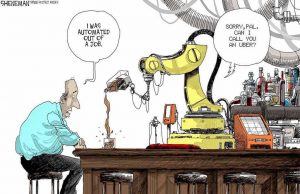
Cartoon about automation by Drew Sheneman

The Guardian of automation

Still from the video for All is Love by Bjork

I have been looking back over the links to news articles I’ve been collecting together about automation and I’ve been struck in particular by how the UK newspaper The Guardian has been running at least one story a week concerning automation in the last few months (see their “AI” category for examples, or the list below). Many are spurred from reports and press releases about particular things, so it’s not like they’re unique in pushing these narratives but it is striking, not least because lots of academics (that I follow anyway) share these stories on Twitter and it becomes a self-reinforcing, somewhat dystopian (‘rise of the robots’) narrative. I’m sure that we all adopt appropriate critical distance when reading such things but… there is a sense in which the ‘robots are coming for our jobs’ sort of arguments are being normalised and sedimented without a great deal of public critical reflection.

We might ask in response to the automation taking jobs arguments: who says? (quite often: management consultants and think tanks) and: how do they know? It seems to me that the answers to those questions are pertinent and probably less clear, and so interesting(!), than one might imagine.

Here’s a selection of the Graun’s recent automation coverage:

CFP: RGS-IBG 2018 – New geographies of automation?

Still from the video for All is Love by Bjork

New Geographies of Automation?
Please send submissions (titles, abstracts (250 words) and author details) to me by 31st January 2018.

This session invites papers that respond to the variously promoted or forewarned explosion of automation and the apparent transformations of culture, economy, labour and workplace we are told will ensue. Papers are sought from any and all branches of geography to investigate what contemporary geographies of automation may or should look like, how we are/could/should be doing them and to perhaps question the grandiose rhetoric of alarmism/boosterism of current debates.

Automation has been the recent focus of hyperbolic commentary in print and online. We are warned by some of the ‘rise of the robots’ (Ford 2015) sweeping away whole sectors of employment or by others exhorted to strive towards ‘fully automated luxury communism’ (Srnicek & Williams 2015). Beyond the hyperbole it is possible to trace longer lineages of geographies of automation. Studies of the industrialisation of agriculture (Goodman & Watts 1997); Fordist/post-Fordist systems of production (Harvey 1989); shifts to globalisation (Dicken 1986) and (some) post-industrial societies (Clement & Myles 1994) stand testament to the range of work that has addressed the theme of automation in geography. Indeed, in the last decade geographers have begun to draw out specific geographical contributions to debates surrounding ‘digital’ automation. From a closer attention to labour and workplaces (Bissell & Del Casino 2017) to the interrogation of automation in governance and surveillance across a range of scales (Amoore 2013, Kitchin & Dodge 2011) – the processes and experiences of automation have (again) become a significant concern for geographical research.

The invitation of this session is for papers that consider contemporary discussions, movements and propositions of automation from a geographical perspective (in the broadest sense).

Examples of topics might include (but are certainly not limited to):

  • AI, machine learning and cognitive work
  • Automation and bias
  • Autonomy, agency and law-making
  • Automated governance
  • Boosterism and tales of automation
  • The economics of automation
  • Material cultures of robots
  • Mobilities and materialities of ‘driver-less’ vehicles
  • Robotics and the everyday
  • Techno-bodily relations of automation
  • Working with robots

Cartoon about automation by Drew Sheneman

UK Government ramping up ‘robotic process automation’

Still from George Lucas' THX1138

Quite by chance I stumbled across the twitter coverage of a UK Authority event entitled “Return of the Bots” yesterday. There were a range of speakers it seems, from public and private sectors. An interesting element was the snippets about the increasing use of process automation by the UK Government.

Here’s some of the tweets I ‘favourited’ for further investigation (below). I hadn’t quite appreciated where government had got to. It would be interesting to look into the rationale both central and local government are using for RPA – I assume it is cost-driven(?). I hope to follow up some of  this…

Automation as received wisdom

Holly from the UK TV programme Red Dwarf

For your consideration – a Twitter poll in a sponsored tweet from one of the UK’s largest management consultancies.

Why might a management consultancy do this? – To gain superficially interesting yet fatuous data to make quick claims about? Perhaps for the purposes of advertising? Maybe… Perhaps to try to suggest, in a somewhat calculating way, that the company asks the “important” questions about the future and therefore imply they have some answers? Or maybe simply to boost the now-prevailing narrative that automation is widespread, growing and will take your job. Although to be fair to Accenture, that’s not what they ask.

In any case, this is not neutral – though, I recognise it’s a rather minor and perhaps inconsequential example. Nevertheless, it highlights the growth in pushing a narrative of automation from management consultancies, like Accenture, Deloitte and PWC, who are all writing lots of reports suggesting that companies need to be ready for automation.

A cynical analysis would suggest that it’s within the interests of such companies to jump on the narrative – it’s been in the press quite a bit in recent years, then ramp it up, and offer to sell the ‘solutions’.

What I find particularly interesting is that, while newspaper articles parrot the reports from these consultancies, there appears to be (in my digging around) scant serious evidence for this trend. A lot of it is based on economic modelling (of both past and future economic contexts) and some of the reports when they do list methods seem to use adapted versions of models that once said something else.

A case in point is the recent PWC report about automation that claimed up to 30% of UK jobs could be automated by the early 2030s, widely reported in the press (e.g. BBC, Graun, Telegraph), which was based upon a modified (2016) OECD model – the original model suggested that only 9% of jobs in OECD countries were at relatively high risk (greater than 70% risk in their calculation) of automation with the UK rated at just over 10% of jobs.

I’m working my way through this sort of stuff to get at how these sorts of narratives are generated, become received wisdom and feed into a wider form of social imagination about the kinds of socio-economic and technological future we expect. I’m hoping to pull together a book on this theme with the tentative title “The Automative Imagination”.

Reblog> Should robots be granted the status of legal personhood?

Twiki the robot from Buck Rogers

From John Danaher’s Philosophical Disquisitions.

Danaher offers his incisive analysis of recent additions to the debate on legal personhood re. “robots”. Seems interesting (to me) in relation to two things: agency, and how we imagine automation – since we don’t actually have such ‘robots’ at the moment. It’s quite a long post (so only a snippet below), but worth working through… not least because in geographyland it seems to me many of us have a very narrow understanding of these sorts of things from a fairly narrow (simplified) post-structuralist account of ‘subjectivity‘.

Should robots be granted the status of legal personhood?

The EU parliament attracted a good deal of notoriety in 2016 when its draft report on civil liability for robots suggested that at least some sophisticated robots should be granted the legal status of ‘electronic personhood’. British tabloids were quick to seize upon the idea — the report came out just before the Brexit vote — as part of their campaign to highlight the absurdity of the EU. But is the idea really that absurd? Could robots ever count as legal persons?

A recent article by Bryson, Diamantis and Grant (hereinafter ‘BDG’) takes up these questions. In ‘Of, for and by the people: the legal lacuna or synthetic persons’, they argue that the idea of electronic legal personhood is not at all absurd. It is a real but dangerous possibility — one that we should actively resist. Robots can, but should not, be given the legal status of personhood.

BDG’s article is the best thing I have read on the topic of legal personhood for robots. I believe it presents exactly the right framework for thinking about and understanding the debate. But I also think it is misleading on a couple of critical points. In what follows, I will set out BDG’s framework, explain their central argument, and present my own criticisms thereof.

Read the full blogpost.