“The future will be better tomorrow” – Dan Quayle
“with faith in the future, let us together build tomorrow today” – Gordon Brown

Spatial Machinations
“The future will be better tomorrow” – Dan Quayle
“with faith in the future, let us together build tomorrow today” – Gordon Brown
Last week the British media treated us to a swathe of coverage [Guardian, BBC, Telegraph] of the Metropolitan police force’s apparent fear of a ‘summer of rage‘, set to take place this year, 2009, as a result of increasing disenchantment with the economic state of affairs. One might argue, dismissively, this was either a cynical or ill-thought statement by the Superintendent in charge of the ‘public order’ branch. On the other hand we might see this in the context of a somewhat seedy and calculated suspicion of guilt applied to the general public in advance. The nebulous claim of a ‘summer of rage’ would in this way becomes a tool, both to ask for more resources and to set the grounds for requesting more ‘special’ powers.
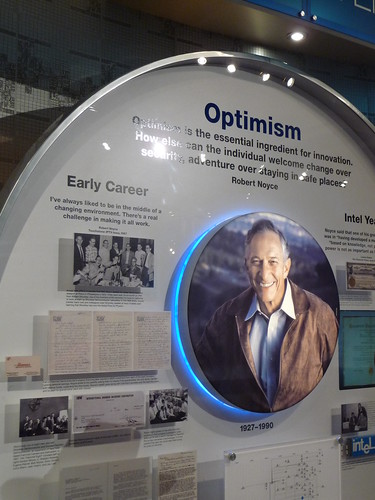
The central quote, by Robert Noyce, from this exhibit at the Intel museum is: “Optimism is the central ingredient for innovation. How else can the individual welcome change over security, adventure over staying in safe places”.
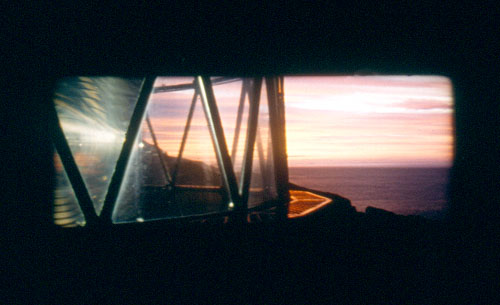
Image taken from Tacita Dean – Disappearance at Sea
In September 1991 Scientific American had a special issue focussing on ‘Communications, Computers and Networks’. An impressive array of articles were collected in this issue, including Mark Weiser’s ‘The Computer for the 21st Century‘, which is often referred to as the foundational article for ‘Ubiquitous Computing‘. An article later in the issue, simply entitled ‘Networks’ by Vint Cerf, expertly charted the issues that were to arise in the exponential growth of the internet. Also in the special issue was an article by Alan Kay about ‘Computers, Networks and Education’, expounding the ideals he set forth in his proposal of the ‘dynabook‘ to think about how technologies can be allies not hindrances in education. In the introduction to this special issue of Scientific American, Michael L. Dertouzos suggests that:
“the authors in this issue share a hopeful vision of a future built on information infrastructure that will enrich our lives by reliving us of mundane tasks, by improving the ways we live, learn and work and by unlocking new personal and social freedoms”.
Joseph Lambert has created, for Business Week, a marvelous cartoon, following Steve Hamm’s new book, charting Alan Kay’s significant role in the development of the personal computer and, in particular, the development path of the laptop. To quote John Markoff’s excellent book, What the Dormouse Said:
Kay’s ideas frequently brought him into conflict with Xerox’s management. He had little patience for the company’s top strategic planner, Don Pendery. To Kay, Pendery saw the world in terms of “trends” and thought defensively, asking, “What was the future going to be like and how can Xerox defend against it?” This drove Kay to distraction, until one day he got so angry he blurted out [the now infamous], “Look, the best way to predict the future is to invent it.”

Marvelous!
I guess there are two ways of looking at the form of invention Kay suggests. The first is cynical – futures can be controlled and explicitly directed for profit. The second, and I think Kay’s intended meaning, is that researchers have a responsibility to experiment with, and propose, what is not yet possible. As Ryan Aipperspach once insightfully said to me: “as a researcher or designer there is an interesting responsibility to design and propose things that aren’t completely possible.” This is perhaps exemplified by Lars Erik Holmquist’s ideas about prototyping, or Mike Kuniavsky and Liz Goodman’s “Sketching in Hardware” conference.

Last week I attended the RGS-IBG annual international conference, for which I convened a session and presented a paper.
Shamelessly borrowing a title from a paper by Genevieve Bell and Paul Dourish, my presentation entitled “Yesterday’s tomorrows” was concerned with the manner in which Ubiquitous Computing has been envisioned. I largely focussed upon the example of HP Labs’ ‘CoolTown’ agenda/project. This largely stemmed from some of the fascinating conversations I had with various engineers, researchers and scientists during recent fieldwork in and around Silicon Valley.
My research seems to orbit around the future orientation of ubicomp research and development and in that wavering trajectory I encounter various modes of anticipation. In presenting a semblance of certainty (where there need not be, and perhaps is not), obligations may be construed, and promises apparently made. Promises can be thought of as a ‘giving of ground’ to a potential future, an opening of self to a responsibility, perhaps as Nietzsche suggests, to vouch for oneself as a future. Considerations of promises can be suggested as a reading of our anticipatory knowledges that retains an intention, and perhaps responsibility, for particular futures but, against a prescriptive ‘going forward‘ or technological determinism, includes an inherent potential of uncertainty.
At the recent Association of American Geographers annual conference in Boston I was lucky enough to take part in an interesting session: “Governing Technologies(I) – Representation, participation and governance in the ‘digital age'”, organised by Matt Wilson and Kevin Ramsey of U Washington.
I particularly enjoyed talks by Jeremy Crampton on ‘progressive’ political blogs as cartographies of left-leaning American politics, Richard Donahue on critical cartography, digital mapping and how participatory GIS might be usefully engaged with, and Matt Wilson on cyborg subjectivation (via Harraway) in relation to GIS technologies.
My own talk was an attempt to articulate one of the specific questions that is arising in my research, and how we might look to answering: Do anticipatory practices of technology development condition expectations for those technologies? What follows is an edited and tidied version of my notes.