A political economy of Twitter data – revised and published on LSE Impact blog

Last year I wrote a blog post for the Contagion project website, building from the experience of attempting to do research with Twitter data as relative novices. Putting the pragmatic techniques of doing such to one side, it became striking that doing this kind of research with Twitter’s apparatus is neither easy, nor, when one delves a bit deeper, is it ‘free’.

The post was been picked up by the LSE Impact blog, who asked to re-blog it, which was very nice of them. So, you can find a slightly updated (numbers, sources and bit more nuance in the argument) version of the blog post there.

The question I end up posing is: “Should researchers be using data sources (however potentially interesting/valuable) that restrict the capability of reproducing our research results?” This is not easily answered, not least when so many ‘non-academic’ researchers are merrily plugging away producing social scientific research, increasingly consumed by the general public, which is gaining influence, and which, perhaps, could benefit from some critical engagement…

Please do read the post and get in touch if you’d like to discuss this, and any of our research, further.

Reflecting on the field trip to Kilburn

Montage of Kilburn High Road using pictures taken by the author

At the end of October 2014, I accompanied 140 students in their first year of studying geography at the University of Exeter on a field trip to London to put into practise some of what they have learned so far on the BA Geography course. While many of the activities were located in central London locations, including Hyde Park and the V&A museum, all 140 students also visited Kilburn. You may ask: Why? Obvious answers would include that ‘it’s a diverse area’, with which you may or may not agree. Then again, as Zadie Smith argued, at the launch of her novel “NW”: “But that is only the dullest thing that can be said about Kilburn, that’s it’s so ‘diverse’.”

We took the students to Kilburn for a number of reasons: that it is precisely not ‘central London’ but still has carries the attributes of being situated within a ‘world city’ like London; that immigration has helped shape Kilburn in interesting ways; that the High Road marks a boundary, between Brent and Camden; and, significantly for me at least, because Kilburn has previously been an inspiration to the geographer Doreen Massey.

In her 1991 article “A Global Sense of Place”, Massey uses the narrative of a walk down Kilburn High Road to illustrate the various ways we can understand feelings of place not as territories encompassed by boundaries but instead as ‘articulated moments in networks of social relations’. It is the vitality and the various movements, the comings and goings of shoppers, families, locals and visitors alike, the businesses opening and closing: all of these connections through space AND time that come to make up our sense of place. This is the shared ‘Kilburnosity’ about which Zadie Smith writes. For Massey, places – and Kilburn in particular – are not solely local. The global threads through the local (producing those movements of people, money and goods) and, in the same way, the local builds the global.

The students enjoyed their brief exposure to ‘Kilburnosity’ and I enjoyed the questions Kilburn prompted them to begin to ask of themselves in the process: of how ‘places’ get continually made and of our various roles in that process. I think we all began to see why Zadie Smith boldly stated: “I’d rather walk down Kilburn High Road than the King’s Road – than any road in London. For selfish reasons: there’s so much more to see, and hear.”

A political economy of twitter data?

Over on our Contagion project website, I have written a blog post concerning some issues around whether or not and how we can or should access and use Twitter data in research.

Here’s the beginning:

Many of the research articles and blogs concerning conducting research with social media data, and in particular with Twitter data, offer overviews of their methods for harvesting data through an API. An Application Programming Interface is a set of software components that allow third parties to connect to a given application or system and utilise its capacities using their own code. Most of these research accounts tend to make this process seem rather straight forward. Researchers can either write a programme themselves, such as, or can utilise one of several tools that have emerged that provide a WYSIWYG interface for undertaking the connection to the social networking platform, such as implementing yourTwapperKeeper, COSMOS or using a service such as ScraperWiki (to which I will return). However, what is little commented upon is the restrictions put on access to data through many of the social networking platform APIs, in particular Twitter. The aim of this blog post is to address some of the issues around access to data and what we are permitted to do with it.

Read more >.

To Kilburn

Written on the train, earlier today…

I am heading to London to scout a fieldtrip exercise that will address Massey’s ‘Global Sense of Place’ and the sense in which we (the students and the lecturers) might think about the different ways in which normative scales appear or are transgressed in Kilburn (an area in London, a ‘global city’) – just as Massey had done for her 1991 paper.

Interesting then that in a moment of reflecting upon relations, movement and communication across space, I experience a snapshot of such ‘power geometries’. I am sitting on a train, pulling out of Didcot Parkway Station, within view of a power station, owned by Npower who are in turn owned by a German energy company RWE, watching shipping containers from Maersk, P&O and other global freight companies trundle by on a heavy goods train, listening to another passenger discuss a lovely meal at the River Cafe (in London) two days ago and planning the creation/installation of onshore and offshore energy generation facilities in Norwegian territory with someone clearly not currently in the UK. As I reflect on this, I write on a laptop proudly labelled as ‘Designed… in California. Assembled in China’.

Kilburn is now very different from Massey’s description. Gone are all traces of Irish dissidence and now Halal butchers and shops selling cheap mobile phone SIM cards for international calls vie for space. There remains a cosmopolitan range of ethnic diversity to the shops and restaurants but the credit crunch clearly bit hard here…

UPDATE: This isn’t supposed to be read as some kind of updated commentary following Massey (1991), just a reflection on travelling up to scout the field trip. Sorry for any misunderstanding the post has provoked…

Observation from Iraq: The Nokia IED trigger

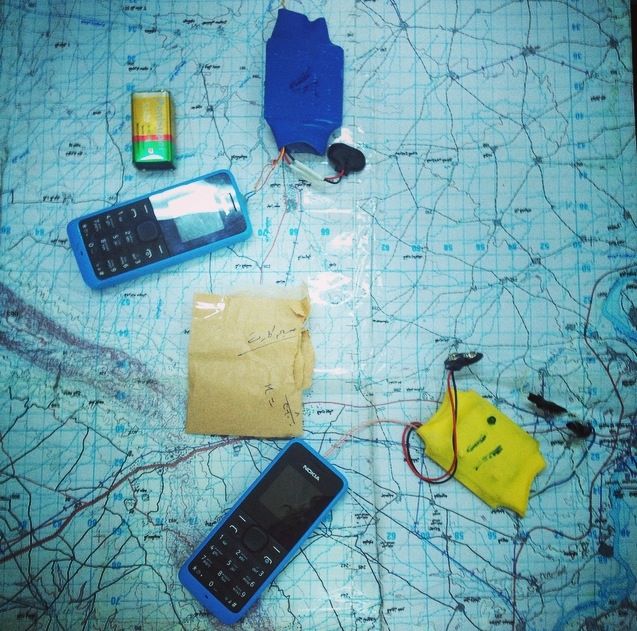
A friend of mine is a journalist for France 24 and is currently in Iraq covering the conflict with IS. His Facebook posts are extraordinary, very powerful, and I wanted to share one of them. So, courtesy of my friend in Iraq (and with his permission), here is a post (verbatim) concerning the use of Nokia 113 phones as IED detonation triggers:


These phones and wires are the remote control detonation devices left behind by Islamic State forces.

The initial activation has a 6 minute timer, after which the fuse becomes “live”.

Then a simple phone call is enough to detonate the explosive charge.

The IS choose this model of Nokia because its battery lasts 10 days. That’s basically a slow fuse that lasts a week and a half.

It’s not failsafe. One phone had 8 missed calls – 8 failed detonation attempts. The Peshmerga commander who found that one says the only jamming device he has is protection from above.

Improvised Explosive Devices are one of the biggest threats the peshmerga face, as the jihadists concede territory.

The fear of bombs has slowed their progress into hostile territory. The Islamists melt away like wraiths, leaving their IEDS to strike blindly at the Peshmerga.

Your email address is worth 100 tea lights…

Ikea Family mailshot: 100 tea lights for your email address

How much is personal data worth? How might that be calculated? These are hard questions. Nevertheless, personal data does attract particular kinds of value, often determined by those harvesting and selling it on, such as Facebook, Google and so on.

These are rarely visible calculations, probably necessarily so – data is sometimes only worth something when it is part of a larger set. We are both an individual and part of one or more populations (which can be variously defined and derived in data). When you make up a ‘segment’ of a given population, your data, and what can thereby be inferred, has a particular value.

For example, the email marketing company Topspin apparently calculate the pecuniary value of a person’s email address to a band harvesting it based upon the amount of money that person (fan) will, on average, go on to spend on their music.

In a recent piece for the New York Times website, Rebecca Lieb, a digital advertising and media analyst at the Altimeter Group, offers an example:

“Facebook has deep, deep data on its users. You can slice and dice markets, like women 25 to 35 who live in the Southeast and are fans of ‘Breaking Bad,’ … The new Atlas platform, she said, “can track people across devices, weave together online and offline.”

The data collected by various market research companies carries a notional value that is sometimes rendered visible in stark ways. Another example illustrates this: In a 2011 article for Huffington Post the price list for marketing data company Rapleaf shows for how much particular pieces of data were sold.  Age and gender are given away free, whereas ‘Likely smart phone user’ is $0.03.

We are thus worth something insofar as we are represented (accurately or otherwise) as a collection of data in one or more databases. We individually value our own data variously, depending on its use, context and so on. An email address, then, may be valuable if it is private, or not valuable if it is used for any old competition entry – this is often contextual and that can, of course, be missed by the marketing data companies (perhaps this is a good thing).

Nevertheless, we, or, more accurately, the data that are used to variously represent us, are commodified – our data-selves are products. Any sense of a unified ‘self’ is possibly too neat, our physically bodied selves rendered endlessly divisible and reducible to data representations, what Deleuze referred to as ‘dividuals’ in his excellent ‘Postscript on Societies of Control‘. There is a real sense in which, thought in this way, we are variously rendered separate from and without control of our representations in data.

The Ikea flyer, pictured above, soliciting an email address for a notional inducement of 100 tea lights made me think through the above and back to the excellent Paying Attention conference of 2010, concerning the idea of attention economies. At the conference, and in other contexts, the redoubtable Tim Kindberg formulated his ‘Facebook data provocations‘ – encouraging others to speculate about what would happen if we (the users) charged Facebook for our data. Thinking back over the academic moment of worry over privacy it seems necessary to continue to think about these things. While the horse has bolted and the stable door has long since been the portal to an upmarket barn conversion, I argue that these  questions remain pertinent.

Paper accepted – Memory programmes: the retention of collective life

I am pleased to share that I have recently had a paper accepted for Cultural Geographies, which will form part of a theme section/issue co-edited by Sarah Elwood and Katharyne Mitchell concerning “Technology, memory and collective knowing”–stemming from a session at the 2013 AAG in Los Angeles.

The paper is entitled ‘Memory programmes: the retention of collective life’ and builds upon a theoretical conference paper I gave at the Conditions of Mediation conference in 2013.

The aim of the article is to interrogate some key elements of how software has become a means of ‘industrialising’ memory, following Bernard Stiegler. This industrialisation of memory involves conserving and transmitting extraordinary amounts of data. Data that is both volunteered and captured in everyday life, and operationalised in large-scale systems. Such systems constitute novel sociotechnical collectives which have begun to condition how we perform our lives such that they can be recorded and retained.

To investigate the programmatic nature of our mediatised collective memory the article has three parts. The first substantive section looks at a number of technologies as means of capturing, operating upon and retaining our everyday activities in ‘industrial’ scale systems of memory. Particular attention is paid to the quasi-autonomous agency of these systems, that appear to operate at a scale and speed that exceeds a human capacity of oversight.

In the second section I look at the mnemonic capabilities of networked technologies of digital mediation as ‘mnemotechnologies’. Following Stiegler, these are technologies and technical supports that both support and reterritorialise what we collectively understand about our everyday lives.

The conclusion of the article addresses the ways in which an ‘industrialisation of memory’ both challenges and transforms the ways in which we negotiate collective life.

I have copied below the abstract and I’d be happy to share pre-publication copies, please contact me via email.

Abstract:

This article argues that, in software, we have created quasi-autonomous systems of memory that influence how we think about and experience life as such. The role of mediated memory in collective life is addressed as a geographical concern through the lens of ‘programmes’. Programming can mean ordering, and thus making discrete; and scheduling, making actions routine. This article addresses how programming mediates the experience of memory via networked technologies. Materially recording knowledge, even as electronic data, renders thought mentally and spatially discrete and demands systems to order it. Recorded knowledge also enables the ordering of temporal experience both as forms of history, thus the sharing of culture, and as the means of planning for futures. We increasingly retain information about ourselves and others using digital media. We volunteer further information recorded by electronic service providers, search engines and social media. Many aspects of our collective lives are now gathered in cities (via CCTV, cellphone networks and so on) and retained in databases, constituting a growing system of memory of parts of life otherwise forgotten or unthought. Using examples, this article argues that, in software, we have created industrialised systems of memory that influence how we think about living together.

Keywords: memory, technology, mnemotechnics, industrialisation, programming, Stiegler

Rob Kitchin on ‘digital geography’

Based on his notes as discussant in the recent ‘co-production of digital geographies‘ sessions at the RGS-IBG conference (2014), Rob Kitchin has written a helpful and concise blog post reflecting on what we might mean when we talk about ‘digital geographies’. This sort of relates to some of what I’ve written about the kinds of spatial imaginaries of a ‘virtual‘ employed within and beyond geography when discussing digital mediation. So, Rob Kitchin’s post is definitely worth a read and I’ve reproduced the body of it here:

Last Friday I acted as a discussant for three sessions (no. 1, no. 2, no. 3) on Digital Geography presented at the RGS/IBG conference in London.  The papers were quite diverse and some of the discussion in the sessions centred on how to frame and make sense of digital geographies.

In their overview paper, Elisabeth Roberts and David Beel categorised the post-2000 geographical literature which engages with the digital into six classes: conceptualisation, unevenness, governance, economy, performativity, and the everyday.  To my mind, this is quite a haphazard way of dividing up the literature.  Instead, I think it might be more productive to divide the wide range of studies which consider the relationship between the digital and geography into three bodies of work:

Geography of the digital

These works seek to apply geographical ideas and methodologies to make sense of the digital.  As such, it focuses on mapping out the geographies of digital technologies, their associated socio-technical assemblages and production.  Such work includes the mapping of cyberspace, charting the spatialities of social media, plotting the material geographies of ubiquitous computing, detailing the economic geographies of component resources, technologies and infrastructures, tracing the generation and flows of big data, and so on.

Geography produced by the digital

This body of work focuses on how digital technologies and infrastructures are transforming the geographies of everyday life and the production of space.  Such work includes examining how digital technologies and ICTs are increasingly being embedded into different spatial domains – the workplace, home, transport systems, the street, shops, etc.; how they mediate and augment socio-spatial practices and relations such as producing, consuming, communicating, playing, etc; how they shape and remediate geographical imaginaries and how spaces are visioned, planned and built; and so on.

Geography produced through the digital

An increasing amount of geographical scholarship, praxis and communication is now undertaken using digital technologies.  For example, generating, recording and analyzing data using digital devices and associated software and databases; the collection and sharing of datasets and outputs through digital archives and repositories; discussing ideas and conducting debate via mailing lists and social media; writing papers and presentations, producing maps and other visualizations using computers; etc.  A fairly substantial body of work thus reflects on the difference digital technologies make to the production of geographical scholarship.

Taken together these three bodies of work, I would argue, constitute digital geography.

At the same time, however, I wonder about the utility of bounding digital geography and corralling studies within its bounds.  To what extent is it useful to delimit it as a defined field of research?

It might be more productive to reframe much of what is being claimed as digital geography with respect to its substantive focus.  For example, examining the ways in which digital technologies are being pervasively embedded into the fabric of cities and how they modulate the production of urban socio-spatial relations is perhaps best framed within urban geography.  Similarly, a study looking at the use of digital technology in the delivery of aid in parts of the Global South is perhaps best understood as being centrally concerned with development geography.  In other words, it may well be more profitable to think about how the digital reshapes many geographies, rather than to cast all of those geographies as digital geography.

Nonetheless, it is clear that geographers still have much work to do with respect to thinking about the digital.  That is a central task of my own research agenda as I work on the Programmable City project.  I’d be interested in your own thoughts as to how you conceive and position digital geography, so if you’re inclined to share your views please leave a comment.