In Certain Places…

In Certain Places logoIn Certain Places is a programme of artistic interventions and events, led by curators Elaine Speight and Professor Charles Quick with the support of associate Rachel Bartholomew, in the School of Art, Design and Fashion at the University of Central Lancashire. Based in the City of Preston, in the North West of England, the project examines how artists can contribute to the form and functions of a place, by exploring new approaches to art, culture and urban development.


In Certain Places, whom I happen to follow on Twitter, have a new blog – looking forward to seeing what gets posted. The first post is about the recent Nordic Geographers conference, in which several of my colleagues participated.

Reblog> Data and the City Workshop (31/08-01/09)

The Programmable City project team are running a(nother!) interesting workshop/event at the end of the month, just before the RGS annual conference. See the details below:

Data and the City Workshop

The Programmable City Project is hosting a two day workshop on the relations between data and the city.  The Data and the City Workshop will take place on August 31st and September 1st 2015 and will bring together 20 invited experts in the field and the ProgCity team.  A description of the workshop and the agenda are below with links to some of the papers to be presented that are already available online…

Read more in the original post – including the schedule.

New journal: “Digital Literacy Studies”

David Cooper tweeted a link to an interesting new open access journal called “Digital Literacy Studies“, published through Penn State University Libraries. Here’s the info from their page:

Digital Literary Studies

Digital Literary Studies is an international peer-reviewed interdisciplinary publication with a focus on those aspects of Digital Humanities primarily concerned with literary studies.

Digital Literary Studies publishes scholarly articles on research concerned with computational approaches to literary analysis/criticism, or critical/literary approaches to electronic literature, digital media, and textual resources.

In addition to longer, more traditionally-formed articles, this journal publishes positional papers and articles with a shorter experimental focus, as well as reviews of books and electronic literature. Contributors may also submit curated electronic texts for peer-review, as well as thoroughly-documented hermeneutical methods and tools. Any digital project with a literary focus, whether that be a digital edition, tool, or otherwise, may be considered for peer-review.

I’ve highlighted a bit above to point out that they welcome experimental shorter contributions too.

‘Wide’, not ‘big’, data

Saw this article a while ago on the NetworkWorld website, not sure if it’s a more broadly adopted concept – but the idea of ‘wide’ data appeals. Can’t remember if Rob Kitchin addresses it in his excellent book The Data Revolution… will have to check!

(I’m blogging this so I can finally close the tab in my browser!)

Why businesses should focus on wide data, not big data

In these heady days of big data, a lot of organizations treat data collection like a Pokémon game: Gotta catch it all. But Dane Atkinson, CEO of cross-platform marketing analytics specialist SumAll says most organizations need to think wide, not big, when it comes to data.

“The real impact of data always comes from the intersection of different data sets,” Atkinson says. “You don’t get into the earth shattering discoveries until you start to link disparate data sets.”

This idea of ‘wide’ data is what some marketing people have called ‘horizontals’ – the ability to stitch together different kinds of data to create a particular kind of value proposition (see Irene Ng’s book on this…)

Reblog> Online resources to help students summarize journal articles and write critical reviews

Stuart Elden points to a post by Raul Pacheco-Vega on his blog that has some good resources to help students summarise what they read and to think about how to critically review other people’s work.

Online resources to help students summarize journal articles and write critical reviews

The courses I teach tend to be very practical and applied. My teaching philosophy is founded on helping my students acquire employable skills. Writing solid, robust, concise and easy-to-read analytical summaries should be an acquired tool that they then can transfer to other fields. Politicians, bureaucrats and high-level people in government that I’ve talked to have always considered summarizing information a great tool that undergraduate and graduate education should provide. Yet, the online resources I found to help students summarize journal articles and write critical reviews left me wanting.
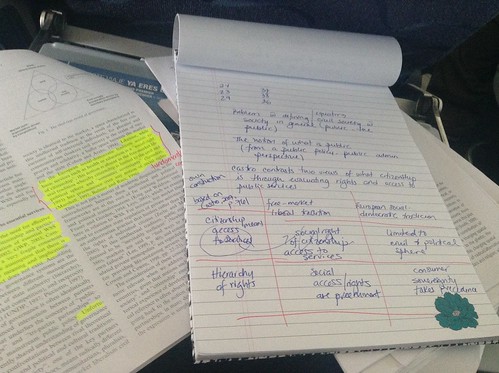
AcWri handwritten notes and journal article reading

There are, of course, plenty of resources. But reading a vast majority of them always left me with a feeling that either they were too long for students to get through (in addition to the relatively high reading load I am assigning for each of my courses), or too focused on the mechanics and too little on the routine-building strategy. So I took to Twitter and Facebook to ask whether someone had found an online resource that would help my students learn how to summarize journal articles. Here are a few suggestions:

a) Dr. Karen Beckwith (Case Western Reserve University) shared with me her handouts on critical reading. Professor Beckwith is incredibly generous and I’m sure she would share them with you if you requested them. They are very useful because they are tailored to each specific course she teaches. She also has a guideline on how to learn from movies.

b) John McMahon (CUNY) shared with me some of his handouts, which are posted online, including this one on critical reading and note-taking. John and I have a different view on highlighting journal articles, and I will write a blog post on this soon.

c) Tressie McMillan Cottom (Virginia Commonwealth University) shared with me her notes from a grad seminar with Regina Werum at Emory University. Professor McMillan Cottom’s notes are a summary of how to read a sociology article.

d) Dr. Neenah Luna-Estrella (NEU) suggested the following books to help students learn how to read and summarize scholarly (and not so scholarly) works. Not online resources, but still, very good ones.

Pyrczak, F. (2014). Evaluating research in academic journals (6th ed.). Glendale, CA: Pyrczak Publishing.

Harris, R. A. (2011). Using Sources Effectively (3rd ed.). Glendale, CA: Pyrzak Publishing.

e) Online resources that I found valuable:
– University of the Fraser Valley Writing Centre’s guide to summarizing an article – this is particularly good because UFV is primarily undergraduate teaching.
– Donna Vandergrift ‘s handout actually gives a guideline for students on which content should be written in each paragraph. This kind of detailed guidance is fundamental.
– This guide on how to read a journal article is a bit long, but it does have some additional references that you can look at.

f) Karra Kshimabukuro shared the guide to writing a Rhetorical Precis, which is a tool that others had suggested we should look at, and apparently, (what I call “analytical summaries”may be rhetorical precis too :) (thanks Theresa MacPhail for reminding me of this!)

I’m happy to continue compiling resources if you want to drop a comment on this post or send me an email (sometimes my commenting system isn’t the best).

Reblog> Reading list on the digital divide/digital inclusion

This looks like a really helpful resource over on the Social Media Collective blog –– although I’m sure Mark Graham may want to add to it… 🙂

Reading list on the digital divide/digital inclusion

We compiled a bibliography on the digital divide (including gender gaps) and ICTD. Please let us know if we missed anything interesting and we would be glad to add it!

1. Allen, Steven G. 2001. “Technology and the Wage Structure.” Journal of Labor Economics 19:440-483.

2. Anderson, B. 2005. “The value of mixed-method longitudinal panel studies in ICT research.” Information, Communication & Society 8:343-367.

3. Anderson, Ben. 2008. “The Social Impact of Broadband Household Internet Access.” Information, Communication & Society 11:5-24.

See the other 191 references on the Social Media Collective blog.

Reblog> I am not here to satisfy you: the NSS and our institutional knickers

Hester Parr tweeted this post by Julie Cupples from a few months ago. As an early career academic on probation it’s difficult to stick your head above the parapet, and os it’s great when you read someone else doing it. This post really does resonate with my feelings about teaching in a university and how that can or should be valued…

There are also some good comments, so take a look.

I am not here to satisfy you: the NSS and our institutional knickers

The neoliberal endeavour to convert university students into consumers is underpinned by a survey culture that is constantly attempting to measure a thing called ‘student satisfaction’. It’s part of the way universities compete with one another and manufacture what is termed the ‘student experience’. In the neoliberal academy, students, faculty and staff are constantly surveyed, a phenomenon that a New Zealand academic has recently described as a tyranny that may “degrade student achievement” and “harm staff” (Heinemann 2015). If you borrow an interloan, ask IT to fix a software issue on your computer, or order sandwiches for a meeting from the preferred corporate supplier, you’re then likely to be sent a survey to assess the level of customer satisfaction with the service. It’s tedious but fortunately most of them can be quickly ignored and deleted. But the survey that seems to produce a bizarre level of managerial emphasis and concern that is quite hard to ignore is the National Student Survey (NSS). In my view, NSS obsession is producing quite pernicious and pedogogically impoverishing outcomes. For those outside the UK, the NSS began in 2005. It is commissioned by HEFCE and carried out by Ipsos Mori. Students are asked 23 questions which relate to student satisfaction and the learning experience (see thestudentsurvey.com for more detail). It then produces scores and rankings to add to the dozens of other league tables in which contemporary universities jostle for position and which get deployed in a highly selective manner in university spin.

The biggest problem with the idea of student satisfaction is that our principal aim as educators should not be to satisfy students. My teaching philosophy is composed in part of the following ideas:

I am not here to satisfy you. I am here to encourage you to interrogate your existing knowledges and possibly your own privilege. This is likely to be a deeply unsettling and uncomfortable process, especially if your class, race or gender location has never required you to interrogate your worldview and how it harms and excludes. I will however do my best to inspire you and encourage you to think. 

In fact, our aim should be to unsettle our students, especially the most privileged ones, not to satisfy them. It can often be satisfying to have your pre-existing values and worldviews endorsed (which is why people with right-wing views tend to watch Fox News for example rather than MSNBC or Democracy Now). While it might be energizing to have them challenged, and sometimes clearly is, for some students it can be deeply and profoundly dissatisfying. Some students react negatively when they are exposed to explicitly feminist perspectives or are forced to confront how they continue to benefit from the legacies of colonialism or white privilege. Engagement with these issues starts at university but is probably not resolved if ever until much later in a student’s life. By the time I graduated after four years of study, I had begun to rethink my worldviews. It wasn’t until much later than I gained a much deeper insight into my own politics and cultural assumptions and began to reformulate them. So if students are dissatisfied, it could be because we are doing our jobs properly, not because we are failing.

Read the rest of the post.

Reblog> Data and the City

Mike Batty blogs about the ‘Data and the City’ event that is being convened by Rob Kitchin and the Programmable City team.

Data and the City

data-city
The Programmable City Project is holding a meeting on Data and the City in Maynooth from August 31- September 1st. You can get Rob Kitchin’s and Mike Batty’s papers from this blog but the programme is diverse and the Project web site contains details of the various contributions. I argue in my paper that we need to redefine big data in terms of the tools we use to interpret it and that size is not the main criterion as quite modest data sets in cities, particularly those dealing with transport and flows, are too large for most of current tools which involve statistical manipulation and visualisation. Here are two of the papers to be presented:

Michael Batty: Data About Cities: Redefining Big, Recasting Small

Rob Kitchin: Data-Driven, Networked Urbanism

The image above was produced by Stephan Hugel and Flora Roumpani from their animation of tweets in London Using City Engine. Click here for the movie.

RGS History & Philosophy of Geography Research Group AGM at the RGS annual conference

A quick plug for the History and Philosophy of Geography Research Group AGM at the RGS conference in Exeter(!) this September:

AGM AT THE RGS-IBG

This year, our AGM will take place on Wednesday 2 September, at 13:10 in Forum – Seminar Room 1 at the University of Exeter (it’s also listed in the conference programme).

While we do not have any committee members with named roles coming to the end of their term we encourage anyone who is interested in becoming involved in the committee and its activities to attend; we’d very much welcome people who want to become involved in – and expand on – the group’s activities.