Reblog> Affect and Social Media Symposium #2 cfp

Tony Sampson has posted this, may be of interest to people who see this blog –

Affect and Social Media Symposium #2 – cfp

Wednesday 23rd March 2016

1-8pm

University of East London, Docklands Campus, Room EB. G.06

Call for 15min Presentations/Position Papers

Following on from the success of last year’s Affect and Social Media research symposium, the emotionUX lab in the School of Arts and Digital Industries at UEL, and in collaboration this year with Cass School of Education and Communities at UEL, will be hosting a second event continuing to explore the relation between social media, affect, feelings and emotions.

Numerous studies from various fields have described interactions with social media in terms of emotional, affective and feely experiences. It is claimed that habitual access to Facebook can have a negative impact on mood and subjective well-being (Kross et al, 2013). Likewise, emotional states experienced on social media can be transferred to others through emotional contagion, ‘leading people to experience the same emotions without their awareness’ (Kramer, 2014). Similarly, positive emotions, like joy, are regarded as more likely to spread than negative ones (Berger and Milkman, 2010).

This year’s call for 15min presentations/position papers asks contributors to explore emotional, affective and feely experiences with social media. More specifically, we ask contributors to investigate how social media ‘work[s] in concert with bodies in the production of emotional and affective activity’ (Ellis and Tucker, 2015: 177).

We welcome proposals on a wide variety of themes that cross disciplinary boundaries. For example”¦

  • Addiction and social media
  • Affective contagion
  • Affect theory relating to social media
  • Care, emotions and social media
  • Methodologies relating to emotion, affect and social media
  • Consumption, emotions and affect on social media
  • Education, emotions and social media
  • Emotional and affective contagions
  • Emotional social media design (theory and practice)
  • Ethical considerations
  • Felt experiences on social media
  • Social gaming and emotions
  • HCI and emotion
  • Learning, emotion and social media
  • Marketing, emotion and social media
  • Networked emotions
  • Online emotional ethnographies
  • Pervasive computing and emotion
  • Emotions and privacy
  • Emotions and security
  • Sharing emotions
  • Emotions and trust
  • The politics of emotional user experiences

Please send a title, brief outline (100words) and institutional affiliation to t.d.sampson@uel.ac.uk and E.Theodotou@uel.ac.uk

Activities  Deadlines
Abstract Submission 15th December 2015
Acceptance notification 15th January 2016
Registration for presenters Details to follow
Registration for all participants Details to follow


Fees and registration

(Refreshments, after symposium drinks and nibbles and attendance certificate included in all registration types)

Type Fee
Presenters Free
UEL students/academics Free
External students £3
External academics/participants £5

Please keep an eye out for follow up emails regarding registration

Updates will also appear on the Virality blog and EmotionUX news page
https://viralcontagion.wordpress.com/

http://emotionuxlab.co.uk/news/

Reblog> CFP: Deleuzian Geographies

CFP: Deleuzian Geographies

Association of American Geographers (AAG) Annual Meeting,
March 29-April 2, 2016
San Francisco, California

“We do not yet know the thought of Deleuze. Too often, whether hostile or adoring, we act as if his concepts were familiar, as if it were enough that his concepts simply touch us in order for us to understand them without spelling them out, or as if we had already made a survey of their promises” (Zourabichvili, 2012: 139)

This session speaks to the ever-growing engagement with the philosophy of Gilles Deleuze in geography and the social sciences. The session will take stock of how Deleuzian (and Deleuzeo-Guattarian) concepts – such as affect, assemblage, becoming, de/re/territorialisation, difference, event, individuation, the minor, and the molecular – have been taken up in geography, productively amplifying key problematics that stage both new conceptual openings and new points of contestation (Sharpe et al, 2014; Woodward and Jones III, 2005).

In particular, we seek papers that respond to Francois Zourabichili’s (2012) call to (re-)engage Deleuze’s philosophy not as a revolution already-made, but instead as a force of creative encounter. Following Deleuze, what are the evaluative terms and stakes of thinking currently emerging in the contact zones of, for example, politics, aesthetics, science, the economy, ethics, and ecology (Ruddick, 2010; Doel and Clarke, 2007; McCormack, 2007; Hynes, 2015; Bonta and Protevi, 2004). We welcome papers then from across the field of geography that explore how Deleuze’s concepts participate in events of thinking that displace extant fields of intelligibility, generating new terms for modifying the conditions of the problems posed by society today. We offer the following ‘conceptual problematics’ and ‘terrains of contestation’ as possible suggestions of some themes that papers might address:

Conceptual problematics:
– Vital materialism and ecologies of nonorganic life
– Dispositions, tendencies, inclinations
– Ethics and the affective production of bodies
– Deleuze’s transcendental empiricism and alternative theorizations of subjectivity
– Earth-thinking: geophilosophy and chaosmosis
– Space after Deleuze: the ‘fold’ of topological thinking and the critique of interiority
– Art after Deleuze: encounters in cinema, music, literature etc.
– Politics after Deleuze: micropolitics and desire

Milieus of contestation:
– Deleuze’s differential ontology: coherence in becoming as opposed to that in being?
– New materialisms and a philosophy of the event: theorising matter as tendency, disposition, inclination as opposed to object-oriented, phenomenological and networked theories?
– The politics of affect: thinking an affective politics through the evental lens of singularities, thresholds and individuations as opposed to those that think these politics through objects, conditions, and atmospheres?
– Deleuze and research methodologies: what is the efficacy in experimenting beyond representation, beyond recognition?
– Deleuze and philosophy: are there different Deleuzes (Deleuze- Nietzsche, -Spinoza, -Bergson, -Simondon, -Whitehead) and how do they marry each to the other?

Please submit abstracts of 250 words or less to Andrew.Lapworth[at]bristol.ac.uk by Wednesday 21st October, 2015.

For more information and more general expressions of interest, please contact the session organizers:

Andrew Lapworth, School of Geographical Sciences, University of Bristol
Andrew.Lapworth[at]bristol.ac.uk

Scott Sharpe, School of Physical, Environmental & Mathematical Sciences, UNSW@Canberra,
S.Sharpe[at]adfa.edu.au

JD Dewsbury, School of Geographical Sciences, University of Bristol,
Jd.dewsbury[at]bristol.ac.uk

Haiku…from @ithke79

Cold room but warm seat,
Starting week reading Haiku,
Badly need coffee

Feeble I know, but here’s Keith Harris’ – he’s been writing them on his blog and I’ve enjoyed reading them… plus, we always need more coffee!

Haiku #6: Gray

Damn that sky is gray
Guess I’ll read some Althusser
And drink more coffee

Brilliant new paper: Mortal Questions, by @PepeRomanillos

There some good articles (with some interesting contributions to debates on urban geographies) in the latest issue of Progress in Human Geography, including a brilliant article by my colleague Pepe Romanillos, I heartily recommend reading this:

Mortal questions
Geographies on the other side of life

Drawing upon resources from philosophy, sociology, history, and anthropology, this paper explores the possibilities of attending to geographies on the other side of life. After an introductory review of work on deathscapes and extant geographical reflections on absence and loss, the paper turns to consider three horizons in which geographers might extend their interrogations of different mortal conditions: mourning, the spatial politics of the dead, and corporeality. The paper concludes by reflecting on the disciplinary possibilities of responding to these empirical concerns at a time when we are often asked to cultivate all manner of lively geographies.

Drone Culture – new issue of Culture Machine

Hitting a contemporary ‘hot topic’, especially amongst social scientists and, in particular, geographers, the current issue of Culture Machine  is themed as “Drone Culture“.

There’s some interesting looking contributions, ranging from a media archaeology of the control room to a critique of the cybernetic utopianism that underlies the logic of drone use for governmental ends.

Lots to get your teeth into – and all open access.

Character assassinations? There’s an app for that…

Interesting article on the Washington Post  site, tweeted by David Murakami Wood (above), that talks about a service/app called “Peeple” that seeks to be a “Yelp for people” – to enable us to ‘rate’ and ‘review’ one another… A market-driven death-knell for treating one another like ‘people’ (rendering the name rather ironic) and another attempt to pull a further aspect of ‘ordinary’ life into the attention economy. This is an attempted renegotiation of the ‘normative’, what Daniel Miller and Sophie Woodward, in their book Blue Jeans, describe as the sense in which “the expectation that actions within a social field are likely to be judged as right or wrong, appropriate or inappropriate, proper or transgressive”. What if reviewing one another became ‘normal’..?(!!) *sigh*

Reblog> 12 Critical Theory books that came out this month, September

Lots to explore here!

12 Critical Theory books that came out this month, September

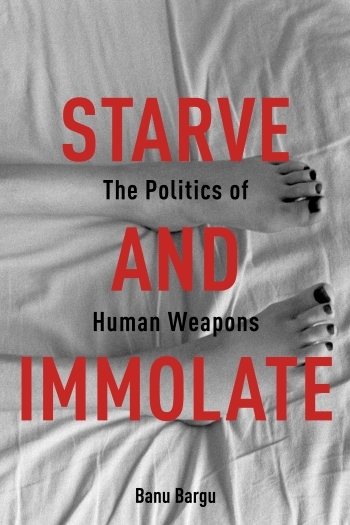
Starve and Immolate

By Banu Bargu

starve and immolate

“Starve and Immolate tells the story of leftist political prisoners in Turkey who waged a deadly struggle against the introduction of high security prisons by forging their lives into weapons. Weaving together contemporary and critical political theory with political ethnography, Banu Bargu analyzes the death fast struggle as an exemplary though not exceptional instance of self-destructive practices that are a consequence of, retort to, and refusal of the increasingly biopolitical forms of sovereign power deployed around the globe.

Bargu chronicles the experiences, rituals, values, beliefs, ideological self-representations, and contentions of the protestors who fought cellular confinement against the background of the history of Turkish democracy and the treatment of dissent in a country where prisons have become sites of political confrontation. A critical response to Michel Foucault’s Discipline and Punish, Starve and Immolate centers on new forms of struggle that arise from the asymmetric antagonism between the state and its contestants in the contemporary prison. Bargu ultimately positions the weaponization of life as a bleak, violent, and ambivalent form of insurgent politics that seeks to wrench the power of life and death away from the modern state on corporeal grounds and in increasingly theologized forms. Drawing attention to the existential commitment, sacrificial morality, and militant martyrdom that transforms these struggles into a complex amalgam of resistance, Bargu explores the global ramifications of human weapons’ practices of resistance, their possibilities and limitations.”

See the other eleven here…

Reblog> Here’s why visions of ubiquitous connectivity aren’t going to be realised any time soon

Interesting post from Mark Graham on his blog…

Here’s why visions of ubiquitous connectivity aren’t going to be realised any time soon

The last few months have seen a wealth of stories about visions to connect the world. Facebook, Google, large international organisations, states, and even Bono, dream of a world in the near future in which we are all hooked into the network.

In the midst of all of this, I found a comment made by Jimmy Wales particularly interesting.

This hope of the inevitability of ubiquitous connectivity is one that is widely reproduced by other policy makers, technologists, and thought leaders.

However, it is a hope that needs to be unpacked. There are two ways in which this hypothetical future in which everyone is connected could be brought into being.
The first one of these futures is a world where everyone can afford access. But as we demonstrated in our research about the global affordability of broadband, dropping prices is unlikely to be a sufficient strategy. There will remain billions of people making a subsistence living, for whom even extremely cheap access is unaffordable.  The average Mozambican worker, for instance, would need over one and a half year’s salary to pay for one year’s worth of broadband access.

In other words, Jimmy Wales’ prediction won’t happen simply by lowering prices.
Broadband_Affordability-1024x723
The second future is the one promoted by the likes of Mark Zuckerberg. One in which large corporations sponsor free (and importantly, limited) access for billions of people in return for attention monopolies. This brings a very different sort of Internet into being: one in which winners and losers, centres and peripheries, are already pre-selected by those who control your access.

What this all ultimately means is that it seems unlikely that any sort of open Web will be ubiquitously available in the near future. Simply lowering the cost of access will continue to leave out the very poorest; and handing over the project of connecting the disconnected to large technology firms will leave us with a very different (and far less desirable) sort of Internet.


To read a bit more about visions of connectivity, here are two of my recent papers:

Two theme issues to explore: ‘Culture Digitally’ and ‘Digital Labour’

Just a quick post to flag two very interesting theme issues of journals that have been shared on Twitter recently:

So, in the above order:

As Nancy Baym highlights, the journal Social Media + Society has a theme issue edited, or as they suggest: curated, by Tarleton Gillespie and Hector Postigo on the theme of ‘Culture Digitally’, which is also the title of the group blog to which they both contribute.

As Aphra Kerr highlights, the journal Critical Studies in Media and Communication has a theme section on Digital Labour.

Between them, both have lots of contributions that look really interesting and worth exploring!

Interesting paper: Towards a relational materialism by @digital_objects

Yuk Hui (Leuphana), one of the rising stars in the Ars Industrialis / Digital Studies milieu, has an interesting new paper out in the journal Digital Culture & Society. Unfortunately, my university doesn’t offer access but I trust that a version will appear on academia.edu / ResearchGate sometime soon…

Towards a Relational Materialism

Abstract:

This article takes off from what Lyotard calls ‘the immaterial’, demonstrated in the exhibition Les Immatériaux that he curated at the Centre Pompidou in 1985. It aims at outlining a concept of ‘relational materiality’. According to Lyotard, ‘the immaterial’ is not contrary to material: instead, it is a new industrial material brought about by telecommunication technologies, exemplified by Minitel computers, and serves as basis to describe the postmodern condition. Today this materiality is often referred to as ‘the digital’. In order to enter into a dialogue with Lytoard, and to render his notion of ‘immaterial materials’ contemporary, this article contrasts the concept of relational materiality with some current discourses on digital physics (Edward Fredkin, Gregory Chaitin) and digital textuality (Matthew Kirschenbaum). Against the conventional conception that relations are immaterial (neither being a res nor even having a real esse), and also contrary to a substantialist analysis of materiality, this article suggests that a relational materiality is made visible and explicit under digital conditions. It suggests a reconsideration of the ‘relational turn’ in the early 20th century and the concept of concretisation proposed by Gilbert Simondon. The article concludes by returning to Lyotard’s notion of materialism and his vision of a new metaphysics coming out of this ‘immaterial material’, and offers ‘relational materialism’ as a contemporary response.

In relation to this see also the book 30 Years after Les Immatériaux – Art, Science and Theory (Meson Press) – edited by Yuk Hui, with some great chapters on similar themes…