
Open Access book: The Philosophical Salon from @openhumanities
Worth a read I think… There’s a free PDF, follow the link to Open Humanities Press website.
The Philosophical Salon: Speculations, Reflections, Interventions
edited by Michael Marder and Patricia Vieira
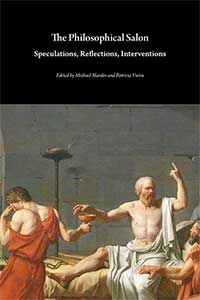
Through the interpretative lens of today’s leading thinkers, The Philosophical Salon illuminates the persistent intellectual queries and the most disquieting concerns of our actuality. Across its three main divisions–Speculations, Reflections, and Interventions–the volume constructs a complex mirror, in which our age might be able to recognize itself with all its imperfections, shadowy spots, even threatening abysses and latent promises. On the cutting edge of philosophy, political and literary theory, and aesthetics, this book courageously tackles a wide array of topics, including climate change, the role of technology, reproductive rights, the problem of refugees, the task of the university, political extremism, embodiment, utopia, food ethics, and sexual identity. It is an enduring record of an ongoing conversation, as well as a building block for any attempt to make sense of our world’s multifaceted realities.
Contributors: Robert Albritton, Linda MartÃn Alcoff, Claudia Baracchi, Geoffrey Bennington, Jay M. Bernstein, Costica Bradatan, Jill Casid, David Castillo, Antonio Cerella, Anna Charlton, Claire Colebrook, Sarah Conly, Nikita Dhawan, William Egginton, Roberto Esposito, Mihail Evans, Gary Francione, Luis Garagalza, Michael Gillespie, Michael Hauskeller, Ãgnes Heller, Daniel Innerarity, Jacob Kiernan, Julia Kristeva, Daniel Kunitz, Susanna Lindberg, Jeff Love, Michael Marder, Todd May, Michael Meng, John Milbank, Warren Montag, T. M. Murray, Jean-Luc Nancy, Kelly Oliver, Adrian Pabst, Martha Patterson, Richard Polt, Gabriel Rockhill, Hasana Sharp, Doris Sommer, Gayatri Spivak, Kara Thompson, PatrÃcia Vieira, Slavoj Žižek.
The Jetsons – reimagined, to sell aluminium
Like US Steel or Corning Glass, a former part of aluminium giant Alcoa – Arconic has decided to create a vision of a future that might loosely be possible if they were the only industrial technology firm left standing… Even more, they borrow the aesthetic and nostalgia of ‘space age’ cartoon The Jetsons…
Probably an interesting visual cultures case study to unpick and think about through the lenses of ‘design fiction’, digital imaging practices, ‘viral’ marketing, audiencing and so on…
(Not to mention to gender politics… oh dear…)
Petition to save Goldsmiths Centre for Cultural Studies – please sign

Another important home of Cultural Studies research, Goldsmiths Centre for Cultural Studies, is apparently under threat. I encourage anyone reading this to please read about this and why it’s important and consider signing the petition here:
“Masterclass with Melissa Gregg” at University of Bristol in Feb.
This looks really interesting. Mel Gregg has done some excellent work and is a good communicator so I’m sure this is a great opportunity…
Masterclass with Dr Melissa Gregg
27th February 2017, 9:30–17:00
Dr Gregg is a leading world scholar in the field of gender, technology and critical management studies. She is best known for her ethnographic research of information professionals in the book Work’s Intimacy (Polity 2011), and as co-editor of the influential collection The Affect Theory Reader (with Gregory Seigworth, Duke 2010). Dr Gregg is currently working as a Principal Engineer at Intel Corporation and is exceptionally well placed to address the challenges in bridging the gap between organisational scholarship and practice.
This Masterclass is aimed at postgraduate students, academic staff and the wider community and will engage the participants in a critical, interdisciplinary debate on gender, subjectivity, organisations and organising. The day will be organised around recent themes in Dr Gregg’s work that explore technology, gender and culture in Silicon Valley; and methodologies for studying work and society.
Schedule for the Day
9.30-10.00am – Refreshments
10.00-11.30am – Counterproductive: The history of time management from a feminist perspective
11.30-12.00pm – Refreshments
12.00-1.30pm – Technology and the future of work
1.30-2.30pm – Lunch
2.30-4.30pm – Group Discussion: Gender, Culture and Methods
4.30-5.00pm – Refreshments Registration
The Masterclass is free and participants should register by emailing one of the organisers. Refreshments and lunch will be provided. Please also state any dietary requirements. Spaces are limited to 30 participants.
For further information, please contact one of the organisers.
Anticipation 2017 (a conference)
This is interesting…
From 8th to 10th November 2017 the 2nd International Conference on Anticipation will provide an interdisciplinary meeting ground in which researchers, scholars and practitioners who are seeking to understand anticipation and anticipatory practices can come together to deepen their understanding and create productive new connections.
The overarching aim of the conference and of the emerging field of Anticipation Studies is to create new understandings of how individuals, groups, institutions, systems and cultures use ideas of the future to act in the present. This conference will build on the 1st Conference of Anticipation, held in Trento, Italy in 2015 which saw over 350 delegates gather to explore topics ranging from design futures, to anticipatory economics and the philosophy of the present.
This second conference aims to put into dialogue the empirical, practical and theoretical insights that are emerging in highly diverse fields ranging from biology to psychology, cultural geography to critical theory, physics to design, history to mathematics, urban theory to engineering.
The conference will be held at Senate House, School of Advanced Study in central London. This venue is right next to the British Museum and in the heart of Bloomsbury. The area offers a wide range of accommodation options, from budget to five star facilities and is easily accessible from Heathrow and other London airports.
If you would like to present at the conference further information is available on the Call for Papers page. Booking for other delegates opens in May 2017.
If you are interested in sponsoring an element of the conference or if you are able to assist with travel bursaries please contact us at info@anticipation2017.org.
Urban resilience and infrastructures – @LizzieCIRich
From a nice blogpost by Lizzie Richardson on the British Academy blog:
The ‘economy’, or the diverse practices of production, circulation and consumption that constitute the city, means turning attention towards the resources needed for urban life. So we might think here of the stuff that people eat, make, sell, chuck away and how this finds its way into and out of different parts of the city. Here urban resilience is certainly infrastructural, but that infrastructure is not purely ‘physical’ in any straightforward sense. The infrastructures that sustain urban economies include pop-up shops, street-level drug dealers, digital platforms, and so on. So through a focus on these economic practices, urban resilience shifts from being primarily a measure of the built environment to encompass the broader entanglements of the social and technical life of the city.
From this perspective, the economy then becomes a means of diversifying conventional approaches to urban resilience. In the workshop, discussion moved between different senses of functioning economy, some more drawn towards ‘survival-orientated’, some more towards ‘growth-orientated’ activity. For me, what is interesting about the term is precisely how it might bridge the human and non-human aspects of social life, and therefore direct attention towards the ways people are resourced for living with and through the changing ‘nature’ of the urban in the future.
“Where are you going? DHCP config apparently…”
“what’s your route?”
“DHCP CONFIG” pic.twitter.com/1JIet1Rktg
– Internet of Shit (@internetofshit) January 18, 2017
Reblog> Landscape, Space, and Place Conference at IU – Bloomington
Reblog> [Future Cities] Shenzhen: The Silicon Valley of Hardware
Worth a watch…