Reblog> CFP: Affect, Politics, Social Media

Via Tony Sampson.

This may be of interest to followers of this blog…

Call for papers: Affect, Politics, Social Media

In prolongation of Affect and Social Media #3 Conjunctions: Transdisciplinary Journal of Cultural Participation welcomes proposals that interpret and explore affective and emotional encounters with social media and the ways in which the interfaces of social media in return modulate affectivity. Fake news have come to be a highly debated framework to understand the consequences of the entanglements of affect, politics and social media. But theories on fake news often fail to grasp the consequences and significance of social media content that are not necessarily fake, but are merely intended to affectively intensify certain political positions.

It is in this context that it becomes crucial to understand the role of affect in relation to the ways in which social media interfaces function, how affective relations are altered on social media and not least how politics is transformed in the attempt to capitalize on the affective relations and intensities potentially fostered on social media.

This special issue invites empirical, theoretical and practical contributions that focus on recent (political) media events – such as Brexit, the US and French elections and the refugee crisis – and how these unfolded on, and are informed by, social media. Proposals might, for instance, address how the Trump campaign allows us to develop a new understanding of the relationship between social media and politics. As such the issue seeks papers that develop new understandings of affective politics and take into account shared experiences, affective intensities, emotional engagements and new entanglements with social media.

For more information, including author guidelines, please visit http://www.conjunctions-tjcp.com/

Deadline 28 November 2017

Articles must be submitted to conjunctions@cc.au.dk
“Digital”, noun

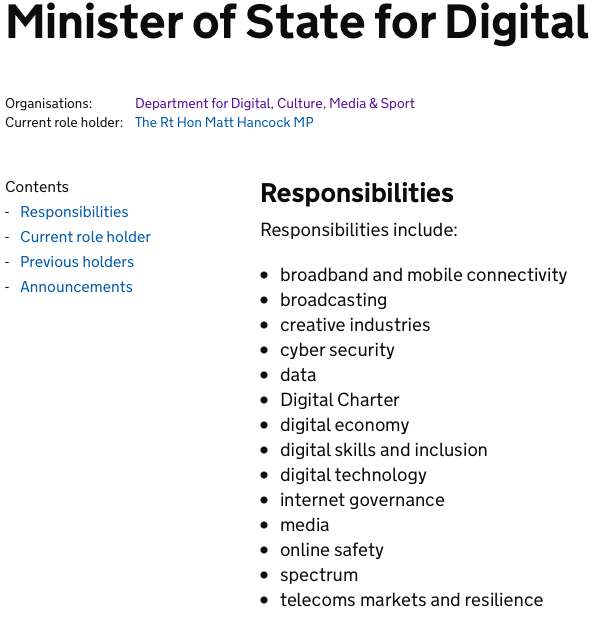
Minister of State for Digital, responsibilities

I tweeted a bit about the name change of the UK government Department for Culture, Media and Sport to Department for Digital, Culture, Media and Sport yesterday. I started off with a throwaway remark about the ongoing transition of the word “digital” to becoming a noun, rather than an adjective.

I think I understand, a little, why this has taken off in some quarters, especially in the civil service and government. It seems, to me, to be about capturing, with one word, the array of, sometimes, loosely related activities undertaken by folks who may have ‘digital’ in their job/unit title and the sorts of things that come under banners such as “digital transformation”.

“Digital” in such contexts might be seen as a managerial or organisational term that describes particular kinds of institutional function/activity. Some of these might have been called something else, previously, but some of the things signified by “digital” are hard to otherwise define, hence the co-opting of an adjective as a noun.

There’s loads more to say about this, but I’m sort of writing this post as a reminder to return to this stuff… maybe…

A communications primer – Eames

Via dmf.

Or “information theory for beginners”, maybe… A heavily stylised interpretation of Shannon’s information theory for IBM, by the Eames’, which may be of interest to those of a cybernetic persuasion.

… it’s a testament to the work of the US mathematician and ‘father of information theory’ Claude Shannon (1916-2001) that his model of communication, laid out in his landmark book A Mathematical Theory of Communication (1949), is still so broadly applicable.

Working from Shannon’s book, in 1953 the iconic husband-and-wife design team Ray and Charles Eames created the short film A Communications Primer for IBM, intending to ‘interpret and present current ideas on communications theory to architects and planners in an understandable way, and encourage their use as tools in planning and design’. Released at the dawn of the personal computer age, the film’s exploration of symbols, signals and ‘noise’ remains thoroughly – almost stunningly – relevant when viewed some 64 years later.

Reblog> Three new OHP books from: Brian Massumi; Steven Connor; and Érik Bordeleau, Toni Pape, Ronald Rose-Antoinette and Adam Szymanski

open access spelled out with books

Via Gary Hall. All of the books are available for free download. Follow links below.

We are pleased to announce the release this month of two new titles in Open Humanities Press’ Immediations series:***

Brian Massumi’s The Principle of Unrest explores the contemporary implications of an activist philosophy, pivoting on the issue of movement. Movement is understood not simply in spatial terms but as qualitative transformation: becoming, emergence, event.

Available for free download at:

http://www.openhumanitiespress.org/books/titles/the-principle-of-unrest/


***

Nocturnal Fabulations/Fabulations nocturnes by Érik Bordeleau, Toni Pape, Ronald Rose-Antoinette and Adam Szymanski with an Introduction by Erin Manning.

This collective, bi-lingual project is animated by a shared curiosity in the pragmatics of fabulation and its speculative gesture of bringing forth a people to come. In an encounter with Apichatpong’s cinematic dreamscape, the concepts of ecology, vitality and opacity emerge to articulate an ethos of fabulation that deframes experience, recomposes subjectivity and unfixes time.Available for free download at:

English: http://www.openhumanitiespress.org/books/titles/nocturnal-fabulations/

French: http://www.openhumanitiespress.org/books/titles/fabulations-nocturnes/

***

We are also pleased to announce the latest book in the Technographies series:

Steven Connor’s Dream Machines

Dream Machines is a history of imaginary machines and the ways in which machines come to be imagined. It considers seven different kinds of speculative, projected or impossible machines: machines for teleportation, dream-production, sexual pleasure and medical treatment and cure, along with ‘influencing machines’, invisibility machines and perpetual motion machines.

“This is an engaging and imaginative exploration of various forms of writing, thinking, and fantasizing about dream machines, an endlessly fertile topic probed here from just about every possible angle “¦ a major intervention into current understandings of technology, literature, and identity.”

Matthew Rubery – Queen Mary University of London

“”¦ a deeply original contribution to the history and philosophy of technology and the cultural history of the imagination “¦”Laura Salisbury – University of Exeter

Available for free download at:

http://www.openhumanitiespress.org/books/titles/dream-machines/

With our best wishes,

Sigi, David, Gary

GoPro as an ethnographic tool

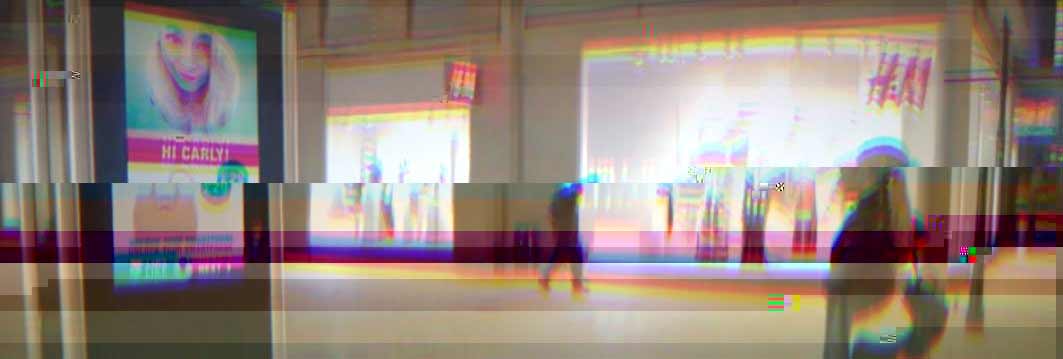
glitches image of man with cardboard camera-shaped helmet

This article concerning using GoPro cameras is interesting and probably relevant to some of the work on video methods in geography… obviously the rationale used here differs from some work in geography but methodologically I think it’s useful. I suspect that this would also be relevant for student dissertation research too, where it seems there is an appetite for adopting more novel and experimental methods (at least amongst the work I’ve seen).

GoPro as an Ethnographic Tool: A Wayfinding Study in an Academic Library.
Kinsley, Kirsten, Schoonover, Dan, Spitler, Jasmine

In this study, researchers sought to capture students’ authentic experience of finding books in the main library using a GoPro camera and the think-aloud protocol. The GoPro provided a first-person perspective and was an effective ethnographic tool for observing a student’s individual experience, while also demonstrating what tools they use to find items. Using the think-aloud protocol, observers could hear students express their internal decisions, thoughts, and feelings about the process. Results confirmed trouble spots in the building and that directories are not typically used and need updating. GoPro footage revealed that there are certain qualities of the help-desk experience that can make a search more or less successful. No major sex differences were found in preference of wayfinding tools and behaviors, except that males appear to have used directories marginally more than females. In a debriefing survey, students still affirmed human help and online maps as the most useful wayfinding tools and advocated for better signage. Mapping of behaviors by floor also validated GoPro observations. At low cost to the library, the GoPro/think-aloud combination along with survey and mapping methodologies affirmed trouble spots in the building and provided suggestions for wayfinding improvements to library administration.

Algorithm 1986

Just cos it’s fun…

From the second edition of The Dictionary of Human Geography, written by Prof. Peter Gould:

A step-by-step procedure, usually supported by a formal mathematical proof, that leads to a desire solution. An example is the Simplex Algorithm in Linear Programming. Heuristic algorithms are not supported by formal proofs, but are highly likely to lead to the optimal solutions. Examples include finding multiple locations within, and the shortest paths through, a network. The word derives from the name Al-Ghorizmeh, a distinguished Arab geographer-mathematician of the sixth century A.D. (See also Districting Algorithm.)   PG

Slightly different from the two-sentence version by Prof. Ron Johnston in the 5th edition (2009).

Responsive media

personal media

It’s interesting to compare competing interpretations of the same ‘vision’ for our near-future everyday media experience. They more or less circle around a series of themes that have been a staple of science fiction for some time: media are in the everyday environment and they respond to us, to varying degrees personally.

On the one-hand some tech enthusiasts/developers present ideas such as “responsive media“, a vision put forward by a former head of ubiquitous computing at Xerox PARC, Bo Begole. On the other hand, sceptics have, for quite some time, presented us with dystopian and/or ‘critical’ reflections on the kinds of ethical and political(economic) ills such ideas might mete out upon us (more often than not from a broadly Marxian perspective), recently expressed in Adam Greenfield’s op-ed for the Graun (publicising his new book “Radical Technologies”).

It’s not like there aren’t plenty of start-ups, and bigger companies (Begole now works for Huawei), trying to more-or-less make the things that science fiction books and films (often derived in some way from Phillip K Dick’s oeuvre) present as insidious and nightmarish. Here I can unfairly pick upon two quick examples: the Channel 4 “world’s first personalised advert” (see the video above) and OfferMoments:

While it may be true that many new inventors are subconsciously inspired by the science fiction of their childhoods, this form of inspiration is hardly seen in the world of outdoor media. Not so for OfferMoments – a company offering facial recognition-powered, programmatically-sold billboard tech directly inspired by the 2002 thriller, Minority Report.

I’ve discussed this in probably too-prosaic terms as a ‘politics of anticipation’, but this, by Audrey Watters (originally about EdTech), seems pretty incisive to me:

if you repeat this fantasy, these predictions often enough, if you repeat it in front of powerful investors, university administrators, politicians, journalists, then the fantasy becomes factualized. (Not factual. Not true. But “truthy,” to borrow from Stephen Colbert’s notion of “truthiness.”) So you repeat the fantasy in order to direct and to control the future. Because this is key: the fantasy then becomes the basis for decision-making.

I have come to think this has produced a kind of orientation towards particular ideas and ideals around automation, which I’ve variously been discussing (in the brief moments in which I manage to do research) as an ‘algorithmic’ and more recently an ‘automative‘ imagination (in the manner in which we, geographers, talk about a ‘geographical imagination’).

AR Super Mario Bros

augmented reality

Via Prosthetic Knowledge.

An AR recreation of the first level of Super Mario Brothers played in first-person with the Microsoft Hololens headset by Abhishek Singh.

Super Mario Bros meets Augmented Reality in this crazy life sized first person experience! I recreated the iconic first level, dressed up as Mario and then played it in Central Park (NYC). Built in Unity3D for the Microsoft Hololens. This video was recorded entirely through the hololens with no post production.

Not quite the AR of William Gibson’s Spook Country, eh?