Forbidden feelings. Or: things you don’t see on Linked In. 4 June.

As we come to the end of an academic year, emerge from underneath the ever growing heap of administration that tumbles on top of many university staff at this time of year, we can be, understandably, reflective. I have a few things ending, or that have ended, this academic year. A couple of milestones too.

My first time being a Principle Investigator came to an end at the beginning of the academic year – a role I had not expected to take on, yet, which was rewarding but hard. I became ‘PI’ because my colleague, and friend, Clive Barnett suddenly and unexpectedly died at the end of 2021. Through the Algorithmic Politics after Brexit project I learned about digital government in the UK, about many things I didn’t know about Brexit, and I learned how (not) to manage. One of my proudest moments associated with the project (though not really anything I did) was my friend and colleague Kuba Jablonowski’s appointment to a permanent Lectureship at Bristol – a really wonderful (‘unofficial’) outcome for the project and one I am certain Clive would have celebrated too.

My first peer reviewed article came out, at least as ‘Early Online’ anyway, since 2018. The paper is part of a theme issue in Environment and Planning D: Society & Space that originated in an event in Singapore convened by Weiqiang Lin, Peter Adey, Tina Harris and Dylan Brady about automation in the time of COVID-19. Somewhat ironically, I gave that original paper online, rather than in-person, because I actually had coronavirus (I’d love to finally go to Singapore one day). I took a long time getting that article over the finish line, with wonderful support from Weiqiang and Dylan in Singapore, as well as Federico Caprotti and Sean Carter at Exeter, because of the mental health issues that had influenced the preceding gap in publications.

This is absolutely not intended as a ‘poor me’ post. I am very sorry if I have got the tone wrong such that it comes across that way. Rather, I wanted to reflect on the things that happen in life that dictate or influence the pattern of a career, which are (for all sorts of reasons) not visible on a CV, or LinkedIn, or ORCID, or the other quasi- ‘official’ ways we present ourselves professionally. Sometimes it can feel like real ‘feelings’, not the humble bragging of social media, are forbidden. Sometimes a peculiar form of nihilism is mistaken for stoicism. We can seem to only see the prosaic sharing of ‘delighted’ announcements and not the fuller story.

Without wishing to over-share, I have a story that sits behind the lack of writing. I lost my father in 2018 after a long battle with non-alcohol-related liver disease. He had survived various treatments, a liver transplant and many setbacks. With two children born during the time of his illness, my wife and I both found it immensely challenging. Very soon after his death we contended with another family illness and bereavement in my wife’s family. The pandemic happened and all of us clapped, stayed indoors, eat out, went back indoors, knocked elbows, met on Teams and Zoom. Clive passed away. My former head of department and commuting companion (on trains to/from Bristol) Henry Buller also, very sadly, passed away due to cancer. Life happens. I didn’t write. I felt I couldn’t.

Colleagues can be very kind. Even those you don’t know well. I had a bad habit, in the days of Twitter (as was), of expressing my feelings in an un-guarded way and on more than one occasion – perhaps unprofessionally – I said I felt I wasn’t coping or that I was watching my career fizzle out. I received responses from colleagues offering support. I received some informal mentoring from one of them. Academic community matters. While there are, undoubtedly, more helpful and more professional ways of seeking help, I definitely recommend doing so.

I applied for a job, at a different university, a couple of years ago. In my CV and covering letter I made some reference to the gaps in my publication record and tried to offer a positive and ambitious plan for the future, rather than dwell on the past. I was not shortlisted. I requested feedback and was told that I needed to be explicit in providing reasons for the gaps, to explain why I had become PI after the project had already started. more recently, I applied for promotion and tried to learn from the feedback – to explain, in a professional manner, the gaps and to demonstrate my ambition. I received constructive feedback that I hope will help me work towards career advancement in the future.

There has been plenty of commentary about the perceived artificialness of self-promotion on social media and on professional profiles. There are LinkedIn jargon generators, a simple search brings up a lot of them, there are satirical commentaries and videos about self-promotion. My own bot, GeoCritBot (formerly of Twitter, now on BlueSky) was an attempt to satirise both the forms of self-promotion and also the kinds of academic jargon that we tend to use. It is, perhaps, all-too-easy to be cynical and even snide about such things – but I think I/we need to try to resist that temptation.

All of us, of course, have stories broader than the one told on a CV, or on LinkedIn. Some people succeed in academia even in profoundly difficult circumstances. Some people leave, sometimes without choosing to do so. Some of us are not, and don’t necessarily want to be, the stellar Professor. Most of us contend with ‘rejection’ regularly – for publication, for grants and, perhaps, for jobs. Some of us don’t embody the ‘vocation’ of academia, perhaps see it as ‘work’. Life events happen, we all have to deal with them. There can be, perhaps has to be, ways of telling some parts of these wider stories as work lives are complicated by the rest-of-life happening. I am not advocating for over-sharing, I am far too British(!), nor for radical transparency, although I do believe in ‘open’ research. I am not really able to offer any neat solution. I want to reflect on reflecting – to think about how not to feel negative about perceived fallings-short. Comparison can be the thief of fulfilment. ‘We’/’I’ can’t be ‘them’, but we can try to find ways to be a good ‘us’/’me’.

Celebrate your successes. Find ways to tell the story of adversity professionally and without underselling yourself. Celebrate other people’s successes too, however you feel comfortable about doing so (in a kind and professional manner). We can’t know some of the challenges people go through, often – we shouldn’t. However, even in a system that rewards individualism, that still reveres the ‘big name’, we can and should look for ways to advocate for and support one another, to work together, where we can. Solidarity is important.

Lastly, even when everything is hard, hold on to the little wins.

Forbidden feelings
A wha ya, a wha ya deal with

Forbidden Feelingz – Nia Archives.

Geography blogs?

A glitched image of a typewriter

Who still blogs? I guess I do… If nothing else to share things that seem interesting, which appears to be a strategy a few people employ. I can see from various WordPress subscriptions that I have that some colleagues still do. Maybe the moment passed (some time ago?!) but I can’t help feeling that there is still something worthwhile in writing in this sort of format – a sort of thinking out loud. My colleague Clive Barnett used to do this fantastically well on his site Pop Theory, which I am hopeful we will get back available online soon.

My question is an honest one though – who is blogging? Or writing a newsletter, which seems to have been a thing, but similarly died down a bit(?) I want to read ‘academic’ blogs or newsletters (or anything like that!) again, I think. Please get in touch with any recommendations.

“Geography” blogs that I currently follow (and people have posted to in the last 6 months) are:

As you can see there’s a few on substack now , which is an interesting platform – but I am not totally sure about (mostly due to the model of subscription), where once it was almost all WordPress. While I have focused on ‘geographers’ here that’s only because I had a list and I mostly rely on email subscriptions and the WordPress app, I used to use an RSS reader but fell out of the habit.

Who/what am I missing? Whose ‘blog’ or newsletter do you read that you enjoy? Please let me know!

Narratives of labour as infrastructure and the automative imagination

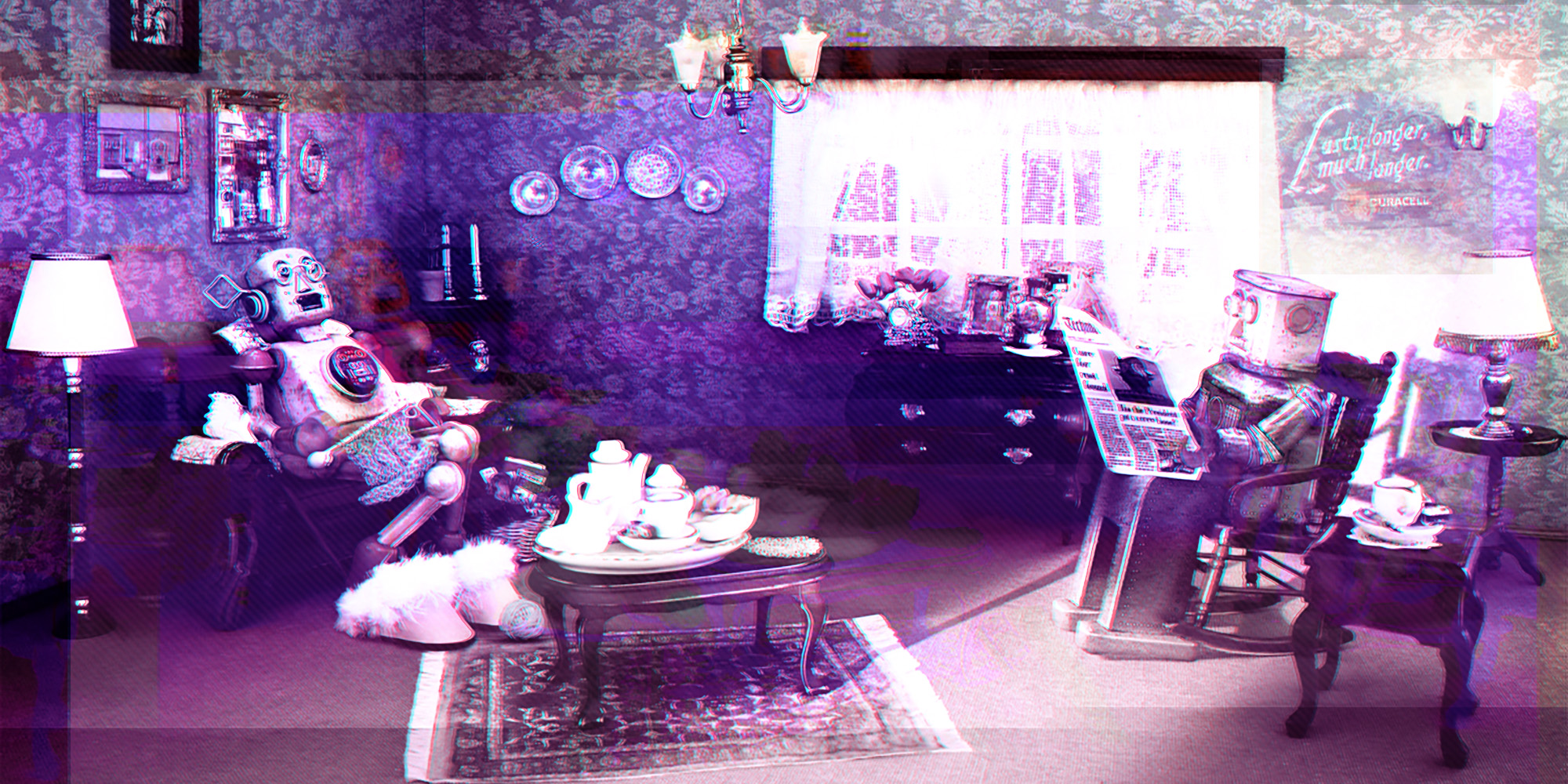
Glitched representation of 1980s Duracell robots in a domestic setting

I have a new journal article out, as part of a theme issue in Environment and Planning D: Society & Space. This forms the first peer-reviewed publication that stems from work I began around 2016 concerning automation (this is one of the earliest posts on this blog about it, with a talk I did at the SW Futures meet-up group). This took an impetus from the work of Bernard Stiegler around automation and my initial thinking with and through his ideas was influenced by many conversations around that time with my friend and former colleague Patrick Crogan, who has also written on automation (more than me!), e.g. here.

What the does ‘automative’ mean? You might be asking yourself. Well, I coined a neologism because I couldn’t find a word that fit what I wanted to say. In the paper I put it this way:

The ‘automative imagination’, in the context of this article, is a heuristic that enables two things: (i) a critique of the spatial politics scale pregnant within debates around the opportunities and threats brought by automation; (ii) an interrogation of the normative character of different habits of considering and discussing automation. I am not using the neologism ‘automative’ to assert any kind of authority but rather as a pragmatic tool. Other words do not quite fit—to speak of an ‘automated’ or ‘automatic’ imagination does not describe the characteristics of automation but suggests the imagining is itself automated, which is not the argument I am seeking to make. My aim is not to validate/invalidate particular narratives of automation. A ‘technologically determinist’ reading of the automative imagination might see what is imagined as goals towards which companies are specifically working, largely driven by economic imperative.

In the final sentence of the article I argue:

Using the automative imagination as a lens for inquiry asks for what kinds of ‘problem’ automation is situated as a ‘solution’, by whom and how they do so; and thereby how they are or may be contested.

For lots of personal reasons, this work has taken a long time to make it into print. Even so, I think the argument I make in the paper is at least interesting and has something to contribute in the current maelstrom of debate/s around automation. You can read the article for free, it is open access, courtesy of ESRC/UKRI funding. Here’s the abstract:

This article argues that the ways automation is imagined illustrate a wider problematisation of labour. The concept of an ‘automative imagination’ is proposed to articulate these different habits of considering and discussing automation. In these forms of imagination, I argue labour is discursively reconfigured as a logistical infrastructure. The concrete value of labour, the labouring body and the place of work as such are abstracted into an opaque logistical infrastructure in the narratives of an automative imagination. The impetus for this analysis comes from press releases and reports concerning automation and COVID-19 focused on the UK economy, creating a vanguard of abstracting ‘labour’ into infrastructure. The work of automation can usefully be understood as a relation, both in its implementation and in its imagining—a relation that geographers can, and should, interrogate. The automative imagination powerfully articulates the normative force of the performative abstraction and devaluation of work.

I hope you find it of interest.

“I used to”

A glitched image of a typewriter

It has been 1230 days (according to Google) since I last posted on this site. It was a Friday in early May of 2021 apparently. I cannot remember anything of it, if I am honest, it is lost in the mists of pandemic affected hazy memory. I have not begun again in order to be morose though, instead I have decided to try to post again for myself, more than anything. In the time since I last posted I lost colleagues, I learned quite a bit about myself, the country in which I live (the UK) has been through turbulent times and across the world we all tried to drag ourselves into a ‘post-COVID’ new normal, whatever that may be.

I used to blog. I used to write observations about academic life. I used to try to share my work, other people’s work. I used to (sometimes) feel a part of something. Perhaps one of the things I learned in trying to come to terms with the death of Clive Barnett, perhaps the biggest influence on my professional life so far, is that you kind of have to make that belonging. Blogs are ‘old’. Who blogs?! Well, I guess I do. Again (for now).

I am under no illusions, I think – I don’t expect to suddenly write every day, or even every week, perhaps. I am going to start out with trying to write once a week, if I can. I am going to trial a return to the “work note” format I began back in 2018 (apparently) and perhaps share some things that may be interesting.

I used to – lcd sound system

Non-Rep as a ‘Key Idea” – Paul Simpson blogs about a book

nonrepresentational geographies

On his new website, Paul Simpson (Ass. Prof. in Geography at Plymouth) is blogging about the writing process of a new book. Part of the “Key Ideas” series for Routledge, Paul is writing Nonrepresentational Theory. The book is due at the end of 2018, so I guess/hope there may be a quite a few blogposts to come. It’s great to see someone other than the “usual [prolific] suspects” doing this and I look forward to following the process in Paul’s blogposts. The first two posts about the book are here: “NRT book post 1“, “NRT book post 2“.

I hope you stick with it Paul! 🙂

It is interesting to see a colleague recommence blogging, because, recently, it feels like it’s been on the decline… part of my motivation to have a break from Twitter is to try and refocus on this blog, which I’ve always found more interesting and ocassionally, rewarding. Although, as is evident if you browse through, it remains largely a case of me writing with little in the way of interaction from any readers, whoever they may be.

If I ever write anything longer than a journal article, I’ll do my best to commit to blogging about it here. But that’s by the by, check out Paul’s blog.

Stiegler on holiday…

Eddie Murphy in the pool in Beverly Hills Cop 2

The usual round of posts by academics on social media about writing during the summer 'holiday' (made more frenzied by Andrew Adonis' remarks)  has made me think of Stiegler's 2012 interview in Philosophie magazine, in which he says:

To deprogram oneself necessitates keeping to very specific schedules, which are what Foucault, once again, described as techniques of the self, echoing Seneca. Holidays are a moment to practice such programmes. Myself, I use relaxation as a form of deprogramming. When I go on holiday, I work early and write all morning. Then, I swim, a lot, until that state when physical exertion stimulates a rush—because the brain produces a lot of endorphins. Swimming thus becomes a journey within oneself, during the course of which I run back through my memory of everything I wrote several hours earlier. Then I lie in the sun, drained, and I let my mind empty, since this is how unlikely thoughts can arise: something un-programmed emerges from all of this. Then I return to writing: I note all that has arisen — first in the water, then in the sun — all through rereading and annotating what I wrote in the morning.

Under the sun, I sense that this mass of hydrogen that has been combusting for several billion years is a cosmic programme that intervenes in my physiological programmes — muscles, brain, various organs — and which, in this intervention, produces a difference, a change of programme which allows me to write another kind of programme: a book in which I comment generally on other books.

Books, when they are good, are thus deprogramming programmes, unlikely programmes, like poems, in which there must be, wrote Paul Claudel, “a number that prevents counting”.

[My translation]

If only…


A tendency to spill…

Talented and creative friends I used to knock about with in the studio have made a lovely thing for the International Literature Showcase that you should definitely check out. Please see A Tendency to Spill, an interactive story created by the superlative duo Hazel Grian and Constance Fleuriot.

A Tendency To Spill is an interactive Science Fiction story that involves a chat bot (instant chat using artificial intelligence.)

Romy is a human child brought up in world of robots. She is about to be taken from her home and expelled to the human world across The Wall. She doesn’t have much time, maybe 10 or 20 minutes. She asks you now for a crash course in what’s really at the heart of human society.

This story is recommended for anyone aged 13 and upwards and is equivalent to Young Adult Fiction. With that in mind, appropriate behaviour and language are expected from you as well as from Romy.

We’d love you to take part in our research, please help us by filling in the form when prompted. It doesn’t mean we’re watching you while you chat but interactions are archived and, if you agree, we may share them in future whilst you remain entirely anonymous.

Thank you and enjoy the short story.

Click here to meet Romy.

A Universe Explodes. A Blockchain book/novel

Blockchain visualisation

Thanks to Max Dovey for the tip on this…

This seems interesting as a sort of provocation about what Blockchain says/asks about ownership perhaps, although I’m not overly convinced by the gimmick of changing words such that the readers unravel, or “explode” the book… I wonder whether The Raw Shark Texts  or These Pages Fall Like Ash might be a deeper or maybe I mean more nuanced take on such things… however, I haven’t explored this enough yet and it’s good to see Google doing something like this (I think?!)

Here’s a snip from googler tea uglow’s medium post about this…

It’s a book. On your phone. Well, on the internet. Anyone can read it. It’s 20 pages long. Each page has 128 words, and there are 100 of the ‘books’ that can be ‘owned’ . And no way to see a book that isn’t one of those 100. Each book is unique, with personal dedications, and an accumulation of owners, (not to mention a decreasing number of words) as it is passed on. So it is both a book and an cumulative expression of the erosion of the self and of being rewritten and misunderstood. That is echoed in the narrative: the story is fluid, the transition confusing, the purpose unclear. The book gradually falls apart in more ways than one. It is also kinda geeky.

The articles of faith of contemporary social and cultural geography

This post comes from a sense of dissatisfaction and a hope for finding different ways of (personally) doing geography. [I’ve been writing it for too long, so I’m just hitting “publish” – I welcome thoughts…]

When struggling for sleep and time to do things due to trying to do all of the things I know I should be doing to advance my career but also wanting to be with my family, I find it disheartening to decide to read newly published journal articles or agree to review articles and settle into reading them only to find they repeat familiar arguments, freighting the same rather narrow set of concepts. This post will likely irk (perhaps seriously) some who feel invested in some of the things I criticise, I can only apologise about that.

What I am identifying can’t be new, I’m sure plenty of others have made similar arguments… but it seems to me that we have a fairly set orthodoxy in how social and cultural geography gets done and what it can say. I am of course complicit. I am not seeking to distance myself from any of this, merely ‘confess’ and look for other ways of working.

The articles of faith we seem to have adopted in the REF-driven, short-termist form of research communication we inhabit and propagate concern both methodology and theory.

Methodologically, in spite of careful commentary reflecting upon the “new orthodoxy” of qualitative methods, we seem to have adopted a faith in the “theory–case study” model.

Generalise through theory – In this model one presents, often rather small scale, ethnographically derived empirical material. But rather than acknowledge the limits of scope and avoid attempting to generalise – following the model, this case study is read as an exemplar of a (sometimes muscular) ontological claim. I suggest this creates an epistemological slip, the modest empirical claims are rendered general by virtue of an appeal to theory. In this way, relatively modest empirical findings about a specific case study can be generalised by appealing to ‘big’ theory. This is of course understandable – we’re supposed to be writing four-star (“world leading”) research and using heavyweight theory is the conventional  ‘shortcut’ (in time and resources) to making such a claim. I’ve written papers like this, many have.

Theoretically, the discourses of social and cultural geography have, dare I say it, become rather dogmatic. There is a collective pressure through journals, email lists, social media and events to adopt the jargon and to conform (‘discursive regime’ anyone?). It seems to me there is a rather narrow range of concepts in use.

In part, I wonder whether this is due to an attempt to systematise the easier aspects of big (mostly French) philosophical systems of thought that gained traction in the late 1990s early 2000s, many of us went about formulating ways of ‘doing’ Deleuze for example (maybe I’m only repeating this mistake with Stiegler – I’m really trying not to!). Some have become a universal mechanism of explanation – regardless of the context of study. I worry that we are in danger of getting caught in a theoretical culdesac – everything becomes an example of those concepts we hold to be the truth. I am not suggesting we should not use the concepts I identify here or that they are in some way ‘wrong’. Some people have done careful and nuanced theoretical work that articulates the value of such theory. However, this doesn’t mean we all have to pile in and parrot the concepts to juice up our publications.

Sometimes concepts can be a sort of “sledgehammer to crack a nut”, sometimes they’re just a blinkered implication of causation that amounts to a dogmatic profession of faith – the empirical material demonstrates the concept, no matter what. Again, there are lots of understandable reasons – REF and employment pressures to get publications out, wanting to ‘fit in’ and being short on time so slipping into the ‘orthodoxy’.

I don’t actually buy the theoretical ‘arms race’ argument that has been posited about (mostly younger) researchers searching out the next ‘big’ theorist. I think we’re actually, mostly, more conservative – we’ve developed an orthodoxy that, in some cases, can verge on dogma: hence my provocation of the ‘articles of faith’.

The core concepts outlined here as the grounds of this ‘articles of faith’ are of course contestable and I’m not seeking to be definitive in any way. I suspect they are also all-too-familiar to the handful of people who will read this blog. My argument here is that perhaps we need to reflect a little more explicitly on how and when we use our theoretical blunderbusses…

  • The constitutional agency of Affect (& Atmosphere) – Given the arguments about the use of this concept, this perhaps one of the more difficult ideas to address. I sympathise with a desire to articulate the nonrepresentational and value some of the work done in that vein. Work around how we might understand intensities of relations and how particular places become constituted as much in unspoken sensations as through signification, and indeed how such spatial experience becomes perturbed, seems like a useful contribution to me. However, in some uses of the concept of affect/atmosphere there is an all-too-easy slip into appealing to amorphous (at times quasi-mystical) pre- / trans- subjective forces of affect/being affected to beef-up an argument. We are, I fear, in danger of creating what a colleague called a kind of ‘Phil Collins geography’, where something is literally “In the Air Tonight”.
  • The invocation of the Anthropocene – How can one argue against anthropogenic climate change? and I’m not trying to, but there appears, to me, to be a danger in invoking an all-encompassing rupture in ‘geological time’, in ecological understandings and in the cautious epistemological reflections upon how, as non-scientists, we understand and use ‘Scientific’ (with a big “S”) knowledge. We are in danger of eliding the careful reflections upon understandings and representations of Earth and world within geographical work. It seems to me this has granted license to engage in some peculiar forms of exercise in phenomenological impossibility, seeking to look ‘after the human’, and can perpetuate (globally) Western/ Northern perspectives that elide other ways of coming to terms with climate change. There has, of course, been some great work [e.g.] examining such problems.
  • The hegemony of Neoliberalism – or: the taken-for-granted force of the lumped together bogeymen of left-leaning thinkers along the lines of the ‘evils of capitalism’,  mostly denoting the combined phenomena of deregulation, privatisation and globalisation. An over-arching concept that affords one the opportunity to point to a thing we can be normatively against. There, of course, exists plenty of critique of the use of the idea in geography and suggestions for other terms or ways of engaging with the phenomena apparently denoted/ connoted by the term but it has a life of its own.
  • Witnessing the Non-human – on the one hand a useful means of articulating that the geographies we seek to explore have more than just us, “human” actors/actants/agents, in them. On the other hand, we are in danger of affirming precisely the sorts of (naive) humanism/human-centric ideas we are attempting to escape (via Latour et al.) For example, when is what gets called ‘non-human’ perhaps actually human? Technology is a case for me here and it all depends on the other theoretical assumptions you make about what a ‘technology’ is… Likewise, if we’re seeking to de-naturalise ‘nature’, to demonstrate that we are not and cannot be separate from what we identify as ‘nature’ then creating label for what may be ‘other’ to the human seems a weird way of going about it. Of course, again, there is some really excellent work that takes on board such understandings and I’m fortunate to work with several of the people doing/writing it. Nevertheless, the wider discursive use of ‘non-human’ risks doing the reverse of what one might think one if doing with it.
  • The supremacy of Subjectivity – The basis for understandings of human experience, in relation to which difference, identity, spatiality and many other concepts are conceived in much of geography. Of course, some fantastic work has been done on the idea of a subject, subject positions and subjectivity. I guess the reason I raise the concept here is because there seems an increasingly common slip between the ways we discuss subjective experience and the ways in which we are individualised in different domains (legal, political, technological etc.) to render an equivalence. An example here is an idea of a “digital subjectivity”[1]. On the one-hand we might see this in relation to the various ways one performs different identities through different apps, conforms to or breaks rules/conventions and so on. On the other hand we might see it as the ways we get surveilled, defined, addressed and perhaps conditioned by our data. Weirdly, given the popularity of ‘affect’ theory, we can get caught up in peculiar contradictions between the ‘excessive’ agency of the intersubjective and the repressive agency of subjection/subjectivation. In slipping between the two, we risk falling foul of longstanding arguments around reductive understandings of ‘subjection’ and eliding precisely the epistemological purchase the concept can, potentially, afford, i.e. multiplicity, intersubjectivity and so on.

Alternatives..?  I do not have easy answers, goodness knows I wish I did… However, I can offer some suggestions that I find myself contemplating as ways forward for rethinking how I go about understanding the kinds of knowledge claims I might seek to make in my future writing.

Firstly, maybe we can move beyond what I’ve called the “theory-case study” model? Perhaps it’s ok to return to a grounded theory approach, or to be rigorously empirical and refrain from particular forms of generalisation because that’s not what our ‘data’ grant. Perhaps we can innovate a little more (and perhaps I’m not reading enough to see that this is already happening?!)

Secondly, maybe it’s ok to do theory on it’s own, and we should find the confidence to do geographical theory too. Perhaps the editorial boards of our journals might already be receptive to this. Perhaps also we can collectively decide this is something we can value, so long as appropriate standards are applied.

Thirdly, maybe we should resist the artificial timetables of REF and so on dictating our push to produce work we may not feel entirely comfortable with. Maybe, with growing teaching and admin loads, maybe with increased precarity of work we, as a community of scholars, should say let’s cut ourselves some slack – especially those who are early career and forced into unsustainable habits of work: massive teaching loads for 9-months then a contract ends, all while attempting to get the next one and keep publications ticking over. I have no doubt that the ‘quickness’ with concepts and methods relates to the habits of work to which we are currently conforming. I cannot see how this is sustainable. It certainly isn’t for those of us with families. I admire those who succeed, in spite of all of this, but we cannot all do that and maybe we need to hold out a helping hand to others and say: it’s ok, you don’t need to copy us, you don’t have to do things our way – find your own ways of working, develop your own theory.

These are half-formed thoughts, at the end of term, frazzled by lack of sleep and trying to do too many things. I genuinely do not want to deride other people’s work here, I am merely identifying a dissatisfaction with how I understand my own working practices. I would welcome any thoughts…

Notes

  1. Or of course ‘algorithmic’ power/subjectivity/subjection – ‘algorithm’ might be included in a longer version of this list