“Digital”, noun

Minister of State for Digital, responsibilities

I tweeted a bit about the name change of the UK government Department for Culture, Media and Sport to Department for Digital, Culture, Media and Sport yesterday. I started off with a throwaway remark about the ongoing transition of the word “digital” to becoming a noun, rather than an adjective.

I think I understand, a little, why this has taken off in some quarters, especially in the civil service and government. It seems, to me, to be about capturing, with one word, the array of, sometimes, loosely related activities undertaken by folks who may have ‘digital’ in their job/unit title and the sorts of things that come under banners such as “digital transformation”.

“Digital” in such contexts might be seen as a managerial or organisational term that describes particular kinds of institutional function/activity. Some of these might have been called something else, previously, but some of the things signified by “digital” are hard to otherwise define, hence the co-opting of an adjective as a noun.

There’s loads more to say about this, but I’m sort of writing this post as a reminder to return to this stuff… maybe…

Jen Jack Gieseking on How to Set Up Your Own Website and Why It’s Worth It

A glitched image of a typewriter

Nice post by Jack Gieseking on why it’s worth setting up a website as an academic. I’d broadly echo many of the points here, albeit from a different standpoint – I’m less prolific and I guess I’m more in curatorial mode on this website at the moment… (I am actually writing again though, so that’s nice)

For Academics: How to Set Up Your Own Website and Why It’s Worth It

Dear Academic Friend,

Over the years, many of you have asked me how to build a website. About eleven years ago, a graduate school friend patiently sat next to me and taught me the ropes using pure HTML. It’s much easier now. If you want a little convincing as to why to do this or want to get firmly rooted on your politics in this, continue reading. If you are already determined to build your own website, click here to skip down. My mantra here: ideas are free; let’s share.

Really, people want to hear about what I do? Let’s begin with the obvious: what you do is important. Wildly important. You may think you are boring, dull, unclear, or talking to your navel, but someone, somewhere needs your work on the lesbian spaces, the history of the lute in 1689, Saharan slavery practices, a rare snail on the coast of the Bahamas, or the relationship of the human-animal of lab scientists studying jellyfish. They truly do. Let’s say you actually choose to believe me for a second and the grip of self-doubt can be put aside for even a few minutes. You know I’m going to encourage you to set up your own website. Now let’s deal with your concerns.

Read the rest of this post on Jack’s website.

(Not) Getting Paid to Do What You Love: Gender, Social Media, and Aspirational Work – Brooke Erin Duffy

Via Culture Digitally.

This looks like an interesting read by Brooke Erin Duffy. Although I know what Duffy calls here “aspirational work” is popular, I have been a bit surprised by how many of our students at Exeter actively do this kind of work – mostly fashion vlogging. I have had at least one dissertation on the topic for each of the last three years and many of the videos produced for my final year option module draw on these themes. Those I’ve spoken to are acutely aware of the nuances of the negotiations of different norms and values – ‘authenticity’ and getting paid don’t always sit well together it seems.

I hope I have the chance to check out this book so I can actually learn more about what I can only vaguely sketch (perhaps wrongly) at the moment, I hope some of those who read this will too…

Book Announcement: (Not) Getting Paid to Do What You Love: Gender, Social Media, and Aspirational Work

Fashion bloggers and Instagrammers seem to enjoy a coveted lifestyle–one replete with international jet-setting, designer-comped fetes, and countless other caption-worthy moments. Yet the attention lavished on these so-called “influencers” draws attention away from a much larger class of social media content creators: those aspiring to “make it” amid a precarious, hyper-competitive creative economy.

I tell their story in my new book (Not) Getting Paid to Do What You Love: Gender, Social Media, and Aspirational Work, and I’m grateful to my publisher Yale University Press for allowing me to share the first chapter with you.

The book focuses on female content creators and draws upon in-depth interviews with bloggers, vloggers, designers, and more. I learned that, often, these young women were motivated by the wider culture’s siren call to “get paid to do what you love.” But their experiences often fell short of the promise: only a few rise above the din to achieve major success. The rest are un(der)- paid, remunerated with deferred promises of “exposure” or “visibility”–even as they work long hours to satisfy brands and project authenticity to observant audiences.

A grueling balancing act is required, one that I explore through the lens of “aspirational labor.” As both a practice and a worker ideology, aspirational labor shifts content creators’ focus from the present to the future, dangling the prospect of a career where labor and leisure coexist.

Despite the book’s emphasis on gendered work, the concept of “aspirational labor” offers a framework for understanding, critiquing, and anticipating larger transformations in the social media economy. Indeed, the book closes by exploring the striking parallels between social media aspirants’ self-branding labor and the work so many of us undertake in contemporary academe.

Reblog> Lesser known, or avoided, ‘truths’ of academic life

A glitched image of a typewriter

Stuart Elden points to a piece by Daniel McCormack in the Chronicle of Higher Education entitled “Some lesser-known truths about academe” which raises some interesting issues for consideration. I think the below in particular resonated with me…

Daniel McCormack, ‘Some Lesser-Known Truths About Academe‘ in The Chronicle of Higher Education. While this is a US focused piece, there is still much in here to consider for people in, or considering a career in higher education elsewhere. The writer is a post-doc in international politics who has decided to leave the sector.


Asking a professor whether you should pursue a Ph.D. is a little like asking The Rock – aka Dwayne Douglas Johnson, the world’s highest-paid actor last year – whether you should become an actor.

Once you enter a doctoral program, the main problem isn’t necessarily that you can’t finish. I know very few people who left graduate school because they weren’t smart enough to finish – it happens, but it’s rare. More often people leave because they just decide getting a Ph.D. isn’t for them. The truth is: It’s very difficult to understand what academic life is like until you actually try it, and lots of people try it and decide it’s not a good fit.

This, then, is why you should be wary of any advice you receive from professors about graduate school: It’s coming entirely from people who decided that academe was a good fit for them.

The history of the future of automation – lessons from ed tech

Automated taxi figure in the 1990 film Total Recall

I’ve been re-reading the excellent essay by Audrey Watters: Driverless Ed-Tech: The history of the future of automation in education. I really recommend reading it!

Following on from the vague points I made in my last post about an automative imaginary – one way of getting at this is a sort of classic (political economy) critique, which Watters very adroitly takes in relation to ed-tech and MOOCs (etc), and which she write really clearly – so, here is snippet:

“Put me out of a job.” “Put you out of a job.” “Put us all out of work.” We hear that a lot, with varying levels of glee and callousness and concern. “Robots are coming for your job.”

We hear it all the time. To be fair, of course, we have heard it, with varying frequency and urgency, for about 100 years now. “Robots are coming for your job.” And this time – this time – it’s for real.

I want to suggest – and not just because there are flaws with Uber’s autonomous vehicles (and there was just a crash of a test vehicle in Arizona last Friday) – that this is not entirely a technological proclamation. Robots don’t do anything they’re not programmed to do. They don’t have autonomy or agency or aspirations. Robots don’t just roll into the human resources department on their own accord, ready to outperform others. Robots don’t apply for jobs. Robots don’t “come for jobs.” Rather, business owners opt to automate rather than employ people. In other words, this refrain that “robots are coming for your job” is not so much a reflection of some tremendous breakthrough (or potential breakthrough) in automation, let alone artificial intelligence. Rather, it’s a proclamation about profits and politics. It’s a proclamation about labor and capital.

More specific to education, Watters highlights the logic offer by Udacity, one of the big MOOC start-ups:

“We want to be the Uber of education,” Thrun told The Financial Times, which added that, “Mr Thrun knows what he doesn’t want for his company: professors in tenure, which he claims limits the ability to react to market demands.”

In other words, “disrupt” job protections through a cheap, precarious labor force doing piecemeal work until the algorithms are sophisticated enough to perform those tasks. Universities have already taken plenty of steps towards this end, without the help of algorithms or for-profit software providers. But universities are still bound by accreditation (and by tradition). “Anyone can teach” is not a stance on labor and credentialing that many universities are ready to take.

[read all of Watters’ argument here.]

One of the areas in which what I’ve called the automative imaginary/imagination overlaps with wider stories about digital tech disruption and the widespread creed of that disruption being normatively good, if not admirable, is where automation overlaps with the ‘gig economy’. As we can see, via Thrun, one of the models in play here is not to ‘destroy’ jobs but rather to decouple them from some of the elements that make them valuable and either reallocate or automate those and then offer the remaining tasks as precarious work – which you have to sign up for through a proprietary system as a contractor, rather than an employee.

The ways we are invited to see ‘automation’ by some are over-coded with strong narratives of ‘disruption’ and the breaking down of established employment rights into a two their system in which the ‘taskers’ (as Guy Standing calls them) take the precarious work for relatively meagre earnings and the tech company owners and a few they bring along with them hoover up the profits.

An alternative to such narratives might be ‘accelerationism‘ but I remain skeptical at present (but I’ve not read enough to form an opinion really). It seems to me, we (geographers, social scientists, citizens?! … well, me anyway!) really do need to talk and think about work.

More tales of the automative imaginary

A warehouse worker and robot

Here’s some links that further sketch out some of what I’ve been thinking about as an ‘automative imaginary’. I’ve offered links with a bit of brief commentary at the bottom…

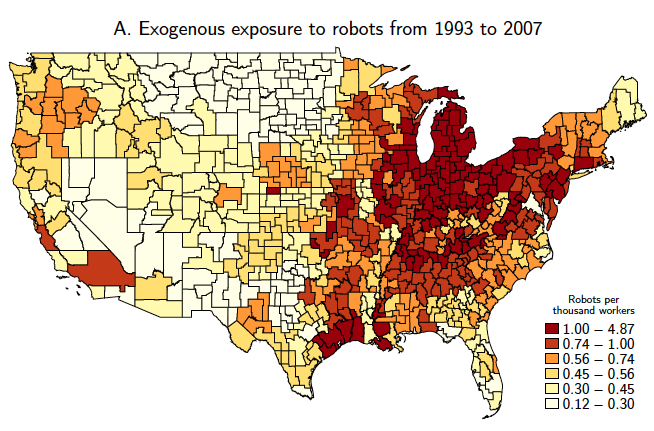
Evidence That Robots Are Winning the Race for American Jobs – in the NYT, pointing to research undertaken by two economists, Acemoglu and Restrepo, published by the (American) National Bureau of Economic Research: Robots and Jobs: Evidence from US Labor Markets (to which I have no access), with a commentary on the Centre for Economic Policy Research‘s Vox site. What is curious for me here is how one can evaluate the method of the researchers and what the assumptions they make say about how we (are invited to) understand automation. There’s some interesting geography in there too! E.g. see the choropleth map of “exogenous exposure to robots” below
How will the rise of automation and AI affect the workforce and economy moving forward? – Francis Fukuyama offers his answer to how automation and AI (interesting easy slip between those as almost a form of equivalence, which is open to significant debate/critique) may or may not “affect” the economy and, in particular, jobs – in the US.

It’s interesting how much of what we are offered in terms of a rationale for automation is a fairly simplistic robots replace workers sort of story. In this regard, it’s worth remembering what the MacDonalds CEO Ed Rensi flippantly observed as a canonical example (documented in this post on Fusion):

former McDonald’s CEO Ed Rensi made news by going on Fox Business and declaring that ongoing protests in the campaign for a $15 minimum wage were encouraging the automation of fast food jobs. The segment goes on for seven minutes, but here’s the meat of it:

I was at the National Restaurant Show yesterday and if you look at the robotic devices that are coming into the restaurant industry – it’s cheaper to buy a $35,000 robotic arm than it is to hire an employee who’s inefficient making $15 an hour bagging French fries – it’s nonsense and it’s very destructive and it’s inflationary and it’s going to cause a job loss across this country like you’re not going to believe

Nevertheless, other economists will tell you that processes of automation have, historically, created new kinds of jobs as they apparently ‘destroy’ others. For example, Deloitte, in their report “Technology and People: The great job creating machine“, suggest that while manual labour and routine jobs have been significantly automated since 1992, there has been an even larger growth in ‘care’ (and service) and ‘cognitive’ work in the UK labour market. So you see fewer people in manufacturing but more analysts, baristas and carers.

Of course, to see it as whole “jobs” that are being automated is somewhat misleading – another aspect of the automative imaginary that owes more to the depiction of automation in 1950/60s cartoons than in the actually existing forms of automation. As many commentators point out, it’s parts of jobs or tasks that become automated, which results in a need to reorganise that work. As the management consultants McKinsey point out in a report in 2016:

currently demonstrated technologies could automate 45 percent of the activities people are paid to perform and that about 60 percent of all occupations could see 30 percent or more of their constituent activities automated, again with technologies available today

What we tend to focus on is the automation full stop, not that it isn’t all of a job and may not result in an easy equivalence of “robot in = worker out”. We imagine the robots doing it all, when, in many cases, the use of robots (when they’re actually economically viable – they have a huge initial set-up cost) require a reorganisation of systems such that the work looks different.

Another illustration of this comes from the excellent Containers podcast by Alexis Madrigal. In the final episode, Madrigal talks to Karen Levy of Cornell  about the forms automation could take in relation to truck driving (upon which Uber clearly has its sights set). Of course, again, it’s not as simple as: automate the lorries, do-away with jobs. It’s more like the process of containerisation that Madrigal is exploring – automation is as much about reorganising systems of work / labour as it is about ‘replacing’ labour. So, in the example of picking in warehouses – you might get a Kiva or Fetch/Freight robot to do the donkey work of warehousing, with the worker performing the more sophisticated movements. This is not a future of people-less spaces but rather robots following people around or being tasked in order to support the worker, the argument being this leads to greater productivity. In fact, in the eighth episode of Containers, the CEO of Fetch Robotics justifies her company’s tech by saying that, in the US, there are over 600k jobs going unfilled in warehousing and manufacturing because people don’t want to do them, with a turnover rate of those who do sign-up for such work at around 25% (I don’t know the basis or veracity of those numbers – would like to though!). Again, if true, such figures are another aspect of the expectations of what work involves and how it may be performed.

So, it seems to me we need to talk about work not simply elide it by (somewhat hysterically) referring to ‘automation’ and ‘robots’. This is something I hope to research and write more about, if I ever get the time…

A Universe Explodes. A Blockchain book/novel

Blockchain visualisation

Thanks to Max Dovey for the tip on this…

This seems interesting as a sort of provocation about what Blockchain says/asks about ownership perhaps, although I’m not overly convinced by the gimmick of changing words such that the readers unravel, or “explode” the book… I wonder whether The Raw Shark Texts  or These Pages Fall Like Ash might be a deeper or maybe I mean more nuanced take on such things… however, I haven’t explored this enough yet and it’s good to see Google doing something like this (I think?!)

Here’s a snip from googler tea uglow’s medium post about this…

It’s a book. On your phone. Well, on the internet. Anyone can read it. It’s 20 pages long. Each page has 128 words, and there are 100 of the ‘books’ that can be ‘owned’ . And no way to see a book that isn’t one of those 100. Each book is unique, with personal dedications, and an accumulation of owners, (not to mention a decreasing number of words) as it is passed on. So it is both a book and an cumulative expression of the erosion of the self and of being rewritten and misunderstood. That is echoed in the narrative: the story is fluid, the transition confusing, the purpose unclear. The book gradually falls apart in more ways than one. It is also kinda geeky.

Reblog> the Ideology behind the gig economy

Deliveroo cyclists

Via John Naughton.

The ideology behind the gig economy

Jia Tolentino has a very good piece in the New Yorker about the ideology that underpins the gig economy. The piece opens with the story of Mary, a Lyft driver in Chicago who kept accepting rides even though she was nine months pregnant – and even kept going when her contractions began!

In the end, it ended well. Mary had a customer who only needed a short ride, so she was able to drive herself to hospital after dropping him off. Once there, she gave birth to a baby girl – who appears on the company blog wearing a “Little Miss Lyft” onesie.

The point of the company blog post is to laud the spirit of workers like Mary. But, writes Tolentino,

It does require a fairly dystopian strain of doublethink for a company to celebrate how hard and how constantly its employees must work to make a living, given that these companies are themselves setting the terms. And yet this type of faux-inspirational tale has been appearing more lately, both in corporate advertising and in the news. Fiverr, an online freelance marketplace that promotes itself as being for “the lean entrepreneur”–as its name suggests, services advertised on Fiverr can be purchased for as low as five dollars–recently attracted ire for an ad campaign called “In Doers We Trust.” One ad, prominently displayed on some New York City subway cars, features a woman staring at the camera with a look of blank determination. “You eat a coffee for lunch,” the ad proclaims. “You follow through on your follow through. Sleep deprivation is your drug of choice. You might be a doer.”

Quite so. Lyft drivers in Chicago earn about $11 per trip.

Perhaps, as Lyft suggests, Mary kept accepting riders while experiencing contractions because “she was still a week away from her due date,” or “she didn’t believe she was going into labor yet.” Or maybe Mary kept accepting riders because the gig economy has further normalized the circumstances in which earning an extra eleven dollars can feel more important than seeking out the urgent medical care that these quasi-employers do not sponsor. In the other version of Mary’s story, she’s an unprotected worker in precarious circumstances.

Spot on.