Standing in the way of control – website issues

If you look at the dates of postings here, or if you happen to follow my posts, you may have noticed that there has been a longer-than-average silence. This has not only been due to being busy at work (though it has been a very busy term, with the commute more challenging than usual). I have also experienced some issues with this website (hence this post has happened twice – due to reverting to a backup) and in particular with WordPress that my wonderful hosting company – Reclaim – have been very kindly and expertly helping me with. I’m now able to post again but I think there will need to be a bit of spring cleaning behind the scenes in the near future!

I can’t speak highly enough of Reclaim Hosting – they have been a bit of a revelation to me. The support has been superb and the prices are very very reasonable (this is not an advert – I genuinely think these things 

I have a couple of bits of work-y news:

  • I have been promoted to ‘Senior Lecturer’, which is good. The paperwork took quite a while to complete and if anyone is in a similar position and would like to talk about it I’d be happy to do so… It is run in a fairly strange way where I work, insofar as it is almost a second probation, so it’s a relief that it’s done. I recognise how fortunate I am in my situation and will do my best to make the most of it.
  • I am still working on my book idea around the ‘automative imagination’. Unfortunately I was unsuccessful in my application for a BA ‘Mid-Career Fellowship’ to support this. I’m trying to make progress regardless. I’ve integrated some of the themes into my teaching and I have a loooong reading list, mostly physically located on a small table I have purloined for my office(!) If anyone reading this has any ideas about other avenues to explore for funding or support I’d really love to hear them! Likewise, if you’re interested in talking about ‘automation’ I would also welcome the opportunity to talk.
  • I’ve been involved in a sort of core curriculum review in my department this year (sadly without workload recognition) in which a group of us (who currently convene those modules) are redesigning our core methods modules. This has been really interesting. We have certainly had to consciously think through what a/our geography degree is for, and what sorts of things we should be inviting the students to learn.
  • I have put forward a double-session on ‘Geographies of/with AI’ for this year’s RGS-IBG annual conference, which hopefully will be accepted – still waiting to find out.

I would very much welcome anyone getting in touch to talk about automation, or any of the other things I tend to blog about, so please do feel free.

Standing in the way of control – The Gossip

Bernard Stiegler: “Rethinking an industrial policy in the era of the Anthropocene and automation”? [translated]

A young man standing in a cloud of yellow smoke

I recently came across an edited interview with Bernard Stiegler published on the website of Philosophie Magazine (17/12/18) [a] in which Stiegler ties together a very brief reading of the ‘yellow vests’ phenomena with the experiments he has been leading in the creation of an ‘economy of contribution’ – a more-or-less as a ethico-political-economic response to the ‘Anthropocene’. It is important to note here that for Stiegler not only means the current global cultural/environmental/social crisis embodied in a new ‘epoch’ but also significantly means the apparently rapid changes in employment/work largely due to technology. I have translated conversations with Stiegler about this topic before and these might be helpful in fleshing out the argument translated below, especially:

Here, in a similar vein to the discussion of previous periods of civil unrest in France (see in particular the books: The Decadence of Industrial Democracy, Uncontrollable Societies of Disaffected Individuals and The Lost Spirit of Capitalism) Stiegler diagnoses a form of immiseration that comes from a loss of capacities that needs to be addressed through a form of therapeutic response. The ‘yellow vests’ movements are a symptom of a broader cultural-environmental-social ‘entropy’ that is ‘The Anthropocene’ needs to be addressed through a re-imagined industrial policy – to engage in what he terms a form of ‘negentropy’. having said all of this, what is important perhaps about this brief interview is that it locates pragmatic action by talking through what Stiegler and colleagues are doing in the Plaine Commune experiments (for more information follow the links above).

As I have previously observed, I still find it curious that underlying the apparent radicalism of re-thinking industrial strategy, acting together towards (political) therapeutic ends, is a strange sort of unflinching (dare-I-say even conservative) faith in the state and institutions. In particular, the model for the central strategy of ‘contributory income’ is the intermittent entertainment policy of the French government for subsidising freelance and somewhat precarious forms of work in the ‘creative industries’. I’m not criticising this, I think it merits greater discussion – not least because it is being trialed in Seine-Saint-Denis – but there’s something curious about this rather measured scheme being central to the strategy, given the almost apocalyptic and incredibly urgent tone of books like The Neganthropocene and Age of Disruption.

ADD. 24/01/19. I think I probably missed a final step to the thought expressed in the paragraph above: while the scheme for a ‘contributory income’ (based upon the intermittent scheme) currently underway in Plaine Commune is perhaps limited, and while the idea of such an income is, in-itself not especially ‘revolutionary’, perhaps I/we should see this as the beginning of a reorientation – the instigation of a different/new therapeutic ‘tendency’, in Steigler’s terminology – away from a competitive individualised economic rationale towards a collective means of flourishing together, whilst also acknowledging that we need to take some form of collective responsibility. In that vein, as others have pointed out, Stiegler’s ‘activist’ thought/activities take on a particular ethical/moral stance (in this way I have some sympathy with Alexander Galloway calling Stiegler a ‘moral philosopher’).

As usual I have included in square brackets original French, where I’m unsure of the translation, or clarifications. I have also maintained, in the Conversation piece, all of the original francophone hyperlinks unless there is a clear anglophone alternative.

I welcome comments or corrections!

Notes

a. The interview appears in a section entitled Gilets Jaune, et maintenant? – something like ‘Yellow vests, now what?’

Bernard Stiegler: “Rethinking an industrial policy in the era of the Anthropocene and automation”

For this thinker of technics, the “yellow vests” movement highlights the desperate need for a new policy that would value work rather than employment. Among his proposals is the widening of the government scheme for irregular workers in the creative sector to everyone.

I was struck by the rapid evolution of the “yellow vests” movement, by the way it was presented and in which it was perceived. In the beginning, occupations of roundabouts [and crossroads] were reminiscent of the Tea Party phenomenon in the United States, which paved the way for Donald Trump’s election, and of Sarah Palin’s astonishing statement: “I like the smell of exhaust emissions!”However, despite the presence of the “ultra-right” which is of course very dangerous, the rise of this movement has evolved positively – and very unexpectedly. Compared with the “protest” scene, well-known in France for decades, the “yellow vests” are obviously a very singular and very interesting event, beyond its extreme ambiguities. Amongst the demands made by these leaderless demonstrators, the proposal to create a deliberative assembly for ecological transition is particularly illustrative of what fundamentally new emerging from this movement. This is confirmed by the encouraging sign, which must be interpreted without being under any illusions: the protest and climate march at a junction, in Bordeaux, on the 8th of December.

When we listen to the “yellow vests”, we hear the voices of people who are a bit lost, often living in unbearable conditions but with the virtue of expressing and highlighting our contemporary society’s limits and immense contradictions. In the face of this, the Macron government seems unable to take the measure of the problems being raised. I fear that the measures announced by the President on the 11th of December resolve nothing and fix in place the movement for the longer term, precisely because it expresses – at least symptomatically – the collective awareness of the contemporary crisis. The political horizon throughout Europe is not at all pleasant: the extreme right will probably draw the electoral benefits of this anger, while failing to answer the questions legitimately posed by “yellow vests” movement. This highlights the lack of a sense of history by President Macron and his ministers, and equally underlines the vanity of those who pretend to embody the left, who are just as incapable of making even the simplest statement at the height of what is the first great social crisis characterised by the Anthropocene. 

For me, a “man of the left”, the important question is what would be a leftist comprehensive industrial policy to take up the challenges of the Anthropocene and automation – which is to say, also addressing “Artificial Intelligence”. To confront this question is to attempt to overcome what is not thought in Marxian criticism, namely: entropy. All of the complex systems, both biologically and socially, are doomed to differential loss – of energy, biodiversity, interpretation of information – that leads to entropic chaos. The concept of negentropy, taken from the works of Erwin Schrödinger, refers to the ability of the living to postpone the loss of energy by differentiating organically, creating islands and niches locally installing a “différance” (as Derrida said) through which the future [l’avenir] is a bifurcation in an entropic becoming [devenir entropique] in which everything is indifferent. 

The fundamental point here is that, while entropy is observed at the macroscopic level, negentropy only occurs locally through energy conversion in all its forms – including libidinal energy. Freud was, with Bergson, the first to understand this radical change in point of view required by entropy. The “nationalist retreat” is a symptomatic expression of the entropic explosion provoked by the globalization [that is the] Anthropocene. This needs to be addressed by a new economic and industrial policy that systematically values negentropy. 

It is in response to such issues that the Institute of Research and Innovation and Ars Industrialis with Patrick Braouezec (President of the Plaine Commune public territorial establishment) are leading an experiment in Seine-Saint-Denis. In this district of 430,000 we are experimenting with putting in place a local economy of contribution, based upon a new macro-economy at the national level. Above all, this scheme values work rather than employment and aims to generalize the system of intermittent entertainment [added emphasis] [1]: The idea is to be able to guarantee people 70% of their most recent salary in the periods when they do not work, provided that within ten months they begin another freelance [intermittent] job. In the case of freelance [intermittent] performers, they must work for 507 hours, after which they have “replenished their right” to a contributory income. We are currently constructing workshops in the areas of child care, quality urban food, construction and urban trades, the conversion of combustion vehicles into clean vehicles, and so on. This experiment is supported by the Fondation de France, Orange, Dassault Systèmes, Caisse des Dépôts et Consignations, Societe Generale, Afnic Foundation and Emmanuel Faber, General Manager of Danone. Every one of which are stakeholders in the search for a new conception of industrial economy fully mobilized in the fight against the Anthropocene and for the restoration of very-long-term economic solvency, based on investment, not speculation. It is by taking bold initiatives of this kind that we will truly respond to the “yellow vests”.

Notes

1. There is no direct translation for ‘intermittent entertainment’/ ‘intermittents du spectacle’ – this refers to state-subsidised freelance workers in the entertainments industry, an arrangement backed by long-standing legislation in France to support their native creative sectors.

“AI will displace 40 percent of world’s jobs in as soon as 15 years” – Kai-Fu Lee

Industrial factory robot arms

In a widely-trailed CBS ’60 minutes’ interview, the A.I-pioneer-cum-venture-capitalist Kai-Fu Lee makes the sorts of heady predictions about job replacement/displacement that the media like to lap up. The automative imagination of ‘automation as progress’ in full swagger…

We should perhaps see this in the context of, amongst other things, geopolitical machinations (i.e. China-USA) around trade and intellectual property; a recently published book; a wider trend for claims about robotic process automation (especially in relation to ‘offshoring‘); and a large investment fund predicated upon ‘disruption’.

“Merger” by Keiichi Matsuda – automation, work and ‘replacement’

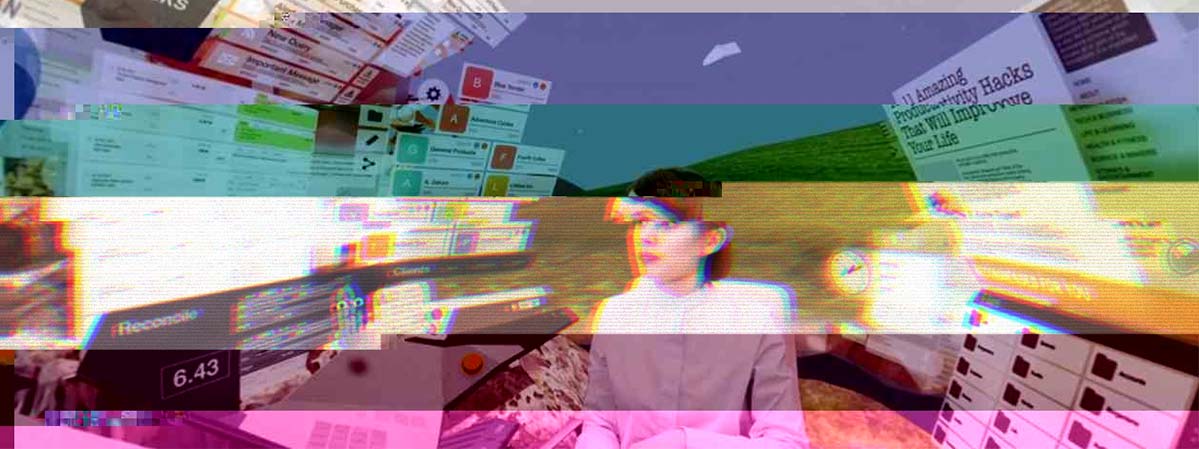
A still from the 360-degree video "Merger" by Keiichi Matsuda
“With automation disrupting centuries-old industries, the professional must reshape and expand their service to add value. Failure is a mindset. It is those who empower themselves with technology who will thrive.
“Merger is a new film about the future of work, from cult director/designer Keiichi Matsuda (HYPER-REALITY). Set against the backdrop of AI-run corporations, a tele-operator finds herself caught between virtual and physical reality, human and machine. As she fights for her economic survival, she finds herself immersed in the cult of productivity, in search of the ultimate interface. This short film documents her last 4 minutes on earth.”

I came across the most recent film by Keichii Matsuda which concerns a possible future of work, with the protagonist embedded in an (aesthetically Microsoft-style) augmented reality of screen-surfaces, and in which the narrative denouement is a sort of trans-human ‘uploading’ moment.

I like Matsuda’s work. i think he skilfully and playfully provokes particular sorts of conversations, mostly about what we used to call ‘immersion’ and the nature of mediation. This has, predictably happened in terms of human vs. AI vs. eschatology (etc etc.) sorts of narratives in various outlets (e.g. the Verge). The first time I encountered his work was at a Passenger Films event at which Rob Kitchin talked about theorisations of mediation in relation to both Matsuda’s work and the (original) Disney film ‘Tron‘.

What is perhaps (briefly) interesting here are two things:

  1. The narrative is a provocative short story that asks us to reflect upon how our world of work and technological development get us from now (the status quo) to an apparent future state of affairs, which carries with it certain kinds of ethical, normative and political contentions. So, this is a story that piggybacks the growing narrative of ‘post-work’ or widespread automation of work by apparently ‘inhuman’ technologies (i.e. A.I) that provokes debate about the roles of ‘technology’ and ‘work’ and what it means to be ‘human’. Interestingly, this (arguably) places “Merger” in the genre of ‘fantasy’ rather than ‘science fiction’ – it is, after all, an eschatological story (I don’t see this final point as a negative). I suppose it could also be seen as a fictional suicide note but I’d rather not dwell on that…
  2. The depiction of the interface and the interaction with the technology-world of the protagonist– and indeed the depiction of these within a 360-degree video –are as important as the story to what the video is signifying. By which I mean – like the videos I called ‘vision videos’ back in 2009/10 (and (in some cases) might be called ‘design fiction’ or ‘diagetic prototypes’) – this video is also trying to show you and perhaps sell you the idea of a technology (Matsuda recently worked for Leap Motion). As I and others have argued – the more familiar audiences are with prospective/speculative technologies the more likely we are (perhaps) to sympathise with their funding/ production/ marketing and ultimately to adopt them.

Bernard Stiegler’s Age of Disruption – out soon

Bernard Stiegler being interviewed

Out next year with Polity, this is one of the earlier of Stiegler’s ‘Anthropocene’ books (in terms of publication in French, see also The Neganthropocene) explicating quite a bit of the themes that come out in the interviews I’ve had a go at translating in the past three years (see: “The time saved through automation must be given to the people”; “How to survive disruption”; “Stop the Uberisation of society!“; and “Only by planning a genuine future can we fight Daesh“). Of further interest, to some, is that it also contains a dialogue with Nancy (another Derrida alumnus). This book is translated by the excellent Daniel Ross.

Details on the Polity website. Here’s the blurb:

Half a century ago Horkheimer and Adorno argued, with great prescience, that our increasingly rationalised and Westernised world was witnessing the emergence of a new kind of barbarism, thanks in part to the stultifying effects of the culture industries. What they could not foresee was that, with the digital revolution and the pervasive automation associated with it, the developments they had discerned would be greatly accentuated and strengthened, giving rise to the loss of reason and to the loss of the reason for living. Individuals are overwhelmed by the sheer quantity of digital information and the speed of digital flows, and profiling and social media satisfy needs before they have even been expressed, all in the service of the data economy. This digital reticulation has led to the disintegration of social relations, replaced by a kind of technological Wild West, in which individuals and groups find themselves increasingly powerless, driven by their lack of agency to the point of madness.
How can we find a way out of this situation? In this book, Bernard Stiegler argues that we must first acknowledge our era as one of fundamental disruption and detachment. We are living in an absence of epokh? in the philosophical sense, by which Stiegler means that we have lost our noetic method, our path of thinking and being. Weaving in powerful accounts from his own life story, including struggles with depression and time spent in prison, Stiegler calls for a new epokh? based on public power. We must forge new circuits of meaning outside of the established algorithmic routes. For only then will forms of thinking and life be able to arise that restore meaning and aspiration to the individual.
Concluding with a substantial dialogue between Stiegler and Jean-Luc Nancy in which they reflect on techniques of selfhood, this book will be of great interest to students and scholars in social and cultural theory, media and cultural studies, philosophy and the humanities generally.

Talk – Plymouth, 17 Oct: ‘New geographies of automation?’

Rachael in the film Blade Runner

I am looking forward to visiting Plymouth (tomorrow) the 17th October to give a Geography department research seminar. It’s been nearly twenty years (argh!) since I began my first degree, in digital art, at Plymouth so I’m looking forward to returning. I’ll be talking about a couple of aspects of ‘The Automative Imagination’ under a slightly different title – ‘New geographies of automation?’ The talk will take in archival BBC and newspaper automation anxieties, management consultant magical thinking (and the ‘Fourth Industrial Revolution’), gendered imaginings of domesticity (with the Jetsons amongst others) and some slightly under-cooked (at the moment) thoughts about how ‘agency’ (what kinds of ‘beings’ or ‘things’ can do what kinds of action).

Do come along if you’re free and happen to be in the glorious gateway to the South West that is Plymouth.

Future of labour governance – a podcast with Jennifer Bair

Glitched Rosie the Riveter poster


From the really interesting Futures of Work journal(?)/project/website…

In a world dominated by the emergence of global supply chains, where the state-based system of labour governance has struggled to deal with the expanding influence of transnational corporations, how can workers resist exploitative labour practices and organise a future (or futures) of regulation that would guarantee decent work for all?
Jennifer Bair joins Huw Thomas in the studio to discuss the challenges and opportunities of cross border labour governance and organisation in the contemporary global economy.

Jennifer Bair – Futures of Work

‘New geographies of automation?’ at the RGS-IBG conference

Industrial factory robot arms

All of a sudden the summer is nearly over, apparently, and the annual conference of the Royal Geographical Society with the Institute of British Geographers is fast approaching, this year in Cardiff.

I am convening a double session on the theme of ‘New geographies of automation?’, with two sessions of papers by some fantastic colleagues that promise to be really interesting. I am really pleased to have this opportunity to invite colleagues to collectively bring their work into conversation around a theme that is not only a contemporary topic in academic work but also, significantly, a renewed topic of interest in the wider public.

There are two halves of the session, broadly themed around ‘autonomy’ and ‘spacings’. Please find below the abstracts for the session.

Details: Sessions 92 & 123 (in slots 3 & 4 – 14:40-16:20 & 16:50-18:30) | Bates Building, Lecture Theatre 1.4

This information is also accessible, with all of the details of venue etc., on the RGS-IBG conference website: session 1 ‘autonomy’ and session 2 ‘spacings’.

New Geographies of Automation? (1): Autonomy

1.1 An Automative Imagination

Samuel Kinsley, University of Exeter

This paper sets out to review some of the key ways in which automation gets imagined – the sorts of cultural, economic and social forms of imagination that are drawn upon and generated when discussing how automation works and the kinds of future that may come as a result. The aim here is not to validate/invalidate particular narratives of automation – but instead to think about how they are produced and what they tell us about how we tell stories about what it means to be ‘human’, who/what has agency and what this may mean for how we think politically and spatially. To do this the concept of an ‘automative imagination’ is proposed as a means of articulating these different, sometimes competing – sometimes complementary, orientations towards automation.


1.2 The Future of Work: Feminist Geographical Engagements

Julie MacLeavy (Geographical Sciences, University of Bristol)

This paper considers the particular pertinence of feminist geographical scholarship to debates on the ‘future of work’. Drawing inspiration from Linda McDowell’s arguments that economic theories of epochal change rest on the problematic premise that economic and labour market changes are gender-neutral, it highlights the questions that are emerging from feminist economic geography research and commentary on the reorganisation of work, workers’ lives and labour markets. From this, the paper explores how feminist and anti-racist politics connect with the imagination of a ‘post-work’ world in which technological advancement is used to enable more equitable ways of practice (rather than more negative effects such as the intensification of work lifestyles). Political responses to the critical challenges that confront workers in the present moment of transformation are then examined, including calls for Universal Basic Income, which has the potential to reshape the landscape of labour-capital relations.


1.3 Narrating the relationship between automation and the changing geography of digital work

Daniel Cockayne, Geography and Environmental Management, University of Waterloo

Popular narratives about the relationship between automation and work often make a straightforward causal link between technological change and deskilling, job loss, or increased demand for jobs. Technological change – today, most commonly, automation and AI – is often scripted as threatening the integrity of labor, unionization, and traditional working practices or as creating more demand for jobs, in which the assumption is the more jobs the better. These narratives elide a close examination of the politics of work that include considerations of domestic and international racialized and gendered divisions of labor. Whether positive or negative, the supposed inevitability of technological transition positions labor as a passive victim of these changes, while diverting attention away from the workings of international financialized capital. Yet when juxtaposed against empirical data, straightforward cause and effect narratives become more complex. The unemployment rate in North America has been the lowest in 40 years (4.1% in the USA and 5.7% in Canada), which troubles the relationship between automation and job loss. Yet, though often touted by publications like The Economist as a marker of national economic well-being, unemployment rates ignore the kinds of work people are doing, effacing the qualitative changes in work practices over time. I examine these tropes and their relationship to qualitative changes in work practices, to argue that the link between technological change and the increasing precaratization of work is more primary than the diversionary relationship between technological change and job loss and gain or deskilling. 


1.4 Sensing automation

David Bissell, University of Melbourne

Processes of industrial automation are intensifying in many sectors of the economy through the development of AI and robotics. Conventional accounts of industrial automation stress the economic imperatives to increase economic profitability and safety. Yet such coherent snapped-to-grid understandings risk short-circuiting the complexity and richness of the very processes and events that compose automation. ­­­This paper draws from and reflects through a series of encounters with workers engaged in the increasingly automated mining sector in Australia. Rather than thinking these encounters solely through their representational dimensions with an aim to building a coherent image of what automation is, this paper is an attempt at writing how automation becomes differently disclosed through the aesthetic dimensions of encounters. It acknowledges how automation is always caught up in multiple affective and symbolic ecologies which create new depths of association. Developing post-phenomenological thought in cultural geography, this paper articulates some of the political and ethical stakes for admitting ambiguity, incoherence and confusion as qualities of our relations with technological change.


1.5 Technological Sovereignty, Post-Human Subjectivity, and the Production of the Digital-Urban Commons

Casey Lynch (School of Geography and Development, University of Arizona)

 As cities become increasingly monitored, planned, and controlled by the proliferation of digital technologies, urban geographers have sought to understand the role of software, big data, and connected infrastructures in producing urban space (French and Thrift 2002; Dodge, Kitchin, and Zook, 2009). Reflections on the “automatic production of space” have raised questions about the role and limitations of “human” agency in urban space (Rose 2017) and the possibilities for urban democracy. Yet, this literature largely considers the proliferation of digital infrastructures within the dominant capitalist, smart-city model, with few discussions of the possibilities for more radically democratic techno-urban projects. Engaging these debates, this paper considers alternative models of the techno-social production of urban space based around the collective production and management of a common digital-urban infrastructure. The paper reflects on the notion of “technological sovereignty” and the case of Guifinet, the world’s largest “community wireless network” covering much of Catalonia.  The paper highlights the way its decentralized, DIY mode of producing and maintaining digital urban infrastructure points to the possibilities for more radically democratic models of co-production in which urban space, technological infrastructures, and subjectivities are continually reshaped in relation. Through this, the paper seeks to contribute to broader discussions about the digitalization of urban space and the possibilities for a radical techno-politics.  

New Geographies of Automation? (2): Spacings

2.1 The urbanisation of robotics and automated systems – a research agenda
Andy Lockhart* (a.m.lockhart@sheffield.ac.uk), Aidan While* (a.h.while@sheffield.ac.uk), Simon Marvin (s.marvin@sheffield.ac.uk), Mateja Kovacic (m.kovacic@sheffield.ac.uk), Desiree Fields (d.fields@sheffield.ac.uk) and Rachel Macrorie (r.m.macrorie@sheffield.ac.uk) (Urban Institute, University of Sheffield)
*Attending authors
Pronouncements of a ‘fourth industrial revolution’ or ‘second machine age’ have stimulated significant public and academic interest in the implications of accelerating automation. The potential consequences for work and employment have dominated many debates, yet advances in robotics and automated systems (RAS) will have profound and geographically uneven ramifications far beyond the realm of labour. We argue that the urban is already being configured as a key site of application and experimentation with RAS technologies. This is unfolding across a range of domains, from the development of autonomous vehicles and robotic delivery systems, to the growing use of drone surveillance and predictive policing, to the rollout of novel assistive healthcare technologies and infrastructures. These processes and the logics underpinning them will significantly shape urban restructuring and new geographies of automation in the coming years. However, while there is growing research interest in particular domains, there remains little work to date which takes a more systemic view. In this paper we do three things, which look to address this gap and constitute the contours of a new urban research agenda. First, we sketch a synoptic view of the urbanisation of RAS, identifying what is new, what is being enabled as a result and what should concern critical scholars, policymakers and the wider public in debates about automation. Second, we map out the multiple and sometimes conflicting rationalities at play in the urbanisation of RAS, which have the potential to generate radically different urban futures, and may address or exacerbate existing socio-spatial inequalities and injustices. Third, and relatedly, we pose a series of questions for urban scholars and geographers, which constitute the basis for an urgent new programme of research and intervention.


2.2 Translating the signals: Utopia as a method for interrogating developments in autonomous mobility

Thomas Klinger1, 2
Brendan Doody2
Debbie Hopkins2
Tim Schwanen2
1. Institute of Human Geography, Goethe-University Frankfurt am Main
2. School of Geography and the Environment, University of Oxford

Connected and autonomous vehicles (CAVs) are often presented as technological ‘solutions’ to problems of road safety, congestion, fuel economy and the cost of transporting people, goods and services. In these dominant techno-economic narratives ‘non-technical’ factors such as public acceptance, legal and regulatory frameworks, cost and investment in testing, research and supporting infrastructure are the main ‘barriers’ to the otherwise steady roll-out of CAVs. Drawing on an empirical case study of traffic signalling, we trace the implications that advances in vehicle autonomy may have for such mundane and taken-for-granted infrastructure. We employ the three modes of analysis associated with Levitas’ (2013) ‘utopia as a method’. Starting with the architectural mode we identify the components, actors and visions underpinning ‘autonomobility’. The archaeological mode is then used to unpack the assumptions, contradictions and possible unintended effects that CAVs may have for societies. In the ontological mode we speculate upon the types of human and non-human subjectivities and agencies implied by alleged futures of autonomous mobility. Through this process we demonstrate that techno-economic accounts overemphasise the likely scale, benefits and impacts these advances may have for societies. In particular, they overlook how existing automobile-dependent mobility systems are the outcome of complex assemblages of social and technical elements (e.g., cars, car-drivers, roads, petroleum supplies, novel technologies and symbolic meanings) which have become interlinked in systemic and path-dependent ways over time. We conclude that utopia as method may provide one approach by which geographers can interrogate and opening up alarmist/boosterish visions of autonomobility and automation.


2.3 Automating the laboratory? Folding securities of malware
Andrew Dwyer, University of Oxford
andrew.dwyer@cybersecurity.ox.ac.uk

Folding, weaving, and stitching is crucial to contemporary analyses of malicious software; generated and maintained through the spaces of the malware analysis laboratory. Technologies entangle (past) human analysis, action, and decision into ‘static’ and ‘contextual’ detections that we depend on today. A large growth in suspect software to draw decisions on maliciousness have driven a movement into (seemingly omnipresent) machine learning. Yet this is not the first intermingling of human and technology in malware analysis. It draws on a history of automation, enabling interactions to ‘read’ code in stasis; build knowledges in more-than-human collectives; allow ‘play’ through a monitoring of behaviours in ‘sandboxed’ environments; and draw on big data to develop senses of heuristic reputation scoring.

Though we can draw on past automation to explore how security is folded, made known, rendered as something knowable: contemporary machine learning performs something different. Drawing on Louise Amoore’s recent work on the ethics of the algorithm, this paper queries how points of decision are now more-than-human. Automation has always extended the human, led to loops, and driven alternative ways of living. Yet the contours, the multiple dimensions of the neural net, produce the malware ‘unknown’ that have become the narrative of the endpoint industry. This paper offers a history of the automation of malware analysis from static and contextual detection, to ask how automation is changing how cyberspace becomes secured and made governable; and how automation is not something to be feared, but tempered with the opportunities and challenges of our current epoch.


2.4 Robots and resistance: more-than-human geographies of automation on UK dairy farms

Chris Bear (Cardiff University; bearck@cardiff.ac.uk)
Lewis Holloway (University of Hull; l.holloway@hull.ac.uk)

This paper examines the automation of milking on UK dairy farms to explore how resistance develops in emerging human-animal-technology relations. Agricultural mechanisation has long been celebrated for its potential to increase the efficiency of production. Automation is often characterised as continuing this trajectory; proponents point to the potential for greater accuracy, the removal of less appealing work, the reduction of risks posed by unreliable labour, and the removal of labour costs. However, agricultural mechanisation has never been received wholly uncritically; studies refer to practices of resistance that have developed due to fears around (for instance) impacts on rural employment, landscapes, ecologies and traditional knowledge practices. Drawing on interviews with farmers, observational work on farms and analysis of promotional material, this paper examines resistant relations that emerge around the introduction of Automated Milking Systems (AMS) on UK dairy farms. While much previous work on resistance to agricultural technologies has pitted humans against machines, we follow Foucault in arguing that resistance can be heterogeneous and directionally ambiguous, emerging through ‘the capillary processes of counter-conduct’ (Holloway and Morris 2012). These capillary processes can have complex geographies and emerge through more-than-human relations. Where similar conceptualisations have been developed previously, technologies continue to appear rather inert – they are often the tools by which humans attempt to exert influence, rather than things which can themselves ‘object’ (Latour 2000), or which are co-produced by other nonhumans rather than simply imposed or applied by humans. We begin, therefore, to develop a more holistic approach to the geographies of more-than-human resistance in the context of automation.


2.5 Fly-by-Wire: The Ironies of Automation and the Space-Times of Decision-Making

Sam Hind (University of Siegen; hind@locatingmedia.uni-siegen.de)

This paper presents a ‘prehistory’ (Hu 2015) of automobile automation, by focusing on ‘fly-by-wire’ control systems in aircraft. Fly-by-wire systems, commonly referred to as ‘autopilots’ work by translating human control gestures into component movements, via digital soft/hardware. These differ historically from mechanical systems in which pilots have direct steering control through a ‘yoke’ to the physical components of an aircraft (ailerons etc.), via metal rods or wires. Since the launch of the first commercial aircraft with fly-by-wire in 1988, questions regarding the ‘ironies’ or ‘paradoxes’ of automation (Bainbridge 1983) have continued to be posed. I look at the occurrence of ‘mode confusion’ in cockpits to tease out one of these paradoxes; using automation in the aviation industry as a heuristic lens to analyze automation of the automobile. I then proceed by detailing a scoping study undertaken at the Geneva Motor Show in March this year, in which Nissan showcased an autonomous vehicle system. Unlike other manufacturers, Nissan is pitching the need for remote human support when vehicles encounter unexpected situations; further complicating and re-distributing navigational labour in, and throughout, the driving-machine. I will argue that whilst such developments plan to radically alter the ‘space-times of decision-making’ (McCormack and Schwanen 2011) in the future autonomous vehicle, they also exhibit clear ironies or paradoxes found similarly, and still fiercely discussed, in the aviation industry and with regards to fly-by-wire systems. It is wise, therefore, to consider how these debates have played out – and with what consequences.

‘Recognition’ for peer review

A glitched image of a typewriter

I must confess. I did that lazy thing by asking on Twitter for something perhaps I could’ve found out with a little more effort (I have also been relatively lax at actually writing this blogpost about it!). However, it actually resulted in something interesting. 

I had just completed a (peer) review for a journal published by Sage and was asked if I wanted to sign up for “Publons” a system that supposedly let you gain ‘recognition’ for your peer reviewing. So, I did sign up but then thought: “hang on…” and this prompted by question on Twitter:

Click through to read the replies. It’s a great sharing of knowledge and expertise around the process of peer review, with plenty of contributions from colleagues with positions as editor in various journals. For example, this from Martin Coward begins to get at some of the issues.

I won’t try to summarise, or indeed embed, all of the things that were said, please do click through for the whole exchange. I do want to, very briefly, reflect upon this longstanding concern with making peer review ‘work’. The concerns that “Publons” purports to address are real. Peer review is the life-blood of academic publishing but is assumed, rather under-valued (by publishers, some colleagues and institutions) and, it seems, the constant frustration of editorial board members. As my former colleague Prof. Martin Weller has observed this labour represents rather a lot of unrecognised and under-appreciated investment.

An attempted ‘technological fix’ is, of course, not new. There have been various attempts to think about this over the years. When I was working with Martin on ‘digital scholarship’ (see his excellent open access book) the trial of an ‘open’ peer review system for Nature was a relatively recent talking point. 

It is not a novel argument but it seems to me that unless and until academics, publishers and institutions stop thinking about lots of forms of labour as a part of a perceived ‘exceptionalism’ and ‘privilege’ of academic life (which I think, if it did ever exist for a few people, is long gone) we are more-or-less doomed to rehearse this debate ad infinitum.