AI Is Pushing Climate Goals Out of Reach

Not new news, but yet another report has stated what is becoming increasingly obvious – the UN Climate Goals, the UN SDGs and the ongoing expansion of energy & water hungry data centres are mutually exclusive.

Without a big increase in investment in renewable energy globally, humanity will not limit global temperature rise to 2 degrees Celsius, but much of the data center boom is powered by fossil fuels.
…

Data center energy demand “is threatening to sabotage the country’s already faltering climate goals,” wrote John Fleming and Jean Su, with the Center for Biological Diversity, in a report published Wednesday. Fleming and Su found that, if AI data centers powered by fossil fuels grow as forecasted, all other sectors of the U.S. economy would need to cut emissions by 60 percent in order for the U.S. to meet its emissions targets.

Jake Bolster – Inside Climate News

Living next to Meta’s data centres

Facebook logo reflected in a human eye

This video, made and shared by the activist group More Perfect Union, offers some ‘real world’ insights into what it is like living next to a huge data centre, in this case one of Meta’s. The resources these things require and the material effects that has on the surrounding communities are issues that perhaps deserve more critical public attention.

Artist talk at The Photographers’ Gallery

A glitched photograph of someone inspecting photographic negatives on a light table

Via Prof. Geoff Cox on LinkedIn:

The Hypothetical Image: Reading the Artifacts of Generative AI

How might we “read” the media produced by generative artificial intelligence? Eryk Salvaggio suggests we engage them as infographics: data visualisations of archives and datasets that strives for plausibility rather than expression or documentation. 

In a presentation blending artistic research into images, video, and sound, Salvaggio will examine the ways artists can hijack the spectacle of AI to engage more critically with its politics and dangers of AI ordering the world on our behalf.

Eryk Salvaggio is a blend of artist, hacker and policy researcher interested in the social and cultural impacts of artificial intelligence. His work explores the creative misuse of AI and reflects on how AI changes our definitions of the human. His award-winning work has been exhibited on four continents, including The New Museum and SXSW. He is a researcher with the metaLab at Harvard University, a Tech Policy Press Fellow, and a visiting professor at the Rochester Institute of Technology (USA) in Humanities, Computing & Design.

The event is organized in collaboration with the Digital x Data Research Centre at London South Bank University.

More information and bookings here

How tech companies (still) hide outsourcing

Silhouetted human figures behind a curtain with shining abstract representations of human heads superimposed on top

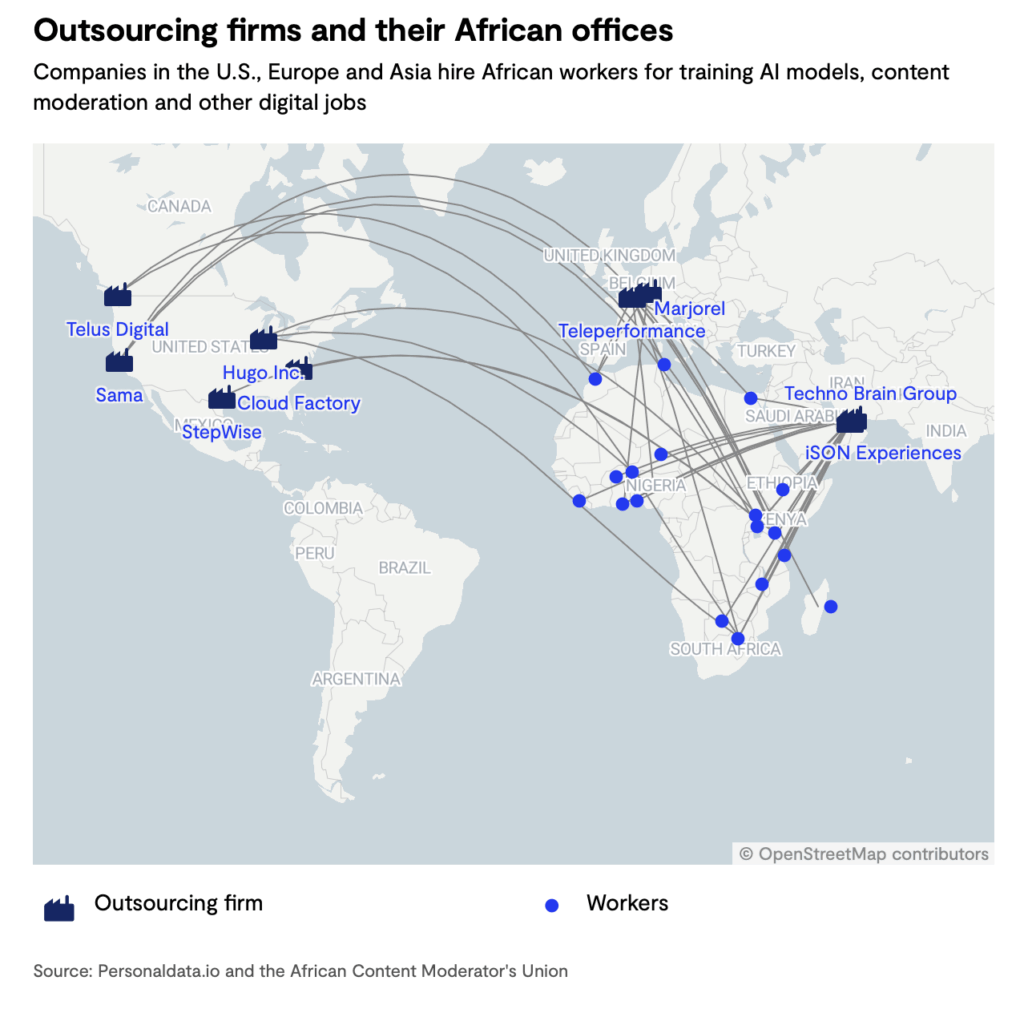
On the news site Rest of the World, there is a really interesting piece by Stephanie Wangari and Gayathri Vaidyanathan concerning research conducted by the African Content Moderators Union (ACMU) and Switzerland-based nonprofit, Personaldata.io that details the ways in which African workers are indirectly employed in the tech sector, doing content moderation, customer service, and data annotation for AI models, among other jobs. 

A new dataset, visualized as maps, reveals the extent to which African workers are indirectly employed in the tech sector, doing content moderation, customer service, and data annotation for AI models, among other jobs. 

READ THE WHOLE ARTCLE

Job opportunities- “AI+ fellowships” at KCL

Still from the video for All is Love by Bjork

While rest of academia is struggling there are opportunities in the areas attracting “strategic” investment. King College London are one of many universities rushing to catch up with the AI juggernaut and there are some pretty exciting job opportunities as a result, full details here:

https://www.kcl.ac.uk/jobs/role/kings-ai-academic-fellowships

King’s is delighted to announce this prestigious new Academic Fellowship scheme for 20 outstanding researchers focused on AI development and application across all disciplines, including health, bioscience, physical sciences, social sciences, security, humanities, business and law.

This is for five years, with minimal teaching, leading to a full position. For those able to make a case around AI research this is a pretty good deal (for the U.K.).

I hope that people conducting research in the social sciences are considered and that there are researchers not only jumping on the bandwagon but genuinely getting to grips with the messy realities of AI who go for these positions. Goodness knows we need that kind of research.

AI Now’s Data Genesis programme – job opportunity

Facial tracking system, showing gaze direction, emotion scores and demographic profiling

The excellent AI Now institute have announced a fantastic new project titled ‘Data Genesis’ – I’ve copied some details below. Importantly – there are jobs, so – if you think you might fit the bill then apply!

 AI Now Institute has been developing new approaches to study and understand the role of training data in the machine learning field. Key research questions include: What type of information is used as training data? Who generates and collects it and for what purpose? What segments of society does it reflect? Who and what does it exclude? And how does that affect the functioning of AI systems themselves?

The Data Genesis program’s goal is to answer and demystify these questions through three core components:

  • Archiving and analyzing the origin and construction of key datasets that serves as foundations for today’s AI systems;
  • Producing visualizations, maps, and other designs to help crystallize and contextualize what this data is and what it means to communities, practitioners, companies, and policymakers; and
  • Convening experts from across disciplines to help build a field around this topic.

The rapid proliferation of AI into various social and political contexts demands a thorough understanding of the data that these systems are trained on, including the biases and flaws this data may encode. Our Data Genesis program will investigate the complex foundation on which AI is built and will call into question the perception of AI as a magical force that is superior to human judgement.

Check out the jobs associated with the project here.

Geographies of/with AI at the RGS-IBG conference this week

Kitt the 'intelligent' car from the TV show Knight Rider

As we race headlong towards September and another term (in the UK), it is the week of the RGS-IBG annual international conference in geographyland. At this year’s conference I am convening a double session with a really interesting and diverse range of papers concerning the intersections of geography and artificial intelligence. The sessions are on Thursday starting at 14:20 and ending at 18:30 with a 20 minute coffee break.

The sessions are: 235 and 268, details below:

235 Geographies of/with Artificial intelligence (1): Spacings

  1. Automating production of the built urban environment: tracing the role of BIM modelling, VR and automated prefabrication in the UK housing sector – Rachel Macrorie (University of Sheffield, UK)
  2. AI/Machine Learning algorithms in public participation– Yu-Shan Tseng (Durham University, UK)
  3. The algorithmic production of space in the age of machine learning: the case of self-driving vehicles– Fabio Iapaolo (Polytechnic University of Turin, Italy)
  4. Facial Recognition and the Automation of Security/Marketing Assemblages: Geographies of Anxiety and Pleasure in Music Festivals- Harrison Smith (Newcastle University, UK), Jeremy Crampton (Newcastle University, UK), Kara C. Hoover (University of Alaska, Fairbanks, USA), J. Colette Berbesque (Roehampton University, UK)

268 Geographies of/with Artificial intelligence (2): Working

  1. “Hey Alexa, why are you gendered?” Automation in the home and emotional labour – Sam Kinsley (University of Exeter, UK)
  2. Cooked with care or a raw deal?: One geographer’s explorations of AI and machine learning from below in London’s gig-economy – Adam Badger (Royal Holloway, University of London, UK)
  3. Workplace Surveillance by AI: it’s for your own good? – Philip Garnett (University of York, UK)
  4. Link NYC and the performative geopolitics of ‘automation’ – Nathaniel O’Grady (University of Manchester, UK)

Please do come and check out the sessions on Thursday – we’ll be in the Sheffield Building (Number 20 on this map).