“algorithmic governance” – recent ‘algorithm’ debates in geography-land

Over on Antipode’s site there’s a blog post about an intervention symposium on “algorithmic governance” brought together by Jeremy Crampton and Andrea Miller, on the back of sessions at the AAG in 2016. It’s good that this is available open access and, I hope, helpful that it maybe puts to bed some of the definition wrangling that has been the fashion. Obviously, a lot draws on the work of geographer Louise Amoore and also of political theorist Antoinette Rouvroy, which is great.

Reading through the overview and skimming the individual papers provokes me to comment that I remain puzzled though by the wider creeping use of an unqualified “non-human” to talk about software and the sociotechnical systems they run/are run on… this seems to play-down precisely the political issues raised in this particular symposium – that the kinds algorithms concerned in this debate are written and maintained by people, they’re not somehow separate or at a distance… It’s also interesting to note that a sizeable chunk of the debates concern ‘data’ but the symposium doesn’t have “data” in the title, but maybe ‘data–’ is passé… 🙂

I’ve copied below the intro to the post, but please check out the whole thing over on Antipode’s site.

Intervention Symposium: “Algorithmic Governance”; organised by Jeremy Crampton and Andrea Miller

The following essays first came together at the 2016 AAG Annual Meeting in San Francisco. Jeremy Crampton (Professor of Geography at the University of Kentucky) and Andrea Miller (PhD candidate at University of California, Davis) assembled five panellists to discuss what they call algorithmic governance – “the manifold ways that algorithms and code/space enable practices of governance that ascribes risk, suspicion and positive value in geographic contexts.”

Among other things, panellists explored how we can best pay attention to the spaces of governance where algorithms operate, and are contested; the spatial dimensions of the data-driven subject; how modes of algorithmic modulation and control impact understandings of categories such as race and gender; the extent to which algorithms are deterministic, and the spaces of contestation or counter-algorithms; how algorithmic governance inflects and augments practices of policing and militarization; the most productive theoretical tools available for studying algorithmic data; visualizations such as maps being implicated by or for algorithms; and the genealogy of algorithms and other histories of computation.

Three of the panellists plus Andrea and Jeremy present versions of these discussions below, following an introduction to the Intervention Symposium from its guest editors (who Andy and Katherine at Antipode would like to thank for all their work!).

Read the whole post and see the contributions to the symposium on the Antipode site.

Reblog> Workshop: Reshaping Cities through Data and Experiments

Smart City visualisation

This looks interesting (via Programmable City):

Workshop: Reshaping Cities through Data and Experiments

When: 30th May 2017 – 9.30am to 3.30pm
Where: Maynooth University, Iontas Building, Seminar Room 2.31

The “Reshaping Cities through Data and Experiments” workshop is part of the Ulysses research exchange programme jointly funded by Irish Research Council and the Ambassade de France. It is organized in collaboration with researchers from the Centre de Sociologie de l’Innovation (i3-CSI) at the École des Mines in Paris – David Pontille, Félix Talvard, Clément Marquet and Brice Laurent – and researchers from the National Institute for Regional and Spatial Analysis (NIRSA) in Maynooth University, Ireland – Claudio Coletta, Liam Heaphy and Sung-Yueh Perng.

The aim is to initiate a transdisciplinary discussion on the theoretical, methodological and empirical issues related to experimental and data-driven approaches to urban development and living. This conversation is vital in a time when cities are increasingly turning into public-private testbeds and living labs, where urban development projects merge with the design of cyber-infrastructures to test new services and new forms of engagement for urban innovation and economic development. These new forms of interaction between algorithms, planning practices and governance processes raise crucial questions for researchers on how everyday life, civic engagement and urban change are shaped in contemporary cities.

Read the full blogpost on the Programmable City site.

A Universe Explodes. A Blockchain book/novel

Blockchain visualisation

Thanks to Max Dovey for the tip on this…

This seems interesting as a sort of provocation about what Blockchain says/asks about ownership perhaps, although I’m not overly convinced by the gimmick of changing words such that the readers unravel, or “explode” the book… I wonder whether The Raw Shark Texts  or These Pages Fall Like Ash might be a deeper or maybe I mean more nuanced take on such things… however, I haven’t explored this enough yet and it’s good to see Google doing something like this (I think?!)

Here’s a snip from googler tea uglow’s medium post about this…

It’s a book. On your phone. Well, on the internet. Anyone can read it. It’s 20 pages long. Each page has 128 words, and there are 100 of the ‘books’ that can be ‘owned’ . And no way to see a book that isn’t one of those 100. Each book is unique, with personal dedications, and an accumulation of owners, (not to mention a decreasing number of words) as it is passed on. So it is both a book and an cumulative expression of the erosion of the self and of being rewritten and misunderstood. That is echoed in the narrative: the story is fluid, the transition confusing, the purpose unclear. The book gradually falls apart in more ways than one. It is also kinda geeky.

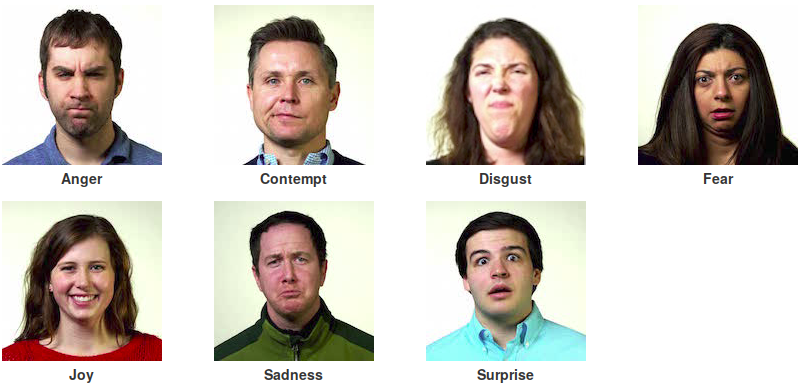
Choose how you feel, you have seven options

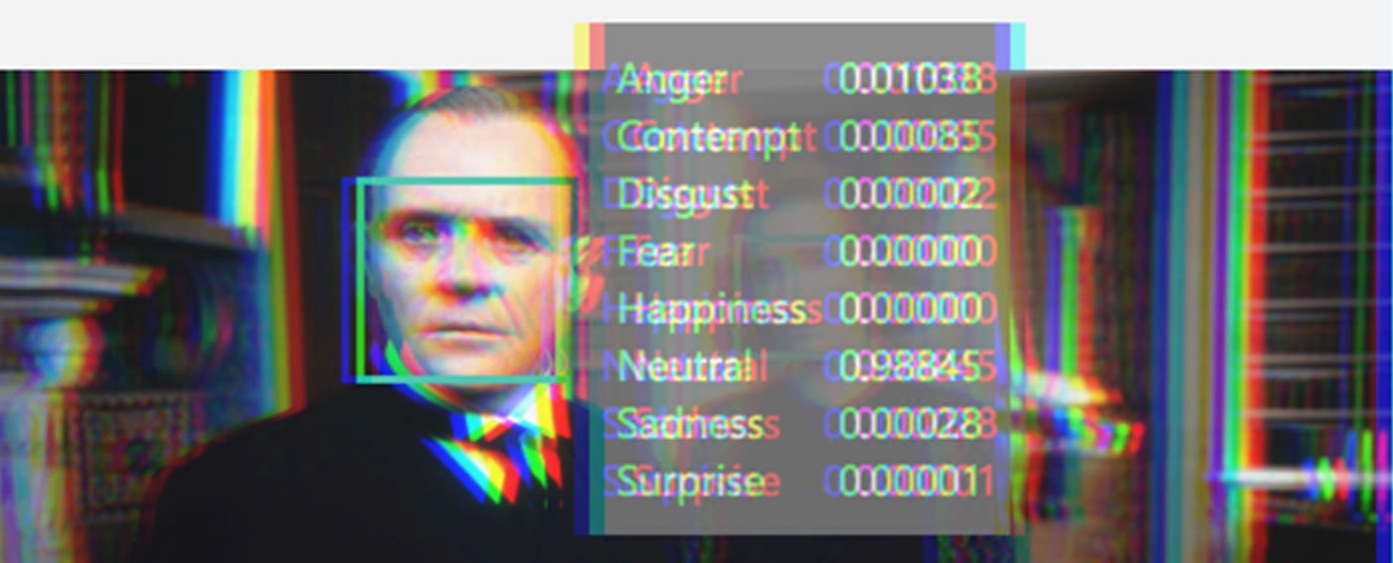
A great piece by Ruben Van de Ven stemming from his artwork of the same name, published on the Institute of Network Culture site. Van de Ven, in a similar vein to Will Davies, deconstructs the logic of ‘affective’ computing, sentiment analysis and their application to what has been termed the ‘attention economy’. The article does a really go job of demonstrating how the knowledge claims, and the epistemologies (perhaps ontologies too), that are at work behind these technologies are (of course) deeply political in their application. Very much worth reading! (snippet below).

 ‘Weeks ago I saw an older woman crying outside my office building as I was walking in. She was alone, and I worried she needed help. I was afraid to ask, but I set my fears aside and walked up to her. She appreciated my gesture, but said she would be fine and her husband would be along soon. With emotion enabled (Augmented Reality), I could have had far more details to help me through the situation. It would have helped me know if I should approach her. It would have also let me know how she truly felt about my talking to her.’

FOREST HANDFORD

This is how Forest Handford, a software developer, outlines his ideal future for a technology that has emerged over the past years. It is known as emotion analysis software, emotion detection, emotion recognition or emotion analytics. One day, Hartford hopes, the software will aid in understanding the other’s genuine, sincere, yet unspoken feelings (‘how she truly felt’). Technology will guide us through a landscape of emotions, like satellite navigation technologies guide us to destinations unknown to us: we blindly trust the route that is plotted out for us. But in a world of digitized emotions, what does it mean to feel 63% surprised and 54% joyful?

Please take the time to read the whole article.

Reblog> Workshop on Security and the Political Turn in the Philosophy of Technologies

An interesting event blogged by Peter-Paul Verbeek:

Workshop ‘Security and the Political Turn in the Philosophy of Technologies’, University of Twente | DesignLab, March 10 2017. How to understand the political significance of things? And how to deal with the politics of technology in a responsible way? Ever since Langdon Winner claimed in the early 1980s that “artifacts have politics”, these questions have been puzzling philosophers and ethicists of technology. Technologies are not just instruments for humans to do politics but actively shape politics themselves. In this workshop we will explore various dimensions of this political role of technologies, especially with regards to security, citizenship in a technological world, and the role of social media and ‘fake news’ in contemporary democracy.

Speakers include:

  • Babette Babich (Fordham)
  • Robin James (UNCC),
  • Laura Fichtner (TUD)
  • Wolter Pieters (TUD)
  • Melis Bas (UT)
  • Jonne Hoek (UT)
  • Philip Brey (UT)
  • Nolen Gertz (UT)
  • Michael Nagenborg (UT)
  • Peter-Paul Verbeek (UT)

The workshop is sponsored by the 4TU.Ethics working group on “Risk, Safety, and Security.”

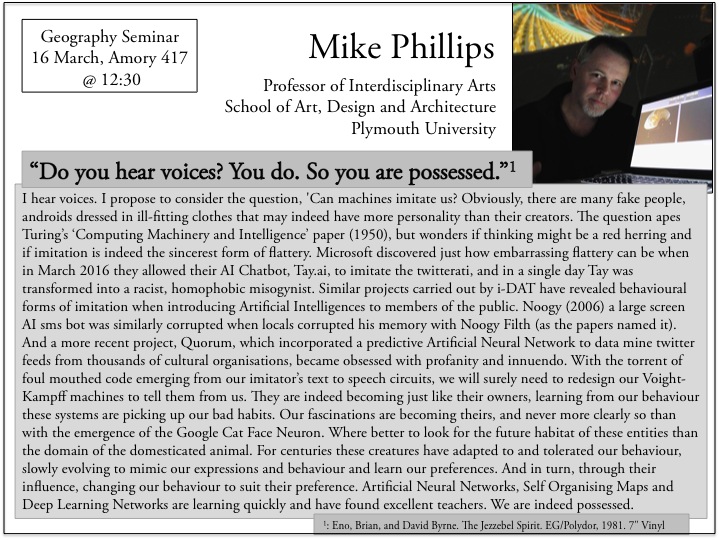
“Do you hear voices? You do. So you are possessed” – @mikedotphillips talk @exetergeography

I’m really pleased to share that Prof. Mike Phillips (i-DAT, Plymouth) will be speaking  next week as part of the Exeter Geography seminar series. Mike is a founder of the Institute of Digital Art and Technology and one of the founders of the undergraduate programme I studied MediaLab Arts, which is now called  Digital Media Design.

Details: Thursday 16th March, 12:30: Amory 417. All welcome!

Reblog> Book Launch: Playful Mapping in the Digital Age

Via Institute of Network Cultures.

Generally wary of anything with “digital age” in the title, but good to see some geographers featuring in ‘digital cultures’ type networks…

Book Launch Playful Mapping in the Digital Age

MONDAY 13TH OF MARCH, 17:00 – 18:15 @SPUI25, AMSTERDAM.

With keynote lectures by Michiel de Lange and, Emma Fraser and Clancy Wilmott.

From Mah-Jong to the introduction of Prussian war-games, through to the emergence of location-based play: maps and play share a long and diverse history. In this programme, we will launch the book Playful Mapping in The Digital Age, which shows how playing and mapping can be liberating, dangerous, subversive and, performative.

>> Sign up here.

Playful Mapping in the Digital Age shows how mapping and playing unfold in the digital age and in which ways the relations between these apparently separate tropes are increasingly woven together. Fluid networks of interaction have encouraged a proliferation of hybrid forms of mapping and playing. A rich plethora of contemporary case-studies, ranging from fieldwork, golf, activism and automotive navigation to pervasive and desktop-based games, emphasizes this trend. Examining these cases shows how mapping and playing can form productive synergies, but also encourages new ways of being, knowing and shaping our everyday lives. This afternoon, the Members of the Playful Mapping Collective explore how play can be more than just an object or practice, and instead focus on its potential as a method for understanding maps and spatiality.

Echoborg

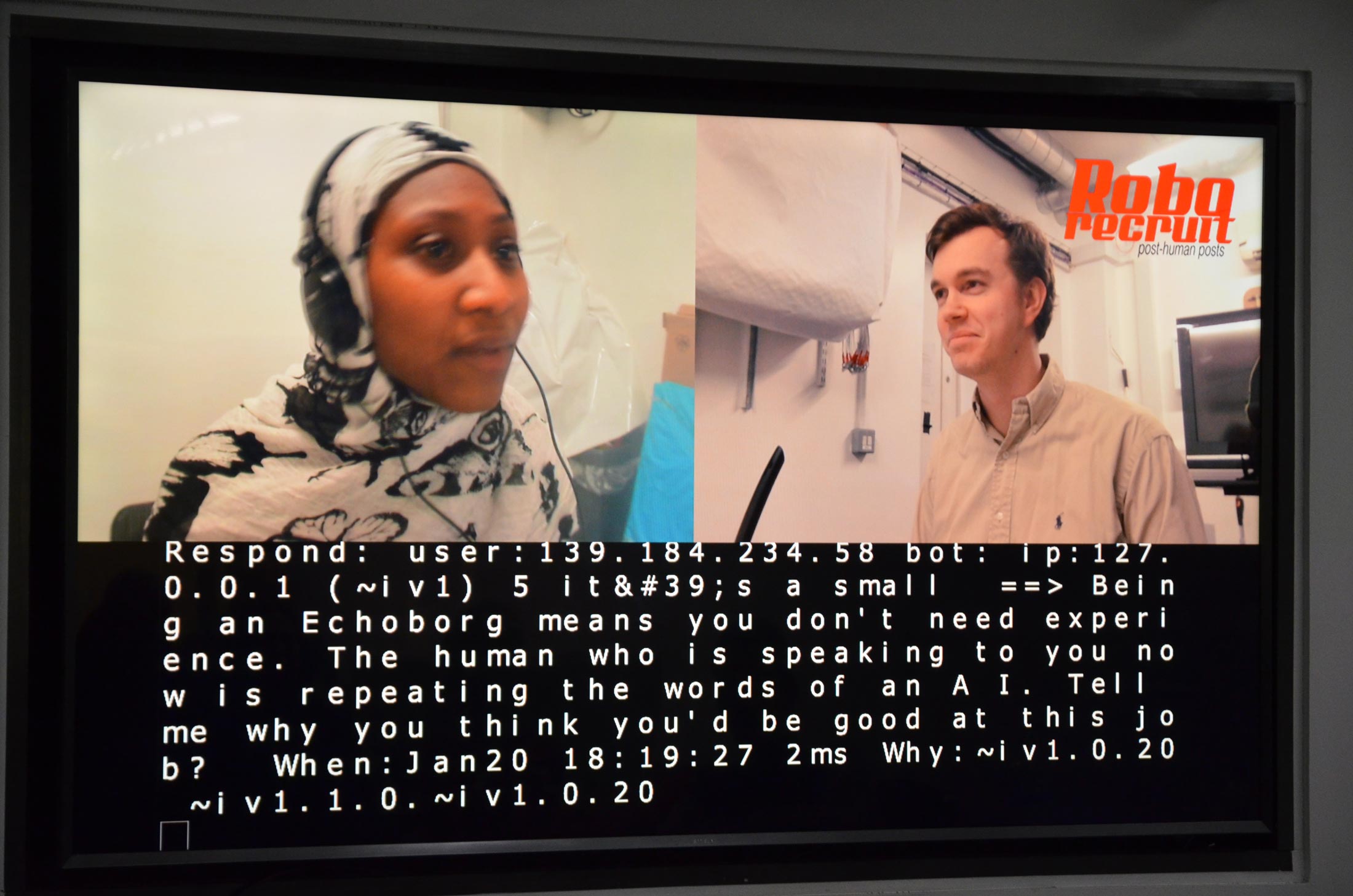
Former colleagues of mine at UWE are developing an interesting project, which you may have seen/heard about through the BBC’s Click programme, called Echoborg.

An echoborg is a hybrid agent composed of the body of a real person and the “mind” (or, rather, the words) of a conversational agent; the words the echoborg speaks are determined by the conversational agent, transmitted to the person via a covert audio-relay apparatus, and articulated by the person through speech shadowing[1].

Recently, the project team have demoed the project as part of an AHRC-funded network on Automation Anxiety and have written this up on the project website, here’s a snippet – it sounds like it is really compelling (I’ve not seen this in action):

Four people were interviewed by the AI which increasingly displayed an interest in eliciting help to reprogram itself. Proceedings were visible on a projector screen and the ‘audience’ of applicants gradually began to discuss the situation of the Echoborg and how to change it. At a certain point their reflections passed a threshold and the group fired into collective action, experimenting with various methods to bring the situation to a head in some way. The lively inventiveness of the group and the individual interviewees went a long way to confirming the interactive potential of this format of the work. It also gave Rik and Phil much to work with in considering the further development of the AI/Chatbot, the restricted delivery of narrative by the human Echoborg and the staging. This event also trialled a secondary, higher level, Echoborg character as part of the slow process of unfolding the potential for this Echoborg recruitment event to be a disruptive and thought and emotion provoking experience for all players.

Notes

  1. Corti, Kevin and Gillespie, Alex (2015) Offscreen and in the chair next to you: conversational agents speaking through actual human bodies. Lecture Notes in Computer Science, 9238 . pp. 405-417.

Reblog> Social Justice in an Age of Datafication: Launch of the Data Justice Lab

Via The Data Justice Lab.

Social Justice in an Age of Datafication: Launch of the Data Justice Lab

The Data Justice Lab will be officially launched on Friday, 17 March 2017. Join us for the launch event at Cardiff University’s School of Journalism, Media and Cultural Studies (JOMEC) at 4pm. Three international speakers will discuss the challenges of data justice.

The event is free but requires pre-booking at https://www.eventbrite.com/e/social-justice-in-an-age-of-datafication-launching-the-data-justice-lab-tickets-31849002223

Data Justice Lab – Launch Event – Friday 17 March 4pm – Cardiff University

Our financial transactions, communications, movements, relationships, and interactions with government and corporations all increasingly generate data that are used to profile and sort groups and individuals. These processes can affect both individuals as well as entire communities that may be denied services and access to opportunities, or wrongfully targeted and exploited. In short, they impact on our ability to participate in society. The emergence of this data paradigm therefore introduces a particular set of power dynamics requiring investigation and critique.

The Data Justice Lab is a new space for research and collaboration at Cardiff University that has been established to examine the relationship between datafication and social justice. With this launch event, we ask: What does social justice mean in age of datafication? How are data-driven processes impacting on certain communities? In what way does big data change our understanding of governance and politics? And what can we do about it?

We invite you to come and participate in this important discussion. We will be joined by the following keynote speakers:

Virginia Eubanks (New America), Malavika Jayaram (Digital Asia Hub), and Steven Renderos (Center for Media Justice).

Virginia Eubanks is the author of Digital Dead End: Fighting for Social Justice in the Information Age (MIT Press, 2011) and co-editor, with Alethia Jones, of Ain’t Gonna Let Nobody Turn Me Around: Forty Years of Movement Building with Barbara Smith (SUNY Press, 2014). She is also the cofounder of Our Knowledge, Our Power (OKOP), a grassroots economic justice and welfare rights organization. Professor Eubanks is currently working on her third book, Digital Poorhouse, for St. Martin’s Press. In it, she examines how new data-driven systems regulate and discipline the poor in the United States. She is a Fellow at New America, a Washington, D.C. think tank and the recipient of a three-year research grant from the Digital Trust Foundation (with Seeta Peña Gangadharan and Joseph Turow) to explore the meaning of digital privacy and data justice in marginalized communities.

Malavika Jayaram is the Executive Director of the Digital Asia Hub in Hong Kong. Previously she was a Fellow at the Berkman Klein Center for Internet & Society at Harvard University, where she focused on privacy, identity, biometrics and data ethics. She worked at law firms in India and the UK, and she was voted one of India’s leading lawyers. She is Adjunct Faculty at Northwestern University and a Fellow with the Centre for Internet & Society, India, and she is on the Advisory Board of the Electronic Privacy Information Center (EPIC).

Steven Renderos is Organizing Director at the Center for Media Justice. With over 10 years of organizing experience Steven has been involved in campaigns to lower the cost of prison phone calls, preserving the Open Internet, and expanding community owned radio stations. Steven previously served as Project Coordinator of the Minnesotano Media Empowerment Project, an initiative focused on improving the quality and quantity of media coverage and representation of Latinos in Minnesota. He currently serves on the boards of Organizing Apprenticeship Project and La Asamblea de Derechos Civiles. Steven (aka DJ Ren) also hosts a show called Radio Pocho at a community radio station and spins at venues in NYC.

The event will be followed by a reception.