From the footnotes of Dan Ross’ introduction to Stiegler’s Neganthropocene comes this limpid definition (p. 271):
‘Transductive’, here, refers to an approach to thinking processes in which the terms of a relation cannot be understood as preceding the relation itself.
There is a danger with much ontology talk we encounter, especially in geographyland, for the ontological category of the thing to stand, almost static, in place of the necessary engagement with what is encountered in the world. In this sense, to think transductively, I suggest, is to follow a counterflow to the monolithic ontology talk that, for all of the appeals to vitality and the lively effervescence of the world, tends to fix things in catch-all concepts (such as ‘affect’, ‘atmosphere’ and other ‘a’s) without really engaging with the relations of the stuff of/under study. To ‘do’ transduction then might involve more than merely pointing it out – of which I am rather guilty.
That’s my quick and not very coherent take at the moment… I think this is actually a constructive form of critique – I believe there is a way forward in this kind of deconstructive thinking but it needs much more fleshing out.
If you happen to be in Exeter on Friday 11th May then I urge you to attend this really interesting talk by Prof. Charis Thompson (UC Berkeley), organised by Sociology & Philosophy at Exeter. Here’s the info:
Charis Thompson is Chancellor’s Professor, Gender and Women’s Studies and the Center for Science, Technology, Medicine and Society, UC Berkeley, and Professor, Department of Sociology, London School of Economics. She is the author of Making Parents; The Ontological Choreography of Reproductive Technologies (MIT Press 2007), which won the Rachel Carson Prize from the Society of the Social Studies of Science, and of Good Science: The Ethical Choreography of Stem Cell Research (MIT Press 2013). Her book in progress, Getting Ahead, revisits classic questions on the relation between science and democracy in an age of populism and inequality, focusing particularly on genome editing and AI.
She served on the Nuffield Council Working Group on Genome Editing, and serves on the World Economic Forum’s Global Technology Council on Technology, Values and Policy. Thompson is a recipient of UC Berkeley’s Social Science Distinguished Teaching Award. In 2017, she was awarded an honorary doctorate from the National Science and Technology University of Norway for work on science and society.
SPA PGR Conference Committee
Maria Dede
Aimee Middlemiss
Celia Plender
Elena Sharratt
Finally feel like I can return to this now though. I’ll try and build momentum up again. Maybe even write more of my own thoughts rather than just curate things but we’ll have to see.
I have had a lot going on outside of work. I am not keen on the apparently modish ‘confessional’ style of telling the world details of things that are uncomfortable or difficult so I’m not going to. Suffice it to say that since December things have generally been hard for me. I’m not asking for sympathy just explaining why there’s been no blogging. Work stuff for many of us has also been fraught. In some UK universities we’ve been on strike to attempt to protect our pension benefits, which the organisation supposedly representing our employers is attempting to change to our detriment. You can read more on this through the excellent ‘USSBriefs’. The strike deeply affected my teaching. My students were excellent but I have found it an emotionally fraught time.
I have tried to keep on top of things and I do have some stuff to talk about, but I confess it really is hard when my head is not really in it. Having said this, here’s what I’m thinking about…
Automation is still on the agenda for me. I am convening a double session at this years RGS-IBG conference. This will include me basically giving my pitch for a book: “The Automative Imagination” — there’s some text below [1] to give you sense of what that means. I had grand hopes of beginning a podcast this year to build on the ideas I had swirling around my head/laptop but with all that’s been going on – it seems like it’s all of sudden April and I’m still where I was at Christmas. I’d still like to do this though. If you’re interested in being a ‘guest’ please feel free to get in touch. I am keen!
How we theorise digital mediation in terms of spatial experience is something I will revisit in a talk next month. I will be speaking at the 2018 IRS Spring Academy on “Virtuality and Socio-Materiality”, which is the second of three ‘Spring Academies’ organised by the Leibniz Institute for Research on Society and Space (IRS) together with different academic partners and supported by the Volkswagen Foundation, with the overall title “Current Theoretical and Methodological Approaches”. I’m really grateful to Oliver Ibert and Karina Böhm at IRS who invited me and have been incredibly supportive. I have copied below my abstract [2]. I’m sort of interested in thinking about this a bit more with a view to maybe writing something about what theorising ‘the digital’ and ‘mediation’ means or can mean for geographyland, which, it seems to me, has a fairly peculiar way of doing that theorising at present.
[1] The Automative Imagination
Automation is imagined as much as it is planned and enacted. There are various kinds of cultural, economic and social forms of imagination that are drawn upon and generated when discussing how automation works and the kinds of future that may come as a result. The concept of an ‘automative imagination’ is proposed as a means of articulating these different, sometimes competing – sometimes complementary, orientations towards automation. The neologism ‘automative’ is not used here to assert discursive authority but rather as a pragmatic tool – to speak of an ‘automated’ or ‘automatic’ imagination does not describe the characteristics of automation but suggests the imagining is itself automated, which is not the argument I am seeking to make. My aim is not to validate/invalidate particular narratives of automation – but instead to think about how they are produced and what they tell us about how we tell stories about what it means to be ‘human’, who/what has agency and what this may mean for how we think politically and spatially.
[2] Worrying realities: Spatial theory and digital geographies
As practitioners of a ‘spatial science’ geographers frequently espouse forms of ‘spatial’ theory, yet the ambiguities of mediation through technologies produces enduring disagreements over the nature of that mediation. While prominent geographical theorists have asserted a relational nature of space on the one hand, on the other hand binaries of ‘real’/’virtual’ worlds remain common currency in the study and theorisation of ‘digital geographies’. There is a sense in which geographers concerned with ‘the digital’, or ‘the virtual’, continue to both worry and worry about the nature of ‘reality’. This talk addresses forms of theorising and problematising ‘the digital’ for geographical research. Rather than asserting a ‘correct’ form of theory, the concern here is to attempt to tease out productive ways to theorise whatever it is that we variously address as ‘cyberspace’, ‘the digital’, mediation and ‘the virtual’. The aim is to think about what it means to ‘do theory’ in relation to such concerns. Thus while there is necessarily an abstract side to such discussions, the kinds of theorising addressed will be grounded in examples taken from contemporary research and popular culture.
The international conference “Human-Technology Relations: Postphenomenology and Philosophy of Technology” will take place on July 11-13, 2018 at the University of Twente, the Netherlands. The conference intends to bring together philosophers, scholars, artists, designers, and engineers in order to foster dialogue and creative collaborations around the interactions between humans, technologies, and society. As has been emphasized by several authors (e.g. Ihde, Haraway, Feenberg, Vallor, Latour, Verbeek), we cannot uphold strict distinctions between humans and technologies. As human beings, we are always interwoven with technologies in our daily practices. This conference aims to reflect on the consequences of this idea in philosophy, ethics, science, sociology, design, art, politics, anthropology, engineering, etc.
We welcome abstract submissions for posters, papers, panels, and workshops:
* Papers – abstract 250 words, and up to three keywords [20 minutes talk, 10 minutes for discussion].
* Panel proposals – can consist of up to 4 abstracts (see above), should include a general description (200 words) and the CV of participants and organiser.
* Posters – abstract 250 words, and up to three keywords. (Master students only, there will be a poster competition) .
* Workshops – description of 250 words, specific requirements.
Abstracts, along with a short CV, should be sent to phtr2018@gmail.com.
The conference is organized and financially supported by The Netherlands Organisation for Scientific Research (NWO) Project Theorizing Technological Mediation.
Editors: Angela Daly (Queensland University of Technology), Kate Devitt (Queensland University of Technology) & Monique Mann (Queensland University of Technology).
In recent years, there has been an exponential increase in the collection, aggregation and automated analysis of information by government and private actors, and in response to this there has been a significant critique regarding what could be termed ‘bad’ data practices in the globalised digital economy. These include the mass gathering of data about individuals, in opaque, unethical and at times illegal ways, and the increased use of that data in unaccountable and potentially discriminatory forms of algorithmic decision-making by both state agencies and private companies. Issues of data ethics and data justice are only likely to increase in importance given the totalizing datafication of society and the introduction of new technologies such as artificial intelligence and automation.
In order to paint an alternative, more optimistic but still pragmatic picture of the datafied future, this open access edited collection will examine and propose what could be termed ‘good’ and ‘ethical’ data practices, underpinned by values and principles such as (but not limited to):
privacy/regulation/information security by design
due process rights
procedural legitimacy
the protection of individual and collective autonomy
digital sovereignty
digital anti-discrimination
data and intersectionality
ethical labour practices
environmental sustainability.
Chapters should be short contributions (2500-5000 words) which can take differing forms, for example:
Manifestos for Good Data
Position papers
Traditional academic chapters
Chapters can be theoretical takes or provocations on what Good Data is or should be, or can be case studies of particular Good Data projects and initiatives e.g. Indigenous data sovereignty initiatives, data cooperatives etc. Chapters can also be critiques of initiatives/movements which claim to be ethical but in fact fall short. All chapters, including academic ones, should be written in an accessible way and avoid the excessive use of jargon, etc. Academic chapters will be peer-reviewed. Other contributions will be editor-reviewed.
We encourage contributions from throughout the world and from different disciplinary perspectives: philosophy, media and communications, cultural studies, STS, law, criminology, information systems, computer science etc.
Proposals for chapters (up to 250 words) should be sent to Kayleigh Hodgkinson Murphy (kayleigh.murphy@qut.edu.au) by Friday 15 December 2017. Please include a brief biography (academic/practitioner) and signal what kind of chapter you are proposing (manifesto/academic chapter, etc).
If you have an idea for a chapter and want to discuss it before submitting a proposal, please contact Angela Daly (angela.daly@qut.edu.au) as soon as possible. We may be able to pair, for example, practitioners with academic authors on request.
Decisions on proposals will be made by mid-January 2017, with a first full draft of chapters to be submitted by 31 March 2018. We anticipate the book will be finalized and launched in late 2018, as part of the Institute of Network Cultures’ Theory on Demand series.
I’m delighted to announce that the very wonderful Michael Samers has arranged an Author Meets Critics session on The Priority of Injustice, my new book (did I mention that?) at the annual meeting of the Association of American Geographers in New Orleans in April. It’s a great panel, with Joshua Barkan (U. of Georgia), Jennifer Fluri (U. of Colorado, Boulder), Leila Harris (UBC), and Kirsi Kallio (University of Tampere) all commenting on the book. The session is sponsored by AAG’s Political Geography Specialty Group and Ethics, Justice, and Human Rights Specialty Group. There’s a nice symmetry about the prospect of discussing the book in New Orleans – the last time the conference was there, in 2003, I presented a paper on theories of radical democracy that was my first post-Culture and Democracy effort at articulating the limits of broadly post-structuralist approaches to that topic, an effort that led eventually to the shape of The Priority of Injustice (yes, I’m a slow thinker).
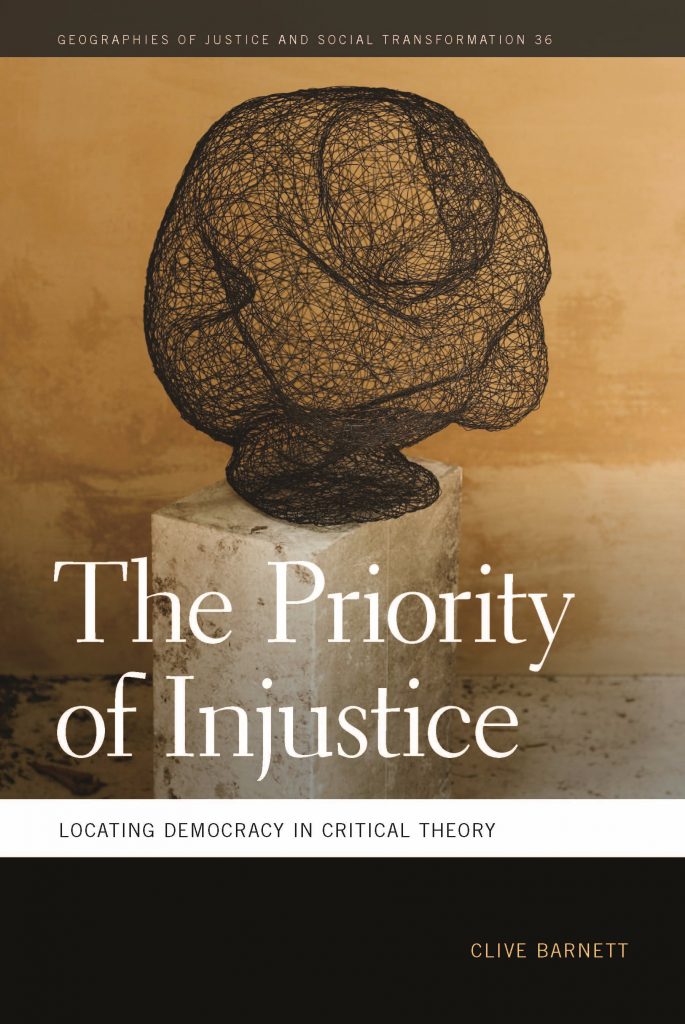
So, finally, the book that I have been writing, on and off, for the last four years, The Priority of Injustice, has been published – or at least, it’s real, since the formal publication date is next month (so I reserve the right to blog further about it as and when). It arrived earlier this week – a rather hectic week, which has oddly meant I have been too busy to experience the strange sense of anti-climax that often accompanies the arrival of the finished form of something that you have been making for so long.
This is, in one sense, my Exeter book – the first thing I did in my very first week here, four years ago, was write the proposal and send it off to prospective publishers, It’s also, though, my Swindon book, a book which attempts to articulate an approach to theorising in an ordinary spirit which has been published just a few weeks after moving away from that very ordinary town where I have lived while writing it.
It’s a beautiful object, with a great cover image, by Helen Burgess (I bought one of her pictures once, in one of those open-house art trail events that you get in places like Bishopston in Bristol, so that’s why I knew of her work; it turns out she is part of a geography-friendly network of artists). And I am honoured and humbled to have the book published in University Georgia Press’s very excellent Geographies of Justice and Social Transformation series.
I’m now faced with the challenge of promoting the book. I’m quite fond of the Coetzee-esque principle that books should have to make their own way in the world without the help of the author; on the other hand, I have some sense of responsibility towards the argument made in the book, a responsibility to help project it into the world. I’ve already realised that it’s not the sort of book that lends itself to an easy press release – ‘THEORY COULD BE THEORISED DIFFERENTLY’, SAYS THEORY-BOY doesn’t really work as a headline, does it?.





 My brilliant colleague Clive Barnett is

