Through a data broker darkly…

Here’s an exercise to do, as a non-specialist, for yourself or maybe as part of a classroom activity: discuss what Facebook (data brokers, credit checkers etc etc.) might know about me/us/you, how accurate the data/information might be, and what that means to our lives.

One of the persistent themes of how we tell stories about the ‘information society’, ‘big data’, corporate surveillance and so on is the extent of the data held about each and every one of us. Lots of stories are told on the back of that and there are, of course, real life consequences to inaccuracies.

Nevertheless, an interesting way of starting the exercise above is to compare and contrast the following two articles:

Corporate Surveillance in Everyday Life:

The exploitation of personal information has become a multi-billion industry. Yet only the tip of the iceberg of today’s pervasive digital tracking is visible; much of it occurs in the background and remains opaque to most of us.

I Bought a Report on Everything That’s Known About Me Online:

If you like percentages, nearly 50 percent of the data in the report about me was incorrect. Even the zip code listed does not match that of my permanent address in the U.S.; it shows instead the zip code of an apartment where I lived several years ago. Many data points were so out of date as to be useless for marketing–or nefarious–purposes: My occupation is listed as “student”; my net worth does not take into account my really rather impressive student loan debt. And the information that is accurate, including my age and aforementioned net worth (when adjusted for the student debt), is presented in wide ranges.

Of course, it does not matter if the data is correct – those inaccuracies have real-world consequences, and the granularity of the accuracy only matters in certain circumstances. So, thinking about how and why the data captured about us matters, what it might facilitate – allow or prevent us or those around us doing seems like an interesting activity to occupy thirty minutes or so…

The Mundane Afrofuturist Manifesto

Via dmf. Definitely worth watching >>


“This dream of utopia can encourage us to forget that outer space will not save us from injustice and that cyberspace was prefigured upon a “master/slave” relationship.

While we are often Othered, we are not aliens.

Though our ancestors were mutilated, we are not mutants.

Post-black is a misnomer.

Post-colonialism is too.

The most likely future is one in which we only have ourselves and this planet.”

The rest is here: http://martinesyms.com/the-mundane-afrofuturist-manifesto/

See also: http://blackradicalimagination.com

The Priority of Injustice – Almost ready…

The Priority of Injustice – BarnettMy colleague Clive Barnett has blogged an update concerning his latest book The Priority of Injustice, with the blurb – see below.

“This original and ambitious work looks anew at a series of intellectual debates about the meaning of democracy. Clive Barnett engages with key thinkers in various traditions of democratic theory and demonstrates the importance of a geographical imagination in interpreting contemporary political change.

Debates about radical democracy, Barnett argues, have become trapped around a set of oppositions between deliberative and agonistic theories–contrasting thinkers who promote the possibility of rational agreement and those who seek to unmask the role of power or violence or difference in shaping human affairs. While these debates are often framed in terms of consensus versus contestation, Barnett unpacks the assumptions about space and time that underlie different understandings of the sources of political conflict and shows how these differences reflect deeper philosophical commitments to theories of creative action or revived ontologies of “the political.” Rather than developing ideal theories of democracy or models of proper politics, he argues that attention should turn toward the practices of claims-making through which political movements express experiences of injustice and make demands for recognition, redress, and repair. By rethinking the spatial grammar of discussions of public space, democratic inclusion, and globalization, Barnett develops a conceptual framework for analyzing the crucial roles played by geographical processes in generating and processing contentious politics.”


Excellent postgrad opportunities with Data Justice Lab

From: Data Justice Lab

Funding is currently available for students in postgraduate programmes at Cardiff University, including the MA Digital Media and Society and the PhD in Journalism (with a focus on Digital Media and Society). Applications for the coming academic year (2017/18) are still accepted. Students are welcome to work on issues of data justice and become part of the Lab.

The MA Digital Media and Society explores current challenges in areas such as big data, digital rights, social media, digital culture and economy, internet governance and online politics. The Cardiff School of Journalism, Media and Cultural Studies also offers a wide range of other MA programmes in areas such as journalism studies, data journalism, and political communication.

Cardiff University offers Master’s Excellence Scholarships in the form of a tuition fee discount. To be eligible for the scholarships, please apply for the MA programme no later than 15 June.

The School’s PhD programme encourages students to engage with one of its research clusters, including Digital Media and Society. Applications that are submitted by Friday 2nd June will be considered for an ESRC studentship programme that addresses research challenges in areas such as digital infrastructure and the use of data.

Cardiff’s School of Journalism, Media and Cultural Studies (JOMEC) is one of the world’s leading departments in Media & Communications. In the 2014 Research Excellence Framework the school was ranked 2nd in the UK for the quality of its journalism, media and communications research.

“algorithmic governance” – recent ‘algorithm’ debates in geography-land

Over on Antipode’s site there’s a blog post about an intervention symposium on “algorithmic governance” brought together by Jeremy Crampton and Andrea Miller, on the back of sessions at the AAG in 2016. It’s good that this is available open access and, I hope, helpful that it maybe puts to bed some of the definition wrangling that has been the fashion. Obviously, a lot draws on the work of geographer Louise Amoore and also of political theorist Antoinette Rouvroy, which is great.

Reading through the overview and skimming the individual papers provokes me to comment that I remain puzzled though by the wider creeping use of an unqualified “non-human” to talk about software and the sociotechnical systems they run/are run on… this seems to play-down precisely the political issues raised in this particular symposium – that the kinds algorithms concerned in this debate are written and maintained by people, they’re not somehow separate or at a distance… It’s also interesting to note that a sizeable chunk of the debates concern ‘data’ but the symposium doesn’t have “data” in the title, but maybe ‘data–’ is passé… 🙂

I’ve copied below the intro to the post, but please check out the whole thing over on Antipode’s site.

Intervention Symposium: “Algorithmic Governance”; organised by Jeremy Crampton and Andrea Miller

The following essays first came together at the 2016 AAG Annual Meeting in San Francisco. Jeremy Crampton (Professor of Geography at the University of Kentucky) and Andrea Miller (PhD candidate at University of California, Davis) assembled five panellists to discuss what they call algorithmic governance – “the manifold ways that algorithms and code/space enable practices of governance that ascribes risk, suspicion and positive value in geographic contexts.”

Among other things, panellists explored how we can best pay attention to the spaces of governance where algorithms operate, and are contested; the spatial dimensions of the data-driven subject; how modes of algorithmic modulation and control impact understandings of categories such as race and gender; the extent to which algorithms are deterministic, and the spaces of contestation or counter-algorithms; how algorithmic governance inflects and augments practices of policing and militarization; the most productive theoretical tools available for studying algorithmic data; visualizations such as maps being implicated by or for algorithms; and the genealogy of algorithms and other histories of computation.

Three of the panellists plus Andrea and Jeremy present versions of these discussions below, following an introduction to the Intervention Symposium from its guest editors (who Andy and Katherine at Antipode would like to thank for all their work!).

Read the whole post and see the contributions to the symposium on the Antipode site.

Reblog> Workshop: Reshaping Cities through Data and Experiments

Smart City visualisation

This looks interesting (via Programmable City):

Workshop: Reshaping Cities through Data and Experiments

When: 30th May 2017 – 9.30am to 3.30pm
Where: Maynooth University, Iontas Building, Seminar Room 2.31

The “Reshaping Cities through Data and Experiments” workshop is part of the Ulysses research exchange programme jointly funded by Irish Research Council and the Ambassade de France. It is organized in collaboration with researchers from the Centre de Sociologie de l’Innovation (i3-CSI) at the École des Mines in Paris – David Pontille, Félix Talvard, Clément Marquet and Brice Laurent – and researchers from the National Institute for Regional and Spatial Analysis (NIRSA) in Maynooth University, Ireland – Claudio Coletta, Liam Heaphy and Sung-Yueh Perng.

The aim is to initiate a transdisciplinary discussion on the theoretical, methodological and empirical issues related to experimental and data-driven approaches to urban development and living. This conversation is vital in a time when cities are increasingly turning into public-private testbeds and living labs, where urban development projects merge with the design of cyber-infrastructures to test new services and new forms of engagement for urban innovation and economic development. These new forms of interaction between algorithms, planning practices and governance processes raise crucial questions for researchers on how everyday life, civic engagement and urban change are shaped in contemporary cities.

Read the full blogpost on the Programmable City site.

Digital Everyday – conference at KCL this weekend

This looks interesting… via Tony Sampson

THE DIGITAL EVERYDAY CONFERENCE

Location
Strand Campus – King’s College London
Category
Conference/Seminar
When
06/05/2017 (10:30-18:30)
Contact
Please direct enquiries to digitalculture@kcl.ac.uk

Sign up to the CDC mailing list here

The conference is paid and registration is essential. Registration closes midday on 4 May.

The Digital Everyday: Exploration or Alienation?

This international conference aims at exploring the digital everyday, understood as the transformation of everyday life practices brought about by digital technology. From how we buy, walk around, get a cab, love, break up, go to bed, meet new people and sexual partners to the way we rate services, turn on the fridge, exercise, eat, use social media and apps, Big Data is reshaping some of the most basic activities in our lives.

The conference will explore these digitally enabled transformations by looking at a number of domains affected by these shifts, for instance: of work and leisure, of friendship and love, of habits and routines. We will also explore a number of overarching dynamics and trends in the digital world that contribute to these transformations, including: processes of digital individualisation and aggregation; the elisions of spatial and temporal barriers; trends towards quantification and datafication; and the dialectic between control and alienation.

Please click here to see the full programme 

(Please note that refreshements will be provided but delegates will need to get their own lunch)

Image

Deum ex machina? a journey into transhuminism as/via religion

Machines from the gods… or…

God in the machine: my strange journey into transhumanism – podcast

After losing her faith, a former evangelical Christian felt adrift in the world. She then found solace in a radical technological philosophy – but its promises of immortality and spiritual transcendence soon seemed unsettlingly familiar

An interesting and compelling podcast of a ‘long read’ for the Graun by Meghan O’Gieblyn that eloquently articulates the not-so-crypto-theistic nature of (some) transhumanism(s).

Here’s a paragraph to whet the appetite:

By this point I’d passed beyond idle speculation. A new, more pernicious thought had come to dominate my mind: transhumanist ideas were not merely similar to theological concepts but could in fact be the events described in the Bible. It was only a short time before my obsession reached its culmination. I got out my old study Bible and began to scan the prophetic literature for signs of the cybernetic revolution. I began to wonder whether I could pray to beings outside the simulation. I had initially been drawn to transhumanism because it was grounded in science. In the end, I became consumed with the kind of referential mania and blind longing that animates all religious belief.

The history of the future of automation – lessons from ed tech

Automated taxi figure in the 1990 film Total Recall

I’ve been re-reading the excellent essay by Audrey Watters: Driverless Ed-Tech: The history of the future of automation in education. I really recommend reading it!

Following on from the vague points I made in my last post about an automative imaginary – one way of getting at this is a sort of classic (political economy) critique, which Watters very adroitly takes in relation to ed-tech and MOOCs (etc), and which she write really clearly – so, here is snippet:

“Put me out of a job.” “Put you out of a job.” “Put us all out of work.” We hear that a lot, with varying levels of glee and callousness and concern. “Robots are coming for your job.”

We hear it all the time. To be fair, of course, we have heard it, with varying frequency and urgency, for about 100 years now. “Robots are coming for your job.” And this time – this time – it’s for real.

I want to suggest – and not just because there are flaws with Uber’s autonomous vehicles (and there was just a crash of a test vehicle in Arizona last Friday) – that this is not entirely a technological proclamation. Robots don’t do anything they’re not programmed to do. They don’t have autonomy or agency or aspirations. Robots don’t just roll into the human resources department on their own accord, ready to outperform others. Robots don’t apply for jobs. Robots don’t “come for jobs.” Rather, business owners opt to automate rather than employ people. In other words, this refrain that “robots are coming for your job” is not so much a reflection of some tremendous breakthrough (or potential breakthrough) in automation, let alone artificial intelligence. Rather, it’s a proclamation about profits and politics. It’s a proclamation about labor and capital.

More specific to education, Watters highlights the logic offer by Udacity, one of the big MOOC start-ups:

“We want to be the Uber of education,” Thrun told The Financial Times, which added that, “Mr Thrun knows what he doesn’t want for his company: professors in tenure, which he claims limits the ability to react to market demands.”

In other words, “disrupt” job protections through a cheap, precarious labor force doing piecemeal work until the algorithms are sophisticated enough to perform those tasks. Universities have already taken plenty of steps towards this end, without the help of algorithms or for-profit software providers. But universities are still bound by accreditation (and by tradition). “Anyone can teach” is not a stance on labor and credentialing that many universities are ready to take.

[read all of Watters’ argument here.]

One of the areas in which what I’ve called the automative imaginary/imagination overlaps with wider stories about digital tech disruption and the widespread creed of that disruption being normatively good, if not admirable, is where automation overlaps with the ‘gig economy’. As we can see, via Thrun, one of the models in play here is not to ‘destroy’ jobs but rather to decouple them from some of the elements that make them valuable and either reallocate or automate those and then offer the remaining tasks as precarious work – which you have to sign up for through a proprietary system as a contractor, rather than an employee.

The ways we are invited to see ‘automation’ by some are over-coded with strong narratives of ‘disruption’ and the breaking down of established employment rights into a two their system in which the ‘taskers’ (as Guy Standing calls them) take the precarious work for relatively meagre earnings and the tech company owners and a few they bring along with them hoover up the profits.

An alternative to such narratives might be ‘accelerationism‘ but I remain skeptical at present (but I’ve not read enough to form an opinion really). It seems to me, we (geographers, social scientists, citizens?! … well, me anyway!) really do need to talk and think about work.

More tales of the automative imaginary

A warehouse worker and robot

Here’s some links that further sketch out some of what I’ve been thinking about as an ‘automative imaginary’. I’ve offered links with a bit of brief commentary at the bottom…

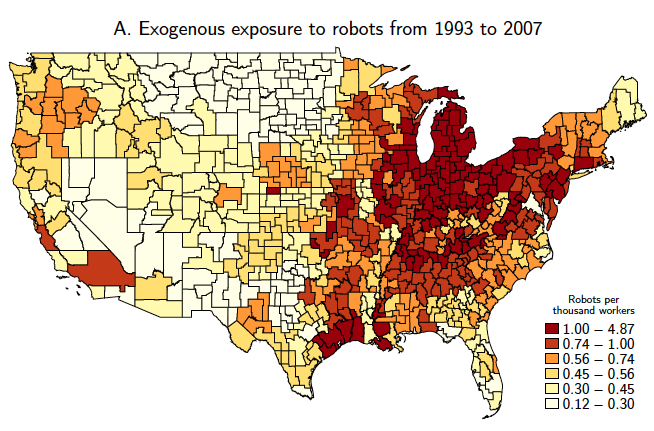
Evidence That Robots Are Winning the Race for American Jobs – in the NYT, pointing to research undertaken by two economists, Acemoglu and Restrepo, published by the (American) National Bureau of Economic Research: Robots and Jobs: Evidence from US Labor Markets (to which I have no access), with a commentary on the Centre for Economic Policy Research‘s Vox site. What is curious for me here is how one can evaluate the method of the researchers and what the assumptions they make say about how we (are invited to) understand automation. There’s some interesting geography in there too! E.g. see the choropleth map of “exogenous exposure to robots” below
How will the rise of automation and AI affect the workforce and economy moving forward? – Francis Fukuyama offers his answer to how automation and AI (interesting easy slip between those as almost a form of equivalence, which is open to significant debate/critique) may or may not “affect” the economy and, in particular, jobs – in the US.

It’s interesting how much of what we are offered in terms of a rationale for automation is a fairly simplistic robots replace workers sort of story. In this regard, it’s worth remembering what the MacDonalds CEO Ed Rensi flippantly observed as a canonical example (documented in this post on Fusion):

former McDonald’s CEO Ed Rensi made news by going on Fox Business and declaring that ongoing protests in the campaign for a $15 minimum wage were encouraging the automation of fast food jobs. The segment goes on for seven minutes, but here’s the meat of it:

I was at the National Restaurant Show yesterday and if you look at the robotic devices that are coming into the restaurant industry – it’s cheaper to buy a $35,000 robotic arm than it is to hire an employee who’s inefficient making $15 an hour bagging French fries – it’s nonsense and it’s very destructive and it’s inflationary and it’s going to cause a job loss across this country like you’re not going to believe

Nevertheless, other economists will tell you that processes of automation have, historically, created new kinds of jobs as they apparently ‘destroy’ others. For example, Deloitte, in their report “Technology and People: The great job creating machine“, suggest that while manual labour and routine jobs have been significantly automated since 1992, there has been an even larger growth in ‘care’ (and service) and ‘cognitive’ work in the UK labour market. So you see fewer people in manufacturing but more analysts, baristas and carers.

Of course, to see it as whole “jobs” that are being automated is somewhat misleading – another aspect of the automative imaginary that owes more to the depiction of automation in 1950/60s cartoons than in the actually existing forms of automation. As many commentators point out, it’s parts of jobs or tasks that become automated, which results in a need to reorganise that work. As the management consultants McKinsey point out in a report in 2016:

currently demonstrated technologies could automate 45 percent of the activities people are paid to perform and that about 60 percent of all occupations could see 30 percent or more of their constituent activities automated, again with technologies available today

What we tend to focus on is the automation full stop, not that it isn’t all of a job and may not result in an easy equivalence of “robot in = worker out”. We imagine the robots doing it all, when, in many cases, the use of robots (when they’re actually economically viable – they have a huge initial set-up cost) require a reorganisation of systems such that the work looks different.

Another illustration of this comes from the excellent Containers podcast by Alexis Madrigal. In the final episode, Madrigal talks to Karen Levy of Cornell  about the forms automation could take in relation to truck driving (upon which Uber clearly has its sights set). Of course, again, it’s not as simple as: automate the lorries, do-away with jobs. It’s more like the process of containerisation that Madrigal is exploring – automation is as much about reorganising systems of work / labour as it is about ‘replacing’ labour. So, in the example of picking in warehouses – you might get a Kiva or Fetch/Freight robot to do the donkey work of warehousing, with the worker performing the more sophisticated movements. This is not a future of people-less spaces but rather robots following people around or being tasked in order to support the worker, the argument being this leads to greater productivity. In fact, in the eighth episode of Containers, the CEO of Fetch Robotics justifies her company’s tech by saying that, in the US, there are over 600k jobs going unfilled in warehousing and manufacturing because people don’t want to do them, with a turnover rate of those who do sign-up for such work at around 25% (I don’t know the basis or veracity of those numbers – would like to though!). Again, if true, such figures are another aspect of the expectations of what work involves and how it may be performed.

So, it seems to me we need to talk about work not simply elide it by (somewhat hysterically) referring to ‘automation’ and ‘robots’. This is something I hope to research and write more about, if I ever get the time…