How Technology Changes Us – Ihde & Verbeek [video]

A statue of three men hammering

A video of a fairly accessible discussion of broadly ‘post-phenomenological’ theories of technology with the philosophers Don Ihde & Peter-Paul Verbeek. Via dmf.

How Technology Changes Us – Lecture and discussion with philosophers of technology Don Ihde and Peter-Paul Verbeek

Thursday 11 January 2018 | 19.30 – 21.15 hrs | Theater Hall C, Radboud University

“From the bow and arrow to smartphones, changes come along with every new technology. According to Don Ihde, one of the founders of North American philosophy of technology, technology does not only offer us new opportunities, it also changes our relation to the world. Come and listen as the Dutch philosopher of technology Peter-Paul Verbeek and his mentor Don Ihde talk about philosophy and technology in the past, present, and future.”

Transduction

A huge array of overhead wires on a street

From the footnotes of Dan Ross’ introduction to Stiegler’s Neganthropocene comes this limpid definition (p. 271):

‘Transductive’, here, refers to an approach to thinking processes in which the terms of a relation cannot be understood as preceding the relation itself.

There is a danger with much ontology talk we encounter, especially in geographyland, for the ontological category of the thing to stand, almost static, in place of the necessary engagement with what is encountered in the world. In this sense, to think transductively, I suggest, is to follow a counterflow to the monolithic ontology talk that, for all of the appeals to vitality and the lively effervescence of the world, tends to fix things in catch-all concepts (such as ‘affect’, ‘atmosphere’ and other ‘a’s) without really engaging with the relations of the stuff of/under study. To ‘do’ transduction then might involve more than merely pointing it out – of which I am rather guilty.

That’s my quick and not very coherent take at the moment… I think this is actually a constructive form of critique – I believe there is a way forward in this kind of deconstructive thinking but it needs much more fleshing out.

Seminar> Charis Thompson: On the Posthuman in the Age of Automation and Augmentation

Still from the video for All is Love by Bjork

If you happen to be in Exeter on Friday 11th May then I urge you to attend this really interesting talk by Prof. Charis Thompson (UC Berkeley), organised by Sociology & Philosophy at Exeter. Here’s the info:

Guest speaker – Professor Charis Thompson: On the Posthuman in the Age of Automation and Augmentation

A Department of Sociology & Philosophy lecture
Date 11 May 2018
Time 14:00 to 15:15
Place IAIS Building/LT1

Charis Thompson is Chancellor’s Professor, Gender and Women’s Studies and the Center for Science, Technology, Medicine and Society, UC Berkeley, and Professor, Department of Sociology, London School of Economics. She is the author of Making Parents; The Ontological Choreography of Reproductive Technologies (MIT Press 2007), which won the Rachel Carson Prize from the Society of the Social Studies of Science, and of Good Science: The Ethical Choreography of Stem Cell Research (MIT Press 2013). Her book in progress, Getting Ahead, revisits classic questions on the relation between science and democracy in an age of populism and inequality, focusing particularly on genome editing and AI.

She served on the Nuffield Council Working Group on Genome Editing, and serves on the World Economic Forum’s Global Technology Council on Technology, Values and Policy. Thompson is a recipient of UC Berkeley’s Social Science Distinguished Teaching Award.  In 2017, she was awarded an honorary doctorate from the National Science and Technology University of Norway for work on science and society.

SPA PGR Conference Committee
Maria Dede
Aimee Middlemiss
Celia Plender
Elena Sharratt

‘An Encounter Between Don Ihde and Bernard Stiegler: Philosophy of Technology at the Crossroads Again’ Nijmegen 11-12 Jan. 2018

Glitched image of a mural of Prometheus giving humans' fire in Freiberg

Via Yuk Hui. Fascinating line-up of speakers:

International Expert Workshop: ‘An Encounter Between Don Ihde and Bernard Stiegler: Philosophy of Technology at the Crossroads Again’

Nijmegen, 11-12 January 2018Organized by Pieter Lemmens (Radboud University) and Yoni Van Den Eede (Free University of Brussels)

Quo vadis philosophy of technology? The defining moment in contemporary philosophy of technology has undoubtedly been the “empirical turn” of the 1990s and 2000s. Contra older, so-called essentialist approaches that saw technology as an all-encompassing phenomenon or force, the turn inaugurated more “micro-level” analyses of technologies studied in their specific use contexts. However, the empirical turn is now increasingly being called into question, with scholars asking whether the turn has not been pushed too far – certainly given recent technological developments that seem to give technology an all-encompassing or all-penetrating countenance (again): pervasive automation through algorithms and (ro)bots, nanoprobes, biotechnology, neurotechnology, etc. Also, the ecological urgency characterizing our “anthropocenic condition” appears to call for more broad-ranging perspectives than the mere analysis of concrete use contexts. At the same time, nevertheless, the “empirical attitude” keeps demonstrating its usefulness for the philosophical study of technologies on a day-to-day basis… Where do we go from here?

This two-day workshop will be dedicated to these questions by way of an encounter between two leading “streams” in philosophical thinking on technology today. Quite literally we organize an dialogue between two key figures, Don Ihde and Bernard Stiegler, and their respective frameworks: postphenomenology-mediation theory and techno-phenomenology-general organology. Together with these two thinkers and a select group of scholars, we will reflect upon the near-future form that philosophical thinking on technology should take in a world struggling with multiple global crises – the planetary ecological crisis being the gravest one.

Speakers: Prof. dr. Don Ihde (Stony Brook University), Prof. dr. Bernard Stiegler (University of Compiègne), Prof. dr. Mark Coeckelberg (University of Vienna), Dr. Yoni van den Eede (Free University of Brussels), Dr. Yuk Hui (Leuphana University), Dr. Pieter Lemmens (Radboud University), Dr. Helena de Preester (Ghent University), Prof. dr. Robert C. Scharff (University of New Hampshire), Dr. Dominic Smith (University of Dundee), Prof. dr. Peter-Paul Verbeek (University of Twente), Dr. Galit Wellner (Tel Aviv University)

Venue: Villa Oud Heyendael, Rene? Descartesdreef 21, 6525 GL Nijmegen (Campus RU)
Time: 11 and 12 January 2018, 10.00h – 17.30h

More information: http://www.ru.nl/ftr/actueel/agenda/@1134542/expert-seminar-philosophy-technology-at-the/

Made possible by the the Faculty of Science, the Institute for Science in Society, the Faculty of Philosophy, Theology and Religious Studies, the International Office of Radboud University and the Centre for Ethics and Humanism, Free University of Brussels (VUB)

“Reconstructing the economy by rediscovering the value of knowledge” an interview with Bernard Stiegler [translation]

Bernard Stiegler being interviewed

In this short interview published inLibérationin March 2017, Bernard Stiegler reprises his argument for a contributory income, as is being trialled in the Plaine-Commune experiment. This is more or less the same argument and ideas presented in previous interviews I’ve translated, such as the Humanité interview, in which Stiegler attempts to provide the answer (albeit rather sweeping) to an incredibly gloomy prognosis of unemployment through full automation and peniary for the majority and with it the ever increasing loss of knowledge. Stiegler’ solution is the economic recognition of the value of work that currently is not captured economically. The device to achieve this is the contributory income, which unlike the Universal Basic Income seems to have a vague set of conditions attached.

The main idea here is Stiegler’s interesting distinction between what you get paid for and what you *do* – your employment [emploi] and your work [travail] – which gets to the heart of a whole host of debates (some that are quite long-running) around what we do that is or is not ‘work’ and how/whether or not it gets economically valued. It also builds on longstanding discussion about knowledge and care as a therapeutic relation [with each other, society, technology and so on] by Stiegler [see, for example, the Disbelief and Discredit series]. I think this may be useful for some of the critical attention to the gig economy and the ways in which people are responding to the current bout of automation anxiety/ ‘rise of the robots’ hand-wringing.

What is interesting to me about this interview is how little it moves on from Stiegler’s past articulations of this argument. There’s some sweeping generalisations about the extent and impact of automation based on questionable and contested sources (which I think does a disservice to Stiegler’s intellectual project). It is curious that the contributory income is still talked about in such vague terms. It is supposedly an active experiment in Plaine-Commune, so surely there’s a little more detail that could be elaborated? It would be interesting to see some more detailed discussion about this [sorry if I’ve missed it somewhere!].

The principle basis of the contributory income seems to be a fairly institutional (and as far as I can tell – peculiarly French) state programme for supporting workers in the creative industries. As in previous written work and interviews, Stiegler uses the idea of the “intermittents” or “intermittents du spectacle” to signify the idea of work that is subsidised through some form of state administered allowance, such as unemployment benefit. In France people working in the performing arts are entitled to claim for social security benefits designed for people without regular employment [as per the definition provided by Larousse online.]

So, here’s a fairly quick translation of the interview. As usual clarifications or queries about terms are in [square brackets]. I welcome comments or corrections!

Bernard Stiegler: “Reconstructing the economy by rediscovering the value of knowledge”

The philosopher Bernard Stiegler determines a difference between employment, which today is largely proletarianised, and work, which transforms the world through knowledge, and thus cultivates wealth.

Philosopher, Director of the Institute of Research and Innovation (IRI) of the Georges-Pompidou centre and founder of the Ars Industrialis association, Bernard Stiegler has for several years concerned himself with the effects of automation and robotisation. He has notably published The Automatic Society 1: The Future of Work (Fayard 2015) and In Disruption: How not to go mad?(Les liens qui libèrent, 2016). Today he is deeply engaged with a project which beings together nine towns in the Plaine-Commune territory, in Seine-Saint-Denis, to develop and experiment with a “contributive income” which would fund activities that go unrecognised but are useful to the community.

Amazon intends to gain a foothold in the groceries sector with cashier-less convenience stores, like in Seattle. Is automation destined to destroy jobs?

For 47% of jobs in the US, the response from the Massachusetts Institute of Technology is potentially “yes”. The remaining 53% cannot be automated because they are professional roles. They are not proletarianised: they are valued for their knowledge, which gives a capacity for initiative. What makes a profession is what is not reducible to computation, or rather reducible to the processing of data by algorithms. Not all jobs can therefore be automated. But this does not mean they are entirely removed from the processes of automation: everyone will be integrated into automatisms.

For you “employment” and “work” are not the same thing…

For two hundred and fifty years the model of industrial employment has been proletarianised employment, which has continued to grow. At first it was only manual workers, today it has largely exceeded the tertiary sector and affects nearly every task. More and more functions of supervision and even analysis have been proletarianised, for example by ‘big data’, doctors have been proletarianised – which means they are performing less and less of their profession. Proletarianised employment is sublimated by closed and immovable system. Work, on the contrary, transforms the world. So there is employment that does not produce work in this sense, rather the reverse: there is work outside of employment.

The big question for tomorrow is that of the link between automatisms, work outside of employment, and the new types of employment that enable the valroisation of work. The aim of contributive income is precisely to enable the reorganisation of the wealth produced by work in all its forms and cultivate, using the time freed up by automation, the forms of knowledge that the economy will increasingly demand in the anthropocene, this era in which the human has become a major geological factor. It is a case of surpassing the limits through an economy founded on the deproletarianisation of employment.

Optimistic discussions would like automation to free individuals, by eliminating arduous, alienating jobs. But today, it is mostly perceived as a threat…

It is a threat as long as we do not put in place the macroeconomic evolution required by deproletarianisation. The macroeconomy in which we have lived since the conservative revolution is a surreptitious, hypocritical and contradictory transformation of the Keynesian macroeconomics established in 1933. Contradictory because employment remains the central function of redistribution, whereas its reduction, and that of wages, drives the system as a whole towards insolvency.

Employment can no longer be the model for the redistribution of value. And this can no longer be limited to the relationship between use value and exchange value. Use value has become a value of usury, that is to say a disposable value that “trashes” the world – goods become waste, as do people, societies and cultures. The old American Way of Life no longer works: which is why Trump was elected… However if employment is destroyed it is necessary to redistribute not only purchasing power but also purchasing knowledge by reorganising all alternative employment and work.

In what way?

We must rebuild the economy by restoring value to knowledge. Proletarianised employment will disappear with full automation. We must create new kinds of employment, what we call irregular employment [emplois intermittents]. They will constitute intermittent periods in which instances of work that are not instances of employment are economically valued. The work itself will be remunerated by a contributory income allocated under conditions of intermittent employment, as is already the case in the creative industries.

In Intermittents et précaires [something like ~ Intermittent and precarious workers] Antonella Corsani and Maurizio Lazzarato that irregular workers in the creative industries [intermittents du spectacle] work mostly when they are not employed: employment is foremost a moment of implementing the knowledge that they cultivate outside of employment. We must encourage the winning back of knowledge, in every area [of work]. This implies on the one hand to evolve the relationship between individuals and education systems as well as professional associations lifelong learning and so on.

And, on the other hand, to precisely distinguish between information and knowledge. Automated systems have transformed knowledge into information. But this is only dead knowledge. To overcome the anthropocene we must resuscitate knowledge by inteligently practising information – through alternative periods of work and employment. Only in this way can we re-stabilise the economy, where the problems induced by climate change, for example, are only just beginning, and where vital constraint [contrainte vitale] is going to be exercised more and more as a criterion of value. It is a long term objective… But today, what should we do? Nobody can pull a rabbit out of their hat to solve the problem. We must therefore experiment. This is what we are doing with the Plaine-Commune project in Seine-Saint-Denis, which in particular aims to gradually introduce a contributory income according to the model of irregular work [l’intermittence]. With the support of the Fondation de France, we are working with residents in partnership with the Établissement public territorial [something like a unitary authority area?], Orange, Dassault Systèmes and the Maison des sciences de l’homme Paris-Nord [a local Higher Education Institution]–and through them the universities Paris 8 and Paris 13– in dialogue with small and medium enterprises, associations, cooperatives and mutual associations [les acteurs de l’économie sociale et solidaire], artists, cultural institutions. It’s a ten-year project.

Reblog> Should robots be granted the status of legal personhood?

Twiki the robot from Buck Rogers

From John Danaher’s Philosophical Disquisitions.

Danaher offers his incisive analysis of recent additions to the debate on legal personhood re. “robots”. Seems interesting (to me) in relation to two things: agency, and how we imagine automation – since we don’t actually have such ‘robots’ at the moment. It’s quite a long post (so only a snippet below), but worth working through… not least because in geographyland it seems to me many of us have a very narrow understanding of these sorts of things from a fairly narrow (simplified) post-structuralist account of ‘subjectivity‘.

Should robots be granted the status of legal personhood?

The EU parliament attracted a good deal of notoriety in 2016 when its draft report on civil liability for robots suggested that at least some sophisticated robots should be granted the legal status of ‘electronic personhood’. British tabloids were quick to seize upon the idea — the report came out just before the Brexit vote — as part of their campaign to highlight the absurdity of the EU. But is the idea really that absurd? Could robots ever count as legal persons?

A recent article by Bryson, Diamantis and Grant (hereinafter ‘BDG’) takes up these questions. In ‘Of, for and by the people: the legal lacuna or synthetic persons’, they argue that the idea of electronic legal personhood is not at all absurd. It is a real but dangerous possibility — one that we should actively resist. Robots can, but should not, be given the legal status of personhood.

BDG’s article is the best thing I have read on the topic of legal personhood for robots. I believe it presents exactly the right framework for thinking about and understanding the debate. But I also think it is misleading on a couple of critical points. In what follows, I will set out BDG’s framework, explain their central argument, and present my own criticisms thereof.

Read the full blogpost.

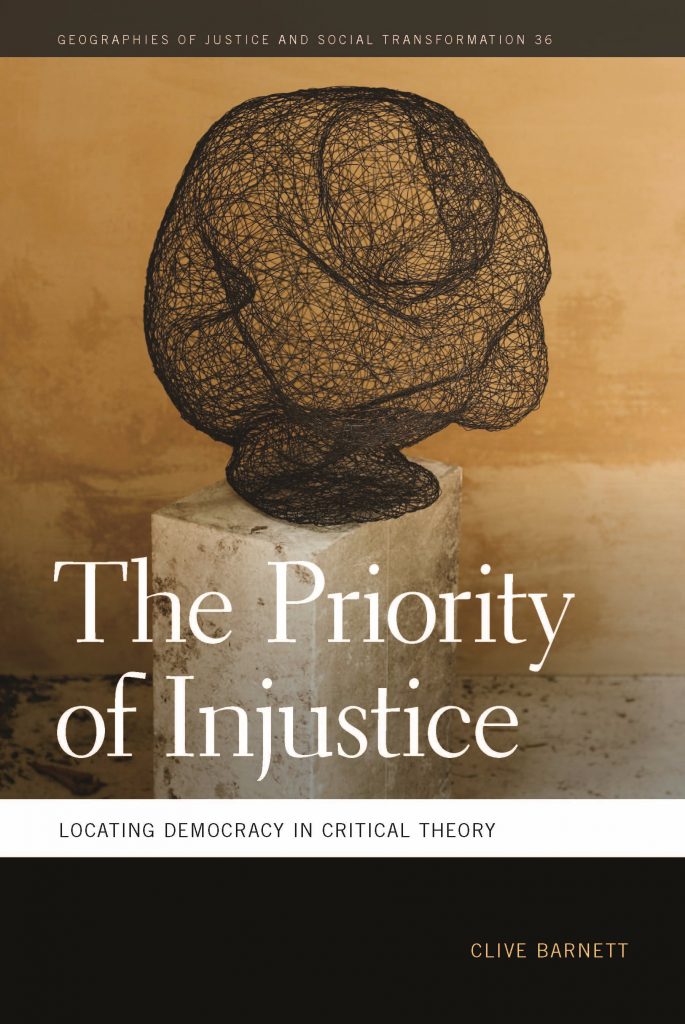
Reblog > The Priority of Injustice

The Priority of Injustice – Clive Barnett

My colleague Prof. Clive Barnett’s excellent new book is out. He introduces it in a recent blogpost:

The Priority of Injustice

So, finally, the book that I have been writing, on and off, for the last four years, The Priority of Injustice, has been published – or at least, it’s real, since the formal publication date is next month (so I reserve the right to blog further about it as and when). It arrived earlier this week – a rather hectic week, which has oddly meant I have been too busy to experience the strange sense of anti-climax that often accompanies the arrival of the finished form of something that you have been making for so long.

This is, in one sense, my Exeter book – the first thing I did in my very first week here, four years ago, was write the proposal and send it off to prospective publishers, It’s also, though, my Swindon book, a book which attempts to articulate an approach to theorising in an ordinary spirit which has been published just a few weeks after moving away from that very ordinary town where I have lived while writing it.

It’s a beautiful object, with a great cover image, by Helen Burgess (I bought one of her pictures once, in one of those open-house art trail events that you get in places like Bishopston in Bristol, so that’s why I knew of her work; it turns out she is part of a geography-friendly network of artists). And I am honoured and humbled to have the book published in University Georgia Press’s very excellent Geographies of Justice and Social Transformation series.

I’m now faced with the challenge of promoting the book. I’m quite fond of the Coetzee-esque principle that books should have to make their own way in the world without the help of the author; on the other hand, I have some sense of responsibility towards the argument made in the book, a responsibility to help project it into the world. I’ve already realised that it’s not the sort of book that lends itself to an easy press release – ‘THEORY COULD BE THEORISED DIFFERENTLY’, SAYS THEORY-BOY doesn’t really work as a headline, does it?.

Read the full blogpost.

Monday thought – OOOber?

statue of a man holding his head with his right hand

A thought experiment based upon flippant suggestion:

Object Oriented Ontology is to philosophy what Uber is to tech development.

Both ‘disruptive’, Uber and OOO have both expanded beyond their initial context, which is by several measures ‘success’. Both have become like discursive shortcuts for a particular set of ideas – ‘gig economy’ and ‘automation’ for Uber and ‘speculative realism’ and maybe even ‘metaphysics’ for OOO (and there’s possibly other associations for these terms too).

Neither OOO or Uber came up with the ideas they propound first, they ‘innovated’ from others (not necessarily a problem) and then made grand claims based on that (maybe a problem).

Neither of the groups involved in the development of Uber or OOO has acted especially ethically, although Uber is almost certainly significantly worse (this isn’t a like-for-like comparison). This is one of the other ways in which these words have become pregnant with meaning. Uber has been variously documented as having a problem with misogyny in the workplace and has also teetered on the edge of legality through ‘greyball’. Some of the proponents of OOO have been accused of bullying graduate students online and at conferences (I recognise gossip can be pernicious but I’ve heard this from several unrelated sources). It has also been suggested some of these folks are garnering a reputation for being somewhat ‘macho’ in attitude – it probably doesn’t help that the lead figures are all male, that they write lots of earnest manifestos or that they succumb to profiles in newspapers that call them “philosopher prophet“. Of course, neither OOO or Uber are unique in this, similar observations/ accusations have been made of antecedent tech firms and philosophical movements, one need only look to TV programmes like “Silicon Valley” or open up the ‘theory boy‘ can of worms.

Finally, there is also a sense that the success both Uber and OOO are easily co-opted into these (pejorative) narratives. There are grounds for this, well – certainly for Uber, but the visibility that success brings makes it easier to tell these stories. I have no doubt that such alleged behaviour is not limited to those involved in Uber or OOO. Likewise, those categories may be contested and we shouldn’t tar everyone who works for a company or does a particular branch of theory with the same brush. Goodness knows there are plenty of “tech bros” and, for want of a better term, “theory bros” outside of Uber and OOO.

Such a critique, however flippant, can come across as a bit pompous or sly. I cannot stand outside this, I am, to a degree, complicit. For example, the citational practices used by “theory bros”, cartel-like, are easy to slip into – many of us have succumbed. To recognise stupidity, as both Ronell and Stiegler point out, is to recognise my own stupidity – the lesson, perhaps the ‘ethic’, is to pass through it towards knowledge. Not the reproduction of the same knowledge (that’s patriarchy), and not always, I think, difference for it’s own sake (isn’t that what the “tech bros” call “disruption”? and doesn’t that always require being in a privileged position?) but perhaps a thoughtful defiance – not ‘laughing along’. This could mean more “no’s” (following Sara Ahmed). Maybe even something like a NO movement – “No Ontology”, at least the kinds of ontology that get used as authority in the kinds of theory top trumps that get played by some of us in the social sciences and humanities… of course this isn’t a novel suggestion either, it’s somewhat akin to feminist standpoint theory.

Perhaps I’m being unkind to OOO and those who do/use it. Success breeds contempt and all that… but the thought experiment was interesting to run through, in my own ham-fisted way…