Part of a series for Motherboard called “Dear future,“.
Reminds me of Bristol Wireless and consume.net in the 00s… but with much higher stakes maybe…

Spatial Machinations
Part of a series for Motherboard called “Dear future,“.
Reminds me of Bristol Wireless and consume.net in the 00s… but with much higher stakes maybe…
On TVO, a public service broadcaster in Ontario, Tim Hwang, Director of the new Ethics and Governance of AI fund, talks about various issues in an accessible way:

From the Institute of Network Cultures:
Editors: Angela Daly (Queensland University of Technology), Kate Devitt (Queensland University of Technology) & Monique Mann (Queensland University of Technology).
In recent years, there has been an exponential increase in the collection, aggregation and automated analysis of information by government and private actors, and in response to this there has been a significant critique regarding what could be termed ‘bad’ data practices in the globalised digital economy. These include the mass gathering of data about individuals, in opaque, unethical and at times illegal ways, and the increased use of that data in unaccountable and potentially discriminatory forms of algorithmic decision-making by both state agencies and private companies. Issues of data ethics and data justice are only likely to increase in importance given the totalizing datafication of society and the introduction of new technologies such as artificial intelligence and automation.
In order to paint an alternative, more optimistic but still pragmatic picture of the datafied future, this open access edited collection will examine and propose what could be termed ‘good’ and ‘ethical’ data practices, underpinned by values and principles such as (but not limited to):
Chapters should be short contributions (2500-5000 words) which can take differing forms, for example:
Chapters can be theoretical takes or provocations on what Good Data is or should be, or can be case studies of particular Good Data projects and initiatives e.g. Indigenous data sovereignty initiatives, data cooperatives etc. Chapters can also be critiques of initiatives/movements which claim to be ethical but in fact fall short. All chapters, including academic ones, should be written in an accessible way and avoid the excessive use of jargon, etc. Academic chapters will be peer-reviewed. Other contributions will be editor-reviewed.
We encourage contributions from throughout the world and from different disciplinary perspectives: philosophy, media and communications, cultural studies, STS, law, criminology, information systems, computer science etc.
Proposals for chapters (up to 250 words) should be sent to Kayleigh Hodgkinson Murphy (kayleigh.murphy@qut.edu.au) by Friday 15 December 2017. Please include a brief biography (academic/practitioner) and signal what kind of chapter you are proposing (manifesto/academic chapter, etc).
If you have an idea for a chapter and want to discuss it before submitting a proposal, please contact Angela Daly (angela.daly@qut.edu.au) as soon as possible. We may be able to pair, for example, practitioners with academic authors on request.
Decisions on proposals will be made by mid-January 2017, with a first full draft of chapters to be submitted by 31 March 2018. We anticipate the book will be finalized and launched in late 2018, as part of the Institute of Network Cultures’ Theory on Demand series.

Via Nancy Baym:
APPLICATION DEADLINE: JANUARY 19, 2018
Microsoft Research New England (MSRNE) is looking for advanced PhD students to join the Social Media Collective (SMC) for its 12-week Internship program. The Social Media Collective (in New England, we are Nancy Baym, Tarleton Gillespie, and Mary Gray, with current postdocs Dan Greene and Dylan Mulvin) bring together empirical and critical perspectives to understand the political and cultural dynamics that underpin social media technologies. Learn more about us here.
MSRNE internships are 12-week paid stays in our lab in Cambridge, Massachusetts. During their stay, SMC interns are expected to devise and execute their own research project, distinct from the focus of their dissertation (see the project requirements below). The expected outcome is a draft of a publishable scholarly paper for an academic journal or conference of the intern’s choosing. Our goal is to help the intern advance their own career; interns are strongly encouraged to work towards a creative outcome that will help them on the academic job market.
The ideal candidate may be trained in any number of disciplines (including anthropology, communication, information studies, media studies, sociology, science and technology studies, or a related field), but should have a strong social scientific or humanistic methodological, analytical, and theoretical foundation, be interested in questions related to media or communication technologies and society or culture, and be interested in working in a highly interdisciplinary environment that includes computer scientists, mathematicians, and economists.
Primary mentors for this year will be Nancy Baym and Tarleton Gillespie, with additional guidance offered by other members of the SMC. We are looking for applicants working in one or more of the following areas:
Interns are also expected to give short presentations on their project, contribute to the SMC blog, attend the weekly lab colloquia, and contribute to the life of the community through weekly lunches with fellow PhD interns and the broader lab community. There are also natural opportunities for collaboration with SMC researchers and visitors, and with others currently working at MSRNE, including computer scientists, economists, and mathematicians. PhD interns are expected to be on-site for the duration of their internship.
Applicants must have advanced to candidacy in their PhD program by the time they start their internship. (Unfortunately, there are no opportunities for Master’s students or early PhD students at this time). Applicants from historically marginalized communities, underrepresented in higher education, and students from universities outside of the United States are encouraged to apply.
PEOPLE AT MSRNE SOCIAL MEDIA COLLECTIVE
The Social Media Collective is comprised of full-time researchers, postdocs, visiting faculty, Ph.D. interns, and research assistants. Current projects in New England include:
SMC PhD interns may also have the opportunity to connect with our sister Social Media Collective members in New York City. Related projects in New York City include:
For more information about the Social Media Collective, and a list of past interns, visit the About page of our blog. For a complete list of all permanent researchers and current postdocs based at the New England lab, see: http://research.microsoft.com/en-us/labs/newengland/people/bios.aspx

This episode of the ‘Talking Politics‘ podcast is a conversation between LRB journalist John Naughton and the Oxford Internet Institute’s Professor Phillip Howard ranging over a number of issues but largely circling around the political issues that may emerge from ‘Internets of Things’ (the plural is important in the argument) that are discussed in Howard’s book ‘Pax Technica‘. Worth a listen if you have time…
One of the slightly throw away bits of the conversation, which didn’t concern the tech, that interested me was when Howard comments on the kind of book Pax Technica is – a ‘popular’ rather than ‘scholarly’ book and how that had led to a sense of dismissal by some. It seems nuts (to me, anyway) when we’re all supposed to be engaging in ‘impact’, ‘knowledge exchange’ and so on that opting to write a £17 paperback that opens out debate, instead of a £80+ ‘scholarly’ hardback, is frowned upon. I mean I understand some of the reasons why but still…

Via dmf.

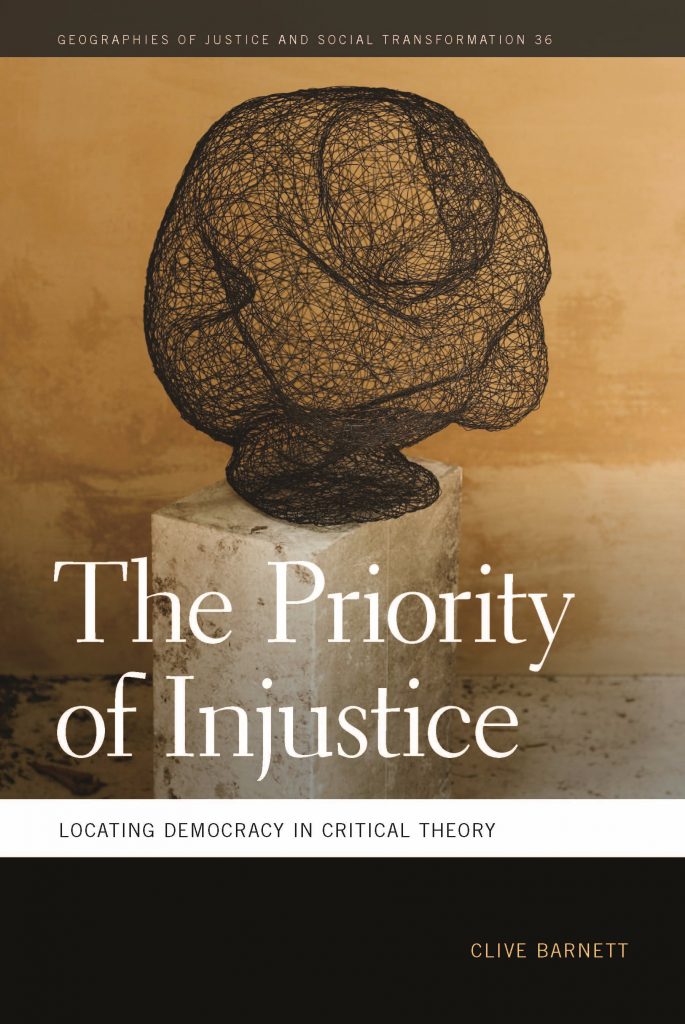 My brilliant colleague Clive Barnett is blogging about some of the key themes from his excellent new book The Priority of Injustice.
The first instalment is: Arguing with theory.
This will be worth following!

Gillian Rose’s recently posted advice has sat with me for a few days, it’s been in the background of my thinking as I fail to get much proper work done. It’s got me thinking about the level of anxiety I have been working with, which I suspect is (sadly) not uncommon for many folk right now. I don’t know whether writing this is a good idea. It’s not like successful people write these sorts of admissions of weakness but there we go…
This is sort of public taking-stock, with the hope that it may help me along and maybe other folks who feel similar things may feel like they’re not alone, I don’t know…
Gillian Rose’s blogpost happened to come along at the same time I’ve been failing to write my first proper annual appraisal type document after passing through our formal probation system. Until that point I only had to do a much abridged version. Now I’m supposed to a full ‘PDR’, with six sections of a page each that ask you to provide an account of what you’re doing about: “Career Goals and Plans”, “Research and Scholarship”, “Impact”, “Education” (4th! *sigh*), “Internationalisation” and “Other significant contributions to the university” (not to your discipline, to scholarship, to academia, but to the institution – make of that what you will). I have been stuck. I was looking at the pages and while I have written some halfhearted bullet points about the few things I’ve done, it worried me to the extent that I kept putting it off.
The grown-up thing to do is, I think (and I’ve received advice about from someone I trust), to fill out these kinds of benchmarking/monitoring forms positively but realistically – trying to keep in mind an understanding of your own worth. So, not just chasing the targets (goodness knows there are plenty of them), but also politely saying where you could use more support to realise the things that are mutually beneficial – things you want to do and the university thinks are good too. In truth, my department is very supportive. The university has it’s jargon and paperwork but it has always been (for me anyway) mediated by good people. Nevertheless, I wasn’t taking my own advice. In part this is because I am tired (due to illness/ sleeplessness), in part because I’ve felt a bit lost with what to prioritise and what, following Gillian, my ‘brand’ is/ should be.
Drawing upon Gillian’s blogpost, I guess what I am reflecting upon then is how life-changes affect how you see yourself, how you plan and manage time, and how you judge what’s ‘good enough’ as Gillian put it. In the last three years, my time in my current position, with my family I’ve moved city to enable my commute, there’s been a very serious family illness, we became a ‘family’ – I have two children (15 months and nearly four years old[!!]), I have changed my working pattern (to compressed hours one week in four days) to enable childcare, and while I know I am incredibly lucky (I really do and remind myself of that frequently): I am exhausted.
This feeling of exhaustion is mostly due to non-work things, which I’d rather keep private, but there are work elements to that exhaustion. This comes from an accumulation of several factors that seem to play out in my mind regularly: Thinking about ‘keeping up’ – with targets, with debates, with expectations (FOMO, apparently). Trying to come up with ideas that don’t feel like they’re already being done, by those quicker to write. Attempting to be as supportive as possible to others whilst worrying about your own stalling career.
I have been feeling that I cannot seem to come up with a convincing narrative ~ what Gillian discussed as ‘brand’. I’ve tried a few times but I cannot seem to get momentum. This is where my anxiety lies. I do my best not to compare myself to others but what with social media, gossip and so on, it’s hard not to do so. I see others ‘networking’ but I feel less-confident about doing it. So I feel in a contradictory position: by most measures I am no longer ‘early career’, but I still feel like I haven’t really got started.
Where I’ve got to is this: I have a plan for a sort of narrative around automation. I know I am late to the party and this is already other people’s ‘brand’ but it’s what I’m interested in reading and thinking about. I have some ideas about how I can write about this in order for me to remain interested but also to meet expected targets. So, I know it’s not especially ‘ambitious’ or cutting edge or anything but that’s where I am.
I regret none of my choices and I am really thankful I had them. I have received support from colleagues and my institution to enable me to spend as much time as I can afford with my young children. I wouldn’t change that for anything. Nevertheless, I didn’t realise how ‘professionally’ anxious I would become. As things are settling down, in my new-ish work pattern, I feel like I am at a point of being able to prioritise more clearly.
It seems to me that Gillian’s closing remarks are really important – caring for yourself is crucial. I think you have to try and be kind to yourself as well as trying to be all of the other things. You may be thinking “it’s alright for you as: a man/ someone [with a ‘permanent’ contract]/[in the UK]/[in a ‘good’ department]”, and you are right but I can only be honest about how I’ve been feeling. I recognise I’m fortunate and I’ve tried to help others and make the most of that good fortune to the extent that I am able.
I hope that these reflections are in some way useful to someone. It may be unwise to write in this public confessional manner, and maybe I’m simply delivering myself to the ‘attention economy’.
Time to finish that form…

We are delighted to share the video of our second seminar in our 2017/18 series, entitled Tweeting the Smart City: The Affective Enactments of the Smart City on Social Media given by Professor Gillian Rose from Oxford University on the 26th October 2017 and co-hosted with the Geography Department at Maynooth University.Abstract
Digital technologies of various kinds are now the means through which many cities are made visible and their spatialities negotiated. From casual snaps shared on Instagram to elaborate photo-realistic visualisations, digital technologies for making, distributing and viewing cities are more and more pervasive. This talk will explore some of the implications of that digital mediation of urban spaces. What forms of urban life are being made visible in these digitally mediated cities, and how? Through what configurations of temporality, spatiality and embodiment? And how should that picturing be theorised? Drawing on recent work on the visualisation of so-called ‘smart cities’ on social media, the lecture will suggest the scale and pervasiveness of digital imagery now means that notions of ‘representation’ have to be rethought. Cities and their inhabitants are increasingly mediated through a febrile cloud of streaming image files; as well as representing cities, this cloud also operationalises particular, affective ways of being urban. The lecture will explore some of the implications of this shift for both theory and method as well as critique.
Via Philosophical Disquisitions.
Be sure to check out Adam’s other videos and support his work.