The Cybernetic Hypothesis – Alexander Galloway

In a recent talk, recorded at the Winchester School of Art, Alexander Galloway constructs a wide-ranging critical engagement with cybernetics that nicely resonates with Andrew Pickering’s alternate history of cybernetics and harks back to his work on protocols. It also overlaps nicely with the work I’ve been involved with around attention.

Alexander Galloway from WSA Global Futures on Vimeo.

(Galloway begins at around 1:43).

Galloway offers a talk that addresses the aftermath of the ‘Cybernetic Hypothesis‘, pace Tiqqun’s critique of cybernetics and perhaps Deleuze’s ‘Control Societies’, which functioned as a vast experiment that has swallowed the planet in an impervious logic of administration and connectivity. Galloway begins from the premise, following Tiqqun, that cybernetics is a new fable for our contemporary milieu that proposes that (our) biological, social and physical behaviour is conceived as fully programmed and reprogrammable. For those conversant with recent debates around ‘neurophilosophy‘ this is, of course, striking familiar with some of the populist arguments around the nature of neuroplasticity [for example by Nicholas Carr] and the resulting critiques, provided by philosophers such as Catherine Malabou.

Galloway observes that cybernetics, and the hypothesis (as outlined) is typically situated in the immediate post-World War II era, with the advent of the transistor and the growth of computation, and literature by people like Norbert Weiner. He charts something like an alternate history of cybernetics, that stretches back a little further (into the 19th Century) – providing two landmarks: the ‘Photo Sculpture’ work of François Willème and work on cellular automata by the mathematician Nils Aal Barracelli. His aim is to offer, in contra-distinction to Kittler, a genealogy “not for… the moving image but form the information model… not for serial media but for parallel media, not for the linear but for the multiplexed… not for something like cinema but for something like cybernetics and the computer”.

Galloway’s alternate genealogy attends to ‘what is selected, what is repressed and what is accentuated’ in different kinds of historical media, charting the slips between space and time, which in its regularised frequencies becomes the naturalised infrastructure for the ‘cinematic mode of mediation’. For Galloway, this allows us to chart a genealogy that does not necessarily lead us to cinema but the multiple ways in which space and time become in some sense automated.

An interesting aspect of this argument, for geographers, is the significance Galloway places upon spatialised, rather than serialised (in time), processing. For Galloway, this sets a distinction between parallel computation (in space) and serialised computation (in time), founded with the advent of ‘cellular automata’. The ‘exploit‘, proposed by Galloway and Thacker, is thus suggested as a source of revolutionary potential – as the laws of asymmetry that exists within cybernetic networked systems: “every network has its own exceptional topology, [am] asymmetric counter-network that can threaten it, that can exploit it”. The challenge then is to identify this exceptional topology and access it, using the ‘appropriate exploit’.

Galloway argues that, today, we have a form of universality, however that universality is without collectivity – which, he argues, is revealed by the cybernetic hypothesis. For Galloway, the ‘singularity’ of people like Agamben, the ‘exodus’ and ‘dissertion’ of Hardt & Negri, Deleuze’s ‘impersonal’, and the ‘generic humanity’ of Laruelle are all attempts to address the dilemma of the cybernetic hypothesis. He argues this is ‘not… by illuminating universality but by showing how collectivity is the natural outcome of the generic, how the common is only achieved by those who have nothing in common’.

As an example of this ‘commonality by nothing in common’, Galloway cites the Occupy movement’s cry “we have no demands” as powerful precisely because it makes no institutional demands, it makes claims about power but outside of the discursive regime of institutions – instead seeking to “upend this power circuit through… non-participation” as kind of “practical non-existence”. This mode of the ‘generic’ is not utopian, neither is it supposed to be a kind of Maoism, it is a practical suggestion, an ethos to de-militarise being, to forget 1968: “let it be. Leave being”.

Its worth spending the 50 minutes to listen to an interesting ‘genealogy’ and argument, although I’m not sure I would buy this account of the political…


The technics of attention – thinking about the attention economy through Stiegler’s philosophy of technology

In a final post about the ESF sponsored conference, Paying Attention, held by DCRC in September, I have recently written about the concept of technicity in relation to the capacity for attention. What follows is the text from that post, I hope it is of vague interest…
Continue reading “The technics of attention – thinking about the attention economy through Stiegler’s philosophy of technology”

Productive reductive computing

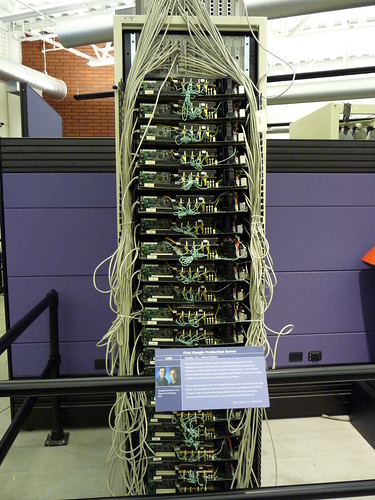
Google's first production server

Towards the end of a recent meeting with my supervisors I was asked a question that went something along the lines of: “do you buy the argument that if something is computational, that it is then necessarily reductive?” An excellent question I think. I suggested at the time, and still believe, there are two answers to this question that go together. First, by virtue of what computing ‘is’, as a machine-enabled set of processes that rely by and large on languages based in a formal logic, we must answer ‘yes’. Second, ‘computing’ as an activity and ‘computers’ as devices do not exist in a vacuum they are a part of our lives. I am writing a blog post using my laptop, connected to a network of other computers, run and maintained by people, allowing me to ‘publish’ my thoughts on a web site held on yet another computer, and hopefully some other people are reading this! Therefore, computing is definitely a part of the ‘politics of things‘, as suggested by Latour, with and by which we and others socialise.

My two answers are not mutually exclusive, “either/or”, they go together such that, I argue, we must increasingly see ‘computing’ as a connective capacity. Computing connects people with other people, people with ideas, information with things, etc etc. In this way, I have some sympathy for those, like Adam Greenfield, that suggest that “ubiquitous computing”, or something like it, was somewhat inevitable. However, I think hindsight definitely smoothes out the errors and stumblings along the way. If we think about ubiquitous computing as “the application of computational tools to human activity regardless of the shape and form of those tools”, following Scott Carter (whom I interviewed this summer), I think we can see computing as an ‘affordance’, the capacity to enable possible actions, which is innately connective. Here we might start looking to Gregory Bateson or Deleuze and Guattari to theorise such a connective capacity.

Why do I blog this? It is useful to keep probing concepts central to, and perhaps assumed, in one’s arguments, and I don’t want to lose sight of the fact that the idea of ‘computing’ is not neccesarily fixed.

Image: Google’s first server, held in the Computer History Museum, CA, taken by me.

Anticipation, innovation and the narratives of technical development

Ubiquitous computing is an interesting yet peculiar (empirical) focus for study by virtue of there being no devices or systems widely available commercially or publicly. This is at the heart of my research interest, the point of friction I feel compelled to address: ubiquitous computing largely exists as a confluence of anticipatory, imaginative and research & development practices. It is these assemblages of practice and the fields of relations therein that I hope will form the empirical focus of my project.

Continue reading “Anticipation, innovation and the narratives of technical development”

Masters Research

What follows is the Abstract to my Masters degree dissertation.

An End to Cyberspace? Metaphor, Affect and Socio-Technical Relations

Despite twenty-five years of the personal computer and a wealth of literature on all things ‘cyber-‘ the discussion of computer-mediated communication largely remains pre-figured by (misguided) binaries, such as ‘material’-‘electronic’ and ‘real’-‘virtual’. This dissertation (re)examines the metaphorical concepts enfolded in constituting computer-mediated place(s). Given the upsurge of social networking websites, this inquiry attends to the place(s) of contemporary phenomenon MySpace.com. After Doreen Massey and Nigel Thrift I utilise prominent theories of relationality, namely Actor-Network Theory. This is situated in an understanding, through the work of philosopher Gilles Deleuze and geographers such as J-D Dewsbury and Nigel Thrift, of a ceaselessly taking-place or becoming world, significantly motivated by the affectual. Following influential work on metaphor by Lakoff and Johnson and work on socio-technical relations, by geographers such as Nick Bingham and Stephen Graham, I chart a typology of transcendental, co-evolutionary and recombinatory metaphors for the Internet, with examples from a cross-section of literature. Evaluating how these metaphors are enrolled in the conception of place(s) is achieved through a dual methodology of interviews, with expert technological commentators and practitioners, and experimental Internet-based participant observation, using MySpace.com. I discuss the manner in which socio-technical assemblages such as MySpace can be considered place(s) through empirical evidence, arguing that a relational approach reveals a finer granularity and nuance to the production and performance of place. Interwoven through my analysis is an attention to the role of the pre-cognitive and impersonal motivations of affect. I move on to evaluate how our normative spatial metaphors orientate or map computer-mediated place(s) framed by the aforementioned typology of metaphor. This dissertation proposes an end to over-simplistic and technologically determinate notions of ‘cyberspace’ by offering a beginning – a conceptualisation of place as an intensity of socio-technical relations, which are an increasingly significant part of the intermeshing skein of networks that makes up the social world.

You can download a full copy of this dissertation. Please understand your downloading of the document as an agreement to respect the Creative Commons license it is issued under. If you are interested in this research feel free to contact me to discuss it more.