Video> Imagining automation – public talk

I gave a talk for the SW Futurists meet up group this week and they’ve recorded the talks. There are two speakers: Lucas Godfrey (Edinburgh) talked about the challenges of creating models of phenomena in the world so that you can automate things. I talked about the politics of the kinds of stories we tell about automation and how they orient our understandings of how automation might function. Both are included in the video but I’ve skipped to the start of my talk below.

Feel free to leave comments, ask questions etc. using the “Comments” function below… this presentation is sort of based on two bits of work about automation that have been developing as academic presentations. The first is about how we tell stories about work in relation to automation, and way we use ‘algorithm’ as a proxy for that idea. The second is about how we imagine what apparently automated/automatic technologies are doing and what they can do. I think both of these things constitute what I’ve come to call an “automative imaginary”… I started out calling this “algorithmic–“, but I don’t think that ‘s what I have ever really meant. I also don’t think, another fashionable term, “robots” is a particularly helpful way to frame the ideas I’m interested in. Anyway, I’m hoping to develop this into a journal article.

N. Katherine Hayles on UAVs/drones as ‘cognitive assemblages’

In a recent article in Critical Inquiry, N. Katherine Hayles formulates an understanding of particular kinds of technological support as ‘cognitive assemblages’ (sort of following Deleuze & Guattari*). She takes as her particular case study the advent of swarming, quasi-autonomous UAVs/drones and their use in warfare. The final paragraph of the piece is interesting but, for me, raises as many questions as it seeks to answer:

Language, human sociality, somatic responses, and technological adaptations, along with emotion, are crucial to the formation of modern humans. Whether warfare should be added to the list may be controversial, but the twentieth and twenty-first centuries suggest that it will persist, albeit in modified forms. As the informational networks and feedback loops connecting us and our devices proliferate and deepen, we can no longer afford the illusion that consciousness alone steers our ships. How should we reimagine contemporary cognitive ecologies so that they become life enhancing rather than aimed toward dysfunctionality and death for humans and nonhumans alike? Recognizing the role played by non conscious cognitions in human/technical hybrids and conceptualizing them as cognitive assemblages is of course not a complete answer, but it is a necessary component. We need to recognize that when we design, implement, and extend technical cognitive systems, we are partially designing ourselves. We must take care accordingly. More accurate and encompassing views of how our cognitions enmesh with technical systems and those of other life forms will enable better designs, humbler perceptions of human roles in planetary cognitive ecologies, and more life-affirming practices as we move toward a future in which technical agency and autonomy become increasingly intrinsic to human complex systems.

(Hayles, 2016: 55)

A couple of immediate questions pop out for me:

  1. Could you get designers of UAVs to factor in affective responses without reducing them to something like galvanic skin response or another quantifiable measure (which Hayles critiques in relation to MIT Prof. Sandy Pentland’s proselytisation of a ‘sociometer‘)?
  2. What is meant by “accuracy” in that final sentence?! How might we qualify the idea of “better” designs? This seems to assert a kind of ethics (and maybe aesthetics) antithetical to the institutions and companies that make military equipment – by not addressing this, there seems to me to be a risk of simply making naive assertions.

I appreciate Hayles’ attempt to harness a broadly Deleuzian understanding of cognition (which might be understood as “affect theory”) in attending to pressing contemporary issues such as the rise of “killer robots” (or quasi-autonomous technological platforms that can inflict death), however – it seems to me that the paper uses the case studies (taken from other researchers’ work, such as Chamayou) to validate the theory, rather than using the theory to critically interrogate the empirical state of affairs. This, it seems to me, is a shame (not least because there’s a fruitful application of aspects of How we became posthuman here), and, as observed above, leaves more questions than answers. Maybe that’s productive, it can open debates – but others are doing slightly more to qualify how we might problematise ethics in this arena. I’d recommend taking a look at Lucy Suchman’s work, especially “robot futures” and the Campaign to Stop Killer Robots…

Addendum: I’m not suggesting that Chamayou and other ‘droners’ are “right” and Hayles is somehow wrong… I’d definitely agree with Prof Louise Amoore who suggested on Twitter that those folk could do with reading Hayles’ (and Suchman’s) work

* I’m uncertain about the proposition of ‘cognitive assemblages’ – if we were to follow D&G’s theory of agencements would not all ‘assemblages’ be cognitive? The implication is, it seems, that the ‘cognitive’ in Hayles’ formulation is human cognition – which implies a human exceptionalism that might be seen as antithetical to D&G’s philosophy.

CFP> “Countercultures of Data” – Special Issue of Philosophy & Technology

Another interesting CFP and goodness knows this needs doing(!) I look forward to seeing what comes of this, should be great!

CFP: “COUNTERCULTURES OF DATA” – SPECIAL ISSUE OF PHILOSOPHY & TECHNOLOGY

Call for Papers for Philosophy and Technology’s special issue on Countercultures of Data

Guest Editor – Anna Lauren Hoffmann, School of Information – University of California, Berkeley

Journal cover featuring white text on blue backgroundAbout the Issue
25 years ago, Sandra Harding–in her influential book Whose Science? Whose Knowledge? Thinking from Women’s Lives–detailed and extended critical debates surrounding knowledge production and practices in science and technology. Collectively, these “countercultures of science” confronted the “problematics, agendas, ethics, and consequences” of scientific and technological production head on. Today, these same perspectives offer insight into the realm of data science, as philosophers, scholars, and practitioners alike grapple with ethical questions in a world where discourse, design, and governance increasingly revolve around “big” data and quantifiable knowledge.

This special issue will bring together rigorous conceptual and theoretical perspectives on what might best be called–following Harding–emerging “countercultures of data.” In particular, this issue will further critical and philosophical thinking about the theories, methods, institutions, and technological arrangements that underwrite or support data science in various industries and forms. Combined, contributions to the special issue will put forward a more realistic assessment of possible futures for a data driven world.

We invite submissions related (but not limited) to:

– Race and Data Science
– Theories of Property, Labor, and Data
– Political Economies of Data
– Data and Imperialism
– Feminist Perspectives on Data Science
– Data, Bodies, and Disability
– Data, Infrastructure, and the Environment
– Data, Philosophy, and the Law
– Communities and Data
– Data and Queer Subjects
– Data and/as Human Subjects in Research
– Data Science and Epistemic Justice

Timetable for Submissions
October 24, 2016: Deadline for paper submissions
December 21, 2016: Deadline reviews papers
February 6, 2017: Deadline revised papers
2017: Publication of the special issue

Submission Details
To submit a paper for this special issue, authors should go to the journal’s Editorial Manager http://www.editorialmanager.com/phte/
The author (or a corresponding author for each submission in case of co- authored papers) must register into EM.

The author must then select the special article type: “COUNTERCULTURES OF DATA” from the selection provided in the submission process. This is needed in order to assign the submissions to the Guest Editor.

Submissions will then be assessed according to the following procedure:
New Submission => Journal Editorial Office => Guest Editor(s) => Reviewers => Reviewers’ Recommendations => Guest Editor(s)’ Recommendation => Editor-in-Chief’s Final Decision => Author Notification of the Decision. (The process will be reiterated in case of requests for revisions.)

About the Journal
The journal addresses the expanding scope and unprecedented impact of technologies, in order to improve the critical understanding of the conceptual nature and practical consequences, and hence provide the conceptual foundations for their fruitful and sustainable developments. The journal welcomes high-quality submissions, regardless of the tradition, school of thought or disciplinary background from which they derive. The journal’s Editor-in-Chief is Luciano Floridi (Oxford).

Contact
For any further information please contact: Anna Lauren Hoffmann – annalauren [at] berkeley [dot] edu

Reblog> In praise of muddling – great post from Anne Galloway

Over on the More-Than-Human Lab blog Anne Galloway offers some wise words on the ways we might understand care: for learning and knowledge, for one another and for ourselves.

The full post is well worth a read, but here’s a couple of the many aspects I liked…

As a human being, and as a researcher, I feel a real duty to be with the world, not against the world. This doesn’t mean that I don’t believe in right and wrong, but it does mean that I think that right and wrong only ever exist as specific, local solutions to particular problems. This position is contrary to one which holds that there are objective morals that can be applied to all circumstances, and it is contrary to the position that we can, or should, ‘hate the sin, but not the sinner.’ (I can’t hate either.) Put a bit differently, I believe in allowing myself and others to muddle along, because in the end she’ll be right. (That last bit’s a wee joke, btw. Feel free not to laugh.)

…

Today I would call on María Puig de la Bellacasa’s reminder that: “[C]are can also extinguish the subtleties of attending to the needs of an ‘other’ required for careful relationality. All too easily it can lead to appropriating the recipients of ‘our’ care, instead of relating ourselves to them [“¦] Appropriating the experience of another precludes us from creating significant otherness, that is, from affirmingthose with whom we build a relation. How to care for the ‘oppressed’ is far from being self-evident (2012, p. 209).”

I bring this up because I want to distinguish care (which I loosely associate with compassion) from justice (which I loosely associate with passion). And here I would ally myself with Mol, Moser and Pols’ practices of care, which “may involve ‘justice’ but other norms (fairness, kindness, compassion, generosity) may be equally or more, important – and not in a foundational way, but as orientations among others (2010, p. 13).

Read the full post here.


The Museum of Contemporary Commodities in EXETER

The Museum of Contemporary Commodities

Just a quick note to let you know that the brilliant Paula Crutchlow has brought “The Museum of Contemporary Commodities” (MoCC) to Exeter for the majority of May.

There’s lots going on, much of it creative and interesting – so if you’re in Exeter or nearby: come and visit!

Two immediate things this week:

RIGHT NOW!: help re-create the internet in paper with Artist Louise Ashcroft from 11 -2 in the Exeter University Forum.

TOMORROW: sign up to do a data walkshop with Alison Powell from the LSE on Saturday from 10-1. Places have to be booked, and the Eventbrite page is here https://www.eventbrite.com/e/mocc-data-walkshop-tickets-24464719635

Please do visit the MoCC website for lots more events and activities taking place this month and visit the shop:

87 Fore St,
Exeter
EX46RT

Open 10:00-18:00pm Weds-Sat, 4th-21st May.

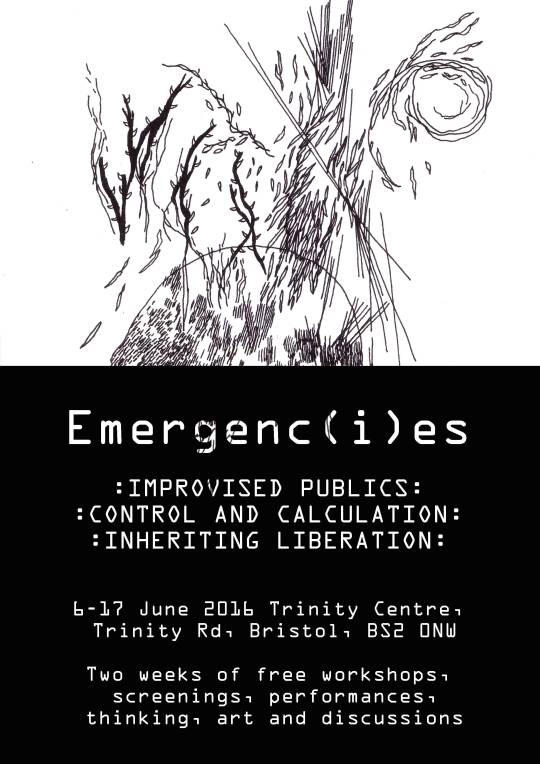
Reblog> Improvised Publics :: Control and Calculation :: Inheriting Liberation :: 6-17 June 2016

This event looks really interesting, check out the website for more information…

Emergenc(i)es – an event in Bristol between 6th and 17th June

Emergenc(i)es is an invitation to consider the emergency of the current historical moment.

The exhibition will dwell in the question of emergence within emergency.

Performance, education activities, visual art, screenings, installations, workshops and a library-cum-pharmacy will create time and space to diagnose, explore and understand the world we live in.

Enter – Relate – Improvise – Diagnose – Inherit – Public – Liberate – Gather

All activities are free to attend, thanks to generous funding from Awards for All.

Artefacts for generations growing up with robots

I’ve had this open in one of my tabs for ages with the intention of writing something about it here but I’ve sort of run out of time on that, so…

Here’s an interesting student project (I’d be delighted to have students like this!!) It’s a sort of deliberately controversial speculative design/ prototyping exercise to provoke thought and conversation about what it might mean to live with actually existing robots (not sci-fi androids).

The creators are: Stephan Bogner, Phillipp Schmitt and Jonas Voigt.

It’s worth a look…

RAISING ROBOTIC NATIVES

RaisingRoboticNatives-All.jpg

Artefacts for generations growing up with robots

Why do future visions of robotics incite discomfort in our generation? Could robots truly render us obsolete or is it our fear of losing control? And are these fears conditioned or instinctive?

Raising Robotic Natives explores interactions between children and robots that could raise them as the first generation of robotic natives.

Just like digital natives grow up in the digital world, robotic natives are born into an environment that is adapting to robots. As a result of unbiased, childlike enthusiasm, they are socialized with the technology early on. Through constant robotic interactions and formalized education, robotic natives get to think differently about robots than we do. It will be their responsibility to shape the future of robotics, not ours–besides we’re robotic immigrants, after all.

See the full details of the project here.

Prof. Louise Amoore awarded Leverhulme Major Research Fellowship for study: ‘Ethics of Algorithms’

This is lovely news – sounds like a really interesting project and I look forward to following this with great interest!

Professor Louise Amoore has been awarded a Leverhulme Major Research Fellowship (2016-2018) for a study of the Ethics of Algorithm

Ethics of Algorithm

Living in a world that is increasingly saturated with algorithmic processes has profound implications for ethics. The scholarly and public accounts of the ethical dimensions of algorithm have overwhelmingly placed the human being as the locus of ethical deliberation. Thus, philosophers and scientists search for ethical frameworks or guidelines for the human designers of software; legal scholars remind us that the protection of humans from “automated decisions made about them” by algorithms is enshrined in data protection law; and social scientists urge that the “black box” of algorithmic decisions be opened to critical scrutiny. Yet, the idea of an ethics that opens the algorithm to human scrutiny has important limits, not only because many algorithms are proprietary and secret, but more significantly because they can operate at a speeds and scales beyond the threshold of human perceptibility.

Louise’s Leverhulme Major Research Fellowship provides an account of the potential for an ethics of algorithm. In a tradition of ethics as the situated giving of an account of one’s actions at the limits of intelligibility – “I cannot give an account of myself without accounting for the conditions under which I emerge” (Judith Butler 2005) – the research excavates how the algorithm might give an account of itself and its emergence. The research develops six conceptual themes – to form the chapters of a book – opening up dimensions of the relation of algorithm to ethics: undecidability; doubt; cognition; perception; association; automation.

Projecting a genuine future for the living? On Latour & Stiegler comments after the Paris attacks

I was quite surprised at how quickly the translation of the short interview with Bernard Stiegler in le Monde spread on twitter, which is not usual for my posts…

Anyway, I have been struck by a similarity in ethos between the comments made by Bernard Stiegler in his interview and the commentary provided by Bruno Latour in an op-ed (translated by Jane Kuntz) for Reporterre, entitled “The Other State of Urgency” [via Installing (Social) Order].

It is an ethos of calling for the casting-off of a short-termism or ‘death-wish’ (pace Latour) focussed on (inadequately mitigating) destruction–destruction of states, of peoples and of our planet–towards affirming what Stiegler calls a ‘genuine’ future and what Latour sees as a taking of fate into our our hands. One might see it as a loosely vitalist ethos: an affirmation of life and its pluri-potency.

It seems to me significant that both Latour and Stiegler frame the issue in relation to the anthropocene and the COP21 talks being held in Paris. For both of them, the affirmation of a ‘genuine’ future entails combining stances towards ecological, economic, political and scientific atmospheres. Such an affirmation of a sustainable path towards a future of the living is set in contra-distinction to a rhetoric of war, which both thinkers reject in their own ways. To submit to war, in the manner of the French government, is to submit to a short-term imperative to (re)act, but to act for whom and to what ends is a question both Latour and Stiegler find troubling. It is analogous to government via catastrophism – such forms of reaction are already presumed in the mode of ‘normal’ operation: the ‘everywhere war’ and ‘state of exception’ is the new ‘normal’.

Who could argue against an affirmation of hope? I certainly would not. Yet, while there is plenty of diagnosis of the ‘state of urgency’, we are left to ponder: what is to be done?

I don’t think I buy Stiegler’s eurocentric call for policy, it is too easy to see how–even with the best of intentions–this would slip into the kind of technocratic malaise that has buggered up the Mediterranean EU countries. Yet, at least Stiegler attempts to offer strategies – and I think the wider outlining of a political-economics of contribution and of a kind of ‘neganthropy‘, while somewhat grandiloquent, remain inspiring. I would be very curious to see what Latour would suggest in order to “invent demonstrations more innovative than yet another march from Place de la République to Place de la Nation.”

It is, of course, excruciatingly hard to offer strategies for action – as Zizek likes to quip: we can see why it has been suggested that it is easier to imagine the end of the world than an end to the ideological milieu of capitalism. Working for a ‘genuine’ future hurts, but as both Latour and Stiegler demonstrate: it remains the task at hand.