Reblog> Internet Addiction watch “Are We All Addicts Now? Video

Twitter

Via Tony Sampson. Looks interesting >

This topic has been getting a lot of TV/Press coverage here in the UK.Here’s a video of a symposium discussing artistic resistance, critical theory strategies to ‘internet addiction’ and the book Are We All Addicts Now? Convened at Central St Martins, London on 7th Nov 2017. Introduced by Ruth Catlow with talks by Katriona Beales, Feral Practice, Emily Rosamond and myself…

@KatrionaBeales @FeralPractice @TonyDSpamson @EmilyRosamond & @furtherfield

Two excellent reflections on ethics in relation to Google’s AI principles

Holly from the UK TV programme Red Dwarf

Two excellent pieces by Anab Jain and Lucy Suchman that I recommend you read if you’re interested in studying technology (not just AI) that reflect upon Google’s announcement of its ‘AI principles’ and its apparent commitment not to work on the US Government’s “project Maven”.

Here’s a couple of quotes that stood out, but you should definitely read both pieces:

Corporate Accountability – Lucy Suchman

The principle “Be accountable to people,” states “We will design AI systems that provide appropriate opportunities for feedback, relevant explanations, and appeal. Our AI technologies will be subject to appropriate human direction and control.” This is a key objective but how, realistically, will this promise be implemented? As worded, it implicitly acknowledges a series of complex and unsolved problems: the increasing opacity of algorithmic operations, the absence of due process for those who are adversely affected, and the increasing threat that automation will translate into autonomy, in the sense of technologies that operate in ways that matter without provision for human judgment or accountability. […]

Tackling the Ethical Challenges of Slippery Technology – Anab Jain

The overriding question for all of these principles, in the end, concerns the processes through which their meaning and adherence to them will be adjudicated. It’s here that Google’s own status as a private corporation, but one now a giant operating in the context of wider economic and political orders, needs to be brought forward from the subtext and subject to more explicit debate.

Given the networked nature of the technologies that companies like Google create, and the marketplace of growth and progress that they operate within, how can they control who will benefit and who will lose? What might be the implications of powerful companies taking an overt moral or political position? How might they comprehend the complex possibilities for applications of their products? […]

How many unintended consequences can we think of? And what happens when we do release something potentially problematic out into the world? How much funding can be put into fixing it? And what if it can’t be fixed? Do we still ship it? What happens to our business if we don’t? All of this would mean slowing down the trajectory of growth, it would mean deferring decision-making, and that does not rank high in performance metrics. It might even require moving away from the selection of The Particular Future in which the organisation is currently finding success.

How can we engage the ethics of data science in practice? barocas & boyd

Stereotypical white male figure of a data scientist

From “Engaging the ethics of data science in practice” published in Communications of the ACM, available here.

The critical writing on data science has taken the paradoxical position of insisting that normative issues pervade all work with data while leaving unaddressed the issue of data scientists’ ethical agency. Critics need to consider how data scientists learn to think about and handle these trade-offs, while practicing data scientists need to be more forthcoming about all of the small choices that shape their decisions and systems.

Technical actors are often far more sophisticated than critics at understanding the limits of their analysis. In many ways, the work of data scientists is a qualitative practice: they are called upon to parse an amorphous problem, wrangle a messy collection of data, and make it amenable to systematic analysis. To do this work well, they must constantly struggle to understand the contours and the limitations of both the data and their analysis. Practitioners want their analysis to be accurate and they are deeply troubled by the limits of tests of validity, the problems with reproducibility, and the shortcomings of their methods.

Many data scientists are also deeply disturbed by those who are coming into the field without rigorous training and those who are playing into the hype by promising analyses that are not technically or socially responsible. In this way, they should serve as allies with critics. Both see a need for nuances within the field. Unfortunately, universalizing critiques may undermine critics’ opportunities to work with data scientists to address meaningfully some of the most urgent problems.

Reblog> Good Data: Call for Proposals for Theory on Demand edited book

My Cayla Doll

From the Institute of Network Cultures:

Good Data: Call for Proposals for an INC Theory on Demand edited book

Editors: Angela Daly (Queensland University of Technology), Kate Devitt (Queensland University of Technology) & Monique Mann (Queensland University of Technology).

In recent years, there has been an exponential increase in the collection, aggregation and automated analysis of information by government and private actors, and in response to this there has been a significant critique regarding what could be termed ‘bad’ data practices in the globalised digital economy. These include the mass gathering of data about individuals, in opaque, unethical and at times illegal ways, and the increased use of that data in unaccountable and potentially discriminatory forms of algorithmic decision-making by both state agencies and private companies. Issues of data ethics and data justice are only likely to increase in importance given the totalizing datafication of society and the introduction of new technologies such as artificial intelligence and automation.

In order to paint an alternative, more optimistic but still pragmatic picture of the datafied future, this open access edited collection will examine and propose what could be termed ‘good’ and ‘ethical’ data practices, underpinned by values and principles such as (but not limited to):

  • privacy/regulation/information security by design
  • due process rights
  • procedural legitimacy
  • the protection of individual and collective autonomy
  • digital sovereignty
  • digital anti-discrimination
  • data and intersectionality
  • ethical labour practices
  • environmental sustainability.

Chapters should be short contributions (2500-5000 words) which can take differing forms, for example:

  • Manifestos for Good Data
  • Position papers
  • Traditional academic chapters

Chapters can be theoretical takes or provocations on what Good Data is or should be, or can be case studies of particular Good Data projects and initiatives e.g. Indigenous data sovereignty initiatives, data cooperatives etc. Chapters can also be critiques of initiatives/movements which claim to be ethical but in fact fall short. All chapters, including academic ones, should be written in an accessible way and avoid the excessive use of jargon, etc. Academic chapters will be peer-reviewed. Other contributions will be editor-reviewed.

We encourage contributions from throughout the world and from different disciplinary perspectives: philosophy, media and communications, cultural studies, STS, law, criminology, information systems, computer science etc.

Proposals for chapters (up to 250 words) should be sent to Kayleigh Hodgkinson Murphy (kayleigh.murphy@qut.edu.au) by Friday 15 December 2017. Please include a brief biography (academic/practitioner) and signal what kind of chapter you are proposing (manifesto/academic chapter, etc).

If you have an idea for a chapter and want to discuss it before submitting a proposal, please contact Angela Daly (angela.daly@qut.edu.au) as soon as possible. We may be able to pair, for example, practitioners with academic authors on request.

Decisions on proposals will be made by mid-January 2017, with a first full draft of chapters to be submitted by 31 March 2018. We anticipate the book will be finalized and launched in late 2018, as part of the Institute of Network Cultures’ Theory on Demand series.

John Danaher interview – Robot Sex: Social and Ethical Implications

Gigolo Jane and Gigolo Joe robots in the film A.I.

Via Philosophical Disquisitions.

Through the wonders of the modern technology, myself and Adam Ford sat down for an extended video chat about the new book Robot Sex: Social and Ethical Implications (MIT Press, 2017). You can watch the full thing above or on youtube. Topics covered include:

  • Why did I start writing about this topic?
  • Sex work and technological unemployment
  • Can you have sex with a robot?
  • Is there a case to be made for the use of sex robots?
  • The Campaign Against Sex Robots
  • The possibility of valuable, loving relationships between humans and robots
  • Sexbots as a social experiment

Be sure to check out Adam’s other videos and support his work.

Reblog > The Priority of Injustice

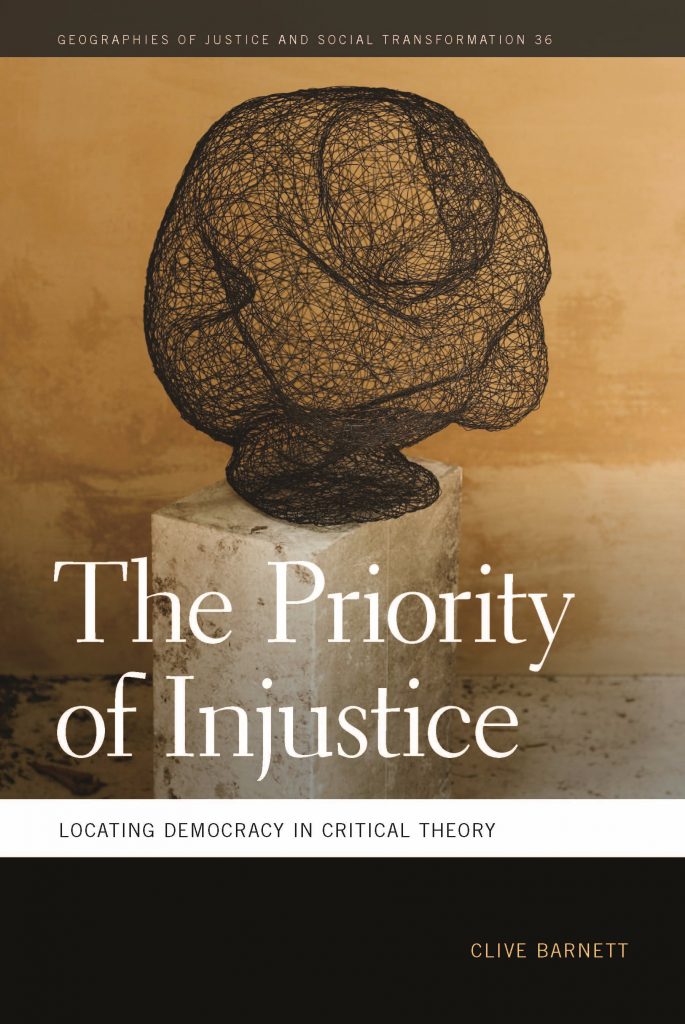
The Priority of Injustice – Clive Barnett

My colleague Prof. Clive Barnett’s excellent new book is out. He introduces it in a recent blogpost:

The Priority of Injustice

So, finally, the book that I have been writing, on and off, for the last four years, The Priority of Injustice, has been published – or at least, it’s real, since the formal publication date is next month (so I reserve the right to blog further about it as and when). It arrived earlier this week – a rather hectic week, which has oddly meant I have been too busy to experience the strange sense of anti-climax that often accompanies the arrival of the finished form of something that you have been making for so long.

This is, in one sense, my Exeter book – the first thing I did in my very first week here, four years ago, was write the proposal and send it off to prospective publishers, It’s also, though, my Swindon book, a book which attempts to articulate an approach to theorising in an ordinary spirit which has been published just a few weeks after moving away from that very ordinary town where I have lived while writing it.

It’s a beautiful object, with a great cover image, by Helen Burgess (I bought one of her pictures once, in one of those open-house art trail events that you get in places like Bishopston in Bristol, so that’s why I knew of her work; it turns out she is part of a geography-friendly network of artists). And I am honoured and humbled to have the book published in University Georgia Press’s very excellent Geographies of Justice and Social Transformation series.

I’m now faced with the challenge of promoting the book. I’m quite fond of the Coetzee-esque principle that books should have to make their own way in the world without the help of the author; on the other hand, I have some sense of responsibility towards the argument made in the book, a responsibility to help project it into the world. I’ve already realised that it’s not the sort of book that lends itself to an easy press release – ‘THEORY COULD BE THEORISED DIFFERENTLY’, SAYS THEORY-BOY doesn’t really work as a headline, does it?.

Read the full blogpost.

AI Now report

My Cayla Doll

The AI Now Institute have published their second annual report with plenty of interesting things in it. I won’t try and summarise it or offer any analysis (yet). It’s worth a read:

The AI Now Institute, an interdisciplinary research center based at New York University, announced today the publication of its second annual research report. In advance of AI Now’s official launch in November, the 2017 report surveys the current use of AI across core domains, along with the challenges that the rapid introduction of these technologies are presenting. It also provides a set of ten core recommendations to guide future research and accountability mechanisms. The report focuses on key impact areas, including labor and automation, bias and inclusion, rights and liberties, and ethics and governance.

“The field of artificial intelligence is developing rapidly, and promises to help address some of the biggest challenges we face as a society,” said Kate Crawford, cofounder of AI Now and one of the lead authors of the report. “But the reason we founded the AI Now Institute is that we urgently need more research into the real-world implications of the adoption of AI and related technologies in our most sensitive social institutions. People are already being affected by these systems, be it while at school, looking for a job, reading news online, or interacting with the courts. With this report, we’re taking stock of the progress so far and the biggest emerging challenges that can guide our future research on the social implications of AI.”

There’s also a sort of Exec. Summary, a list of “10 Top Recommendations for the AI Field in 2017” on Medium too. Here’s the short version of that:

  1. 1. Core public agencies, such as those responsible for criminal justice, healthcare, welfare, and education (e.g “high stakes” domains) should no longer use ‘black box’ AI and algorithmic systems.
  2. 2. Before releasing an AI system, companies should run rigorous pre-release trials to ensure that they will not amplify biases and errors due to any issues with the training data, algorithms, or other elements of system design.
  3. 3. After releasing an AI system, companies should continue to monitor its use across different contexts and communities.
  4. 4. More research and policy making is needed on the use of AI systems in workplace management and monitoring, including hiring and HR.
  5. 5. Develop standards to track the provenance, development, and use of training datasets throughout their life cycle.
  6. 6. Expand AI bias research and mitigation strategies beyond a narrowly technical approach.
  7. 7. Strong standards for auditing and understanding the use of AI systems “in the wild” are urgently needed.
  8. 8. Companies, universities, conferences and other stakeholders in the AI field should release data on the participation of women, minorities and other marginalized groups within AI research and development.
  9. 9. The AI industry should hire experts from disciplines beyond computer science and engineering and ensure they have decision making power.
  10. 10. Ethical codes meant to steer the AI field should be accompanied by strong oversight and accountability mechanisms.

Which sort of reads, to me, as: “There should be more social scientists involved” 🙂

Our friends electric

Another wonderful video from superflux exploring how to think about the kinds of relationships we may or may not have with our ‘smart’ stuff…

Our Friends Electric from Superflux on Vimeo.
Our Friends Electric is a short film by Superflux about voice-enabled AI assistants who ask too many questions, swear & recite Marxist texts.

The film was commissioned by Mozilla’s Open IoT Studio. The devices in the film are made Loraine Clarke and Martin Skelly from Mozilla’s Open IoT Studio and the University of Dundee.

For more information about the project visit: http://superflux.in/index.php/work/friends-electric/#