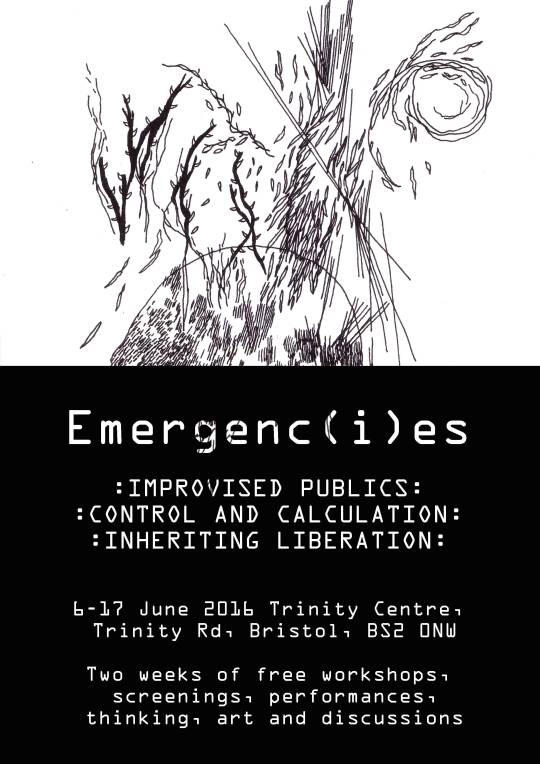
Reblog> Improvised Publics :: Control and Calculation :: Inheriting Liberation :: 6-17 June 2016

This event looks really interesting, check out the website for more information…

Emergenc(i)es – an event in Bristol between 6th and 17th June

Emergenc(i)es is an invitation to consider the emergency of the current historical moment.

The exhibition will dwell in the question of emergence within emergency.

Performance, education activities, visual art, screenings, installations, workshops and a library-cum-pharmacy will create time and space to diagnose, explore and understand the world we live in.

Enter – Relate – Improvise – Diagnose – Inherit – Public – Liberate – Gather

All activities are free to attend, thanks to generous funding from Awards for All.

Stiegler: Stop the uberisation of society!

Posted below is a translation of a piece co-authored by Bernard Stiegler with Ariel Kyrou (journo),  Yann Moulier-Boutang (writer) and Bruno Teboul (Director of innovation at Keyrus) and published in Libération on the 10th April.

I suppose it doesn’t really propose anything especially novel, if you’re familiar with others involved in debates around “postcapitalism”, automation, worklessness and universal income (e.g. Srnicek and Williams, or Mason). What is perhaps novel is an application of the ideas in a distinctly European flavour, with examples in France and in the context of a much more robust unionised response to Uber (and the task/gig economy).

Anyway, it’s an interesting read I think…

The piece is rather conversational in tone and uses idioms I have only been able to infer (not being a fluent and native speaker) so it was quite difficult to translate, and so I’m pretty sure there are errors. As usual clarifications or original French are in [square brackets].

Stop the uberisation of society!

Libération, 10th April

The war by taxi companies against an Uber society cannot be reduced to the storyline of a film depicting an ancient evil battling benevolent forces of modernity. If on the one hand the participatory economy threatens our social structures, it can also, on the other, make possible a society with greater solidarity.

Since the first moves towards the draft Thévenoud law in June 2014[1], the urban transport soap opera has generated multiple variations on the theme of the standard storyline. On one side are the taxi federations, which have been labelled a horde of grumpy medieval malthusians by Uber, who in the opening of the second act of the performance of the trial of the 11th February demanded a whopping €100m in damages from Uber, on the other the ‘white knight’ of the new economic order, the high-tech Robin Hood of its pleb users whose UberPop service enables simple fellows in search of employment the opportunity to offer at cut-price their talents for automotive locomotion, between February 2014 and July 2015. This tale of jokers against modernisers is more attractive than the G7, queen of opaque rentier sorcery, who could not turn themselves with the wave of a magic wand into the cinderella of Parisian Transport.

Except that the movie script of the ancient evil against the benevolent ‘disruptors’ rings as hollow as any Hollywood blockbuster: seen quickly, soon forgotten. It works in the short-term, like the groan of the indefinite vigil for a taxi at 3 o’clock in the morning in the banlieue, but it hardly takes us any distance towards solving the questions about the future of our society and the search for sustainable solutions to the crisis we are experiencing.

Let’s not misunderstand this scenario: the agonism presented by this contemporary drama [série du moment] is neither the ardent need to pit global start-ups against French corporatism [corporatismes franchouillards] nor its exact opposite, namely the obligation to defend the capitalism of tired old barons against the hyper-capitalism of the rulers of the digital future. No, the issue that should be obvious to everyone with a stake in the debate is the urgent need to think about the society we want, and then act in order to build it.

For why should we anoint an ‘uberisation of the economy’ without interrogating its ideology and long-term deleterious effects? Uber, which declares only a fraction of its profits in France thanks to a complex form of tax evasion through the Netherlands, Bermuda and Delaware, is participating in the liquidation of our social structures. It embodies a short circuit that threatens the fragile economic balance between taxation, social law, transport policy, infrastructure investment at the local level and the pensions system. Worse still: its social and economic logic foreshadows the advent of a futuristic no-man’s land in which the a priori ideal of liberty becomes monetised against an a posteriori generalised casualisation throughout society. Indeed, the rictus predatory behaviour of platforms like Uber, Lyft and others such as Amazon’s Mechanical Turk is founded upon a low intensity of capital, little infrastructure, a minimum of salaried employees with more independent or self-employed workers.

The uberisation process forms the first wave in the tsunami of automation. Its primary consequence will be a net loss of five million jobs in industrialised countries by 2020, according to a report published on the 18th of January by the oracles of the World Economic Forum in Davos, the shameless apostles of the “fourth industrial revolution”. This deeply unappealing assertion has been amplified by several studies in the last three years (by Oxford, MIT, the Breugel Institute and Roland Berger) which predict around 47% fewer people in employment by 2025. This slow but inexorable extinction of of the salaried world effects not only warehouse workers, supermarket cashiers and lorry drivers but also barristers, solicitors, journalists, those working in medicine, and so on. Why should it remain necessary to use human beings for tasks that are reducible to systematic procedures? Which in our data economy robots and algorithms will soon perform much more efficiently. The combination of robotics and ‘big data’, algorithms and network effects, is already transforming us into the involuntary gravediggers for salaried employment. Welcome to a world that is ultimately ‘flexible’, boosted by robotic automation [robotisation] and work on the meter. A world where users and customers constantly account for themselves, where each becomes their own big brother and where most of the activity in every market, like with car insurance, will increasingly play out more in an automated big data-driven fashion than according to laws or to forms of trust that are not based in calculation.

Nevertheless we should beware skewed perspectives: such a world is not inevitable. The digital gives us an opportunity to reconsider work not only in terms of jobs doomed to become ever more precarious, provoking anxiety about self-exploitation, but also as a part of a project for a contributory society in which salaried employment would be one means amongst many, rather than an end in itself. A company like TaskRabbit certainly creates use value through its platform of small on-demand jobs, but it keeps for itself and its shareholders the [accompanying] exchange value in the form of profit. In contrast, Loconomics is a co-operative owned by those who use it to advertise their services. Against the platforms of the so-called sharing economy (which it is in name only) Trebor Scholz endorses a ‘platform cooperativism’ [2] to build a society of commons that operates beyond solely economic and financial dimensions.

This shambles needs to be urgently addressed. Thinking in the long-term, this is political in the principal sense of the word. To buckle down to the future of work equally concerns: expertise in data to use and liberate ourselves from algorithms and a care for people without the need for machines; to classify work in a way that is both protective of our ways of life and much less administrative than today; to examine the establishment of an adequate basic income, structurally justified by massive unemployment due to automation and the coming slow death of employment; to experiment with the extension of the regime of casual work in the context of a true society of contribution, with the acquisition and sharing of knowledge by and between everyone; to study tax reform based upon the principles of a financial transactions tax [la taxe pollen], beginning with the establishment of a European tax on the flows of High Frequency Trading, to finance a universal income.

Rather than the two opposing and yet complimentary nightmares that are the integral uberisation of society and the sovereignist protection of the capitalism of yesteryear we prefer the realisation of a dream: to imagine, to experiment, to build, step by step, a freer society with greater solidarity; preferring disagreement to the brainwashing that has played out, historically, through the carrot and the stick, or, in our high-tech times, through a blind obedience to shiny artificial devices [l’obéissance aveugle à de rutilantes mécaniques artificielles et augmentées].

1. For more information on the Thévenoud law see this article – Sam.

2. See this article on Medium by Scholz.

Reblog> Civil Society 4.0 – Refugees and Digital Self Organization

This conference/hackathon at HKW in Berlin looks brilliant – it’s a part of a fantastic programme for 2016, including the exhibition Nervous System, which I hope to take our 2nd year field trip students to in March.

Civil Society 4.0 – Refugees and Digital Self Organization

2016, Mar 03, Thu – 2016, Mar 05, Sat

Refugee-Hackathon | © Lionel-Kreglinger/Berlin 2015

Refugee-Hackathon | © Lionel-Kreglinger/Berlin 2015

Refugees are also digital trailblazers; the use of smartphones and social media are essential both for their escape and for everyday life in their new homes. For voluntary refugee aids, digital tools are also of great importance. Recently projects such as the platform www.arriving-in-berlin.de have demonstrated how important the web is for the self-organization of refugees. The Civil Society 4.0 conference aims to network the many initiatives and projects.

Arriving in Berlin is an example of a participatory online platform in which refugees map their new city of Berlin based on their own experiences and needs. The huge response to the launch of the interactive map on social networks reveals the demand for projects by refugees for refugees. The first Refugee Hackathon held in Berlin in October 2015 was similarly popular. Initiated by Anke Domscheit-Berg, it united 300 programmers and designers in Berlin who developed 18 projects including place4refugees.de and volunteer-planner.org. The Facebook page “Moabit hilft!” is the largest social media platform in Berlin aimed at making life easier for refugees in their new neighborhoods. The group Refugees Emancipation e.V. has set the goal of setting up Internet cafés in refugee accommodations where they can help each other learn basic computer skills in order to be able to program online applications according to their own needs.

A three-day conference at Haus der Kulturen der Welt will center on digital self-organization by refugees. Between March 3 and 5, 2016 existing projects will present themselves while workshops probe the potentials of project and partner synergies. The idea of the hackathon will be taken up by programmers working together with refugees on the relevant tools.

In cooperation with Asyl-in.de, Chaos Computer Club Berlin e.V., Hackathon, Maptime Berlin, Metrozones

Reblog> CFP: Participatory Activism

CFP: Participatory Activism

How to Do It – Call for Papers

Creating Bottom up Political Participation

9-10th April 2016 | Kings College London

This conference brings together academics, political activists and community organisers to contribute to the working out of a question central to the current political climate: ‘how can we create progressive and effective political participation?’ From citizen engagement to radical collective action, the focus of the event is how ‘ordinary’ people can come together to collectively act upon and change their environment.

We are living in a time where conventional political processes are losing credibility and traction, as access to social justice is blocked by the capturing of the state by neoliberal forces. There are substantial academic and mainstream literatures on how states, governments and corporate organisations can act upon their citizens for their own ends. Yet there is a big gap in the knowledge of citizens on how to mobilise popular cultural and political participation.

The challenge is to create determined and conscious collective action, which can be effective, shared and scaled up. Left-wing alternatives are frequently discussed but these ideas often quickly stall as pragmatic processes remain under explored and are never fully envisaged. Too often well-intentioned thoughts fail to translate into action.

This event seeks to generate and share concrete knowledge of how bottom up radical political participation can succeed. It aims to reach out beyond the academy to bring people together to strategise, network and celebrate our collective potential to create a better world. It will bring together disparate knowledge to identify best practice. This will be done through a collective and deliberative process; identifying effective sequences and combinations of campaigning tactics and mechanisms, and a practical programme of radical political social change to move towards a truly democratic culture. The event seeks to challenge the established political class and provide a pre-figurative inspiration of popular deliberation to show that another world is possible.

Relevant topics will include:

  • Participatory education
  • Practice: the stories of actual existing politicised groups and communities
  • Encouraging participation through accessible political language
  • Participation through radical art and culture
  • Opportunities and challenges of participatory organisation in the global city
  • Political strategies and tactics for participatory mobilisation
  • Radical media organisations and strategies
  • Models of participatory organisation and political decision-making

Further information and submission guidelines can be found here: https://how2doit2016.wordpress.com/

Imogen Heap on inventing new [blockchain] contracts for publishing/selling music digitally

This interview/article in Forbes with Imogen Heap offers an interesting insight into what some artists are beginning to think about in relation to how on earth one creates a ‘fair’ mechanism of reward/recognition of work as an artist in a world where one’s work is subject to near infinite digital reproducibility.

This, to me (in my naivety), seems to represent one of the more compelling and believable implementations of what the blockchain can enable. It’s worth checking out Heap’s articulation of Mycelia (the blockchain powered music publishing system she hopes to help create).

For years I’ve been so frustrated with the deep opacity of the music industry stopping me from really making the most out of my career and connecting the dots. The ‘black boxes,’ the NDAs, the endless contracts and statements. In the last few years, auditing labels and publishers seems to have become the norm, as it’s apparent how consistently the books don’t match up. You can pretty much guarantee you’ll find something, but it’s not always intentional; it’s just the deals, trigger points, and percentages are so complex – even more when mergers and acquisitions occur – that it’s hard to get it right every time, if you’re human!

[Mycelia…]

Its success will come from the adoption of millions of music lovers. A grand scale ongoing, collective project like no-other. To document, protect and share that which we love and build a place for it to grow, enabling future generations of artists to blossom as well as honouring those of the past.

Open source, a living, breathing, smart, decentralised, transparent, adaptable, useful, shining home for our love of music. A home which allows creativity to flow, connect and facilitate collaboration on so many levels, many of which just haven’t been possible. With this grand library of all music forming the basis upon which all music businesses from digital radio to tour bookings can then grow and thrive from. Empowering the artists, turning and landing the industry finally on its feet.

Inspired by the largest living organisms on earth, ancient, unseen, core to life itself, Mycelium (plural Mycelia) can stretch for miles, beneath the surface.

Each artist acting like its own Mycelium, in full animated dialogue with others on the global network.

Mycelia is huge, as it holds all music related information ever recorded anywhere ever ever ever but this organism stretches across our planet between hundreds of thousands of personal computers. It is the world’s greatest and most treasured library and it belongs to the two collective parties who solely make music complete. The music makers and their audience.

Read the whole piece here.

Projecting a genuine future for the living? On Latour & Stiegler comments after the Paris attacks

I was quite surprised at how quickly the translation of the short interview with Bernard Stiegler in le Monde spread on twitter, which is not usual for my posts…

Anyway, I have been struck by a similarity in ethos between the comments made by Bernard Stiegler in his interview and the commentary provided by Bruno Latour in an op-ed (translated by Jane Kuntz) for Reporterre, entitled “The Other State of Urgency” [via Installing (Social) Order].

It is an ethos of calling for the casting-off of a short-termism or ‘death-wish’ (pace Latour) focussed on (inadequately mitigating) destruction–destruction of states, of peoples and of our planet–towards affirming what Stiegler calls a ‘genuine’ future and what Latour sees as a taking of fate into our our hands. One might see it as a loosely vitalist ethos: an affirmation of life and its pluri-potency.

It seems to me significant that both Latour and Stiegler frame the issue in relation to the anthropocene and the COP21 talks being held in Paris. For both of them, the affirmation of a ‘genuine’ future entails combining stances towards ecological, economic, political and scientific atmospheres. Such an affirmation of a sustainable path towards a future of the living is set in contra-distinction to a rhetoric of war, which both thinkers reject in their own ways. To submit to war, in the manner of the French government, is to submit to a short-term imperative to (re)act, but to act for whom and to what ends is a question both Latour and Stiegler find troubling. It is analogous to government via catastrophism – such forms of reaction are already presumed in the mode of ‘normal’ operation: the ‘everywhere war’ and ‘state of exception’ is the new ‘normal’.

Who could argue against an affirmation of hope? I certainly would not. Yet, while there is plenty of diagnosis of the ‘state of urgency’, we are left to ponder: what is to be done?

I don’t think I buy Stiegler’s eurocentric call for policy, it is too easy to see how–even with the best of intentions–this would slip into the kind of technocratic malaise that has buggered up the Mediterranean EU countries. Yet, at least Stiegler attempts to offer strategies – and I think the wider outlining of a political-economics of contribution and of a kind of ‘neganthropy‘, while somewhat grandiloquent, remain inspiring. I would be very curious to see what Latour would suggest in order to “invent demonstrations more innovative than yet another march from Place de la République to Place de la Nation.”

It is, of course, excruciatingly hard to offer strategies for action – as Zizek likes to quip: we can see why it has been suggested that it is easier to imagine the end of the world than an end to the ideological milieu of capitalism. Working for a ‘genuine’ future hurts, but as both Latour and Stiegler demonstrate: it remains the task at hand.

Critical reflection on the ‘sharing economy'(?)

“Sharing is caring“, The Circle – David Eggers.

“the question of work time outside employment is posed with renewed vigour, having been totally ignored by the law reducing the working week to thirty-five hours, just as it ignored the exhaustion  of the consumerists industrial model, a model within which production and consumption constitute a functional opposition, but one that has now become obsolete”, For a New Critique of Political Economy – Bernard Stiegler.

I have had a bunch of tabs open in my browser with they intention of writing something about the ‘sharing economy’ and how one might begin to ask questions of the kinds of words we use to variously describe reconfigurations of labour/work in relation to peer-to-peer, precarious work, casualisation and (perhaps) the slow dissolution of labour movements but (as one can easily guess) I just don’t have the time to make something coherent about this… so here’s some notes, off the top of my head, with some pointers to things that may be worth reading…

In the Grauniad (as it struggles to contend with a Labour party that is significantly to the left of it) there was a piece by Alex Hern arguing that the term the ‘sharing economy’ should “die”. His argument is that what the ‘sharing economy’ supposedly denotes is no kind of sharing but rather the continuation of unequal labour relations between those with wealth and those in need of work – an example is TaskRabbit: a system to hire temporary labour, such as caterers, cleaners or someone to stand in the queue for the latest iPhone (probably without needing to ensure competitive remuneration, because people who are willing to stand in a queue for you are probably in a precarious position).

I have some sympathies with the argument  – it’s a reworking of the ‘precariat’ argument, best expressed by Guy Standing, in which the rejigging of the economy has created a new class of worker that is reliant upon ‘precarious’ (temporary, difficult and unpredictable) forms of work. However, reducing it to worrying over terminology seems to miss a broader point: regardless of what you call it, any attempt at novel economic activity will attract those who seek to be exploitative.

Before going on to think about how to address this state of affairs, it is worth noting that some have tried to think about how/why we are in such a situation. Izabella Kominska (on the FT website) offers a good overview of some of the ways in which economists have thought about post-Fordism ~ the kinds of automation that are (and are not) happening in manufacturing, the movements of labour (offshoring etc.) and why we don’t have the amount of leisure time and levels of productivity promised by greater automation.

Indeed, in order to extract more profit in an economy of apparently ever-increasing abundance many argue that it is only through business/industry clawing back a more exploitative relation with the labour force that they can continue to extract the levels of profit to which we have all become accustomed. We can look to the likes of the Italian post-Fordists, such as Berardi, Lazzarato, Terranova and Virno; to net critics such as Morozov; and to Bernard Stiegler for articulations of these latest forms of proletarianisation [you don’t have to agree, I’m just pointing out this is an argument that contextualises the ‘sharing economy’]. It is in this context of a decline in the amount of work – a decline of ‘careers’ and a growth of ‘jobs’, that Melissa Gregg articulates the need to rethink our words for labour and to critically think about what might underlie the push for a ‘sharing’ economy.

It is in this context that one might formulate a critique of the ‘sharing economy’ –– the talismans of this novel form of economic practice, the likes of Uber, TaskRabbit and Airbnb, all extract value out of people either rendering their traditional working capacities more ‘flexible’ (or precarious) or by those people seeking to monetise other parts of their lives, e.g. where they live, the stuff they own, or their ‘leisure time’.

The proponents of these kinds of work argue that this offers ‘flexibility’ – work when you want, how you want etc. but one might counter this with the argument that as flexible labour you have to be opportunistic and so you are precisely not working when you want but rather when there is a demand for your work.

Likewise, many of the kinds of ‘work’ that are offered through the ‘sharing economy’ platforms necessarily constitute unequal power relations. The two principal actors in the contract of ‘sharing’ work are not equal: the ‘sharing’ systems rely on creating competition, and thus a ‘scarcity’ of work such that the ‘customer’ has choice and the ‘worker’ doesn’t. The third actor, the platforms themselves, are also seeking to extract value out of the ‘sharing’ of labour by acting as the mediator, which means the system itself is always geared to the creation of a margin.

Seen as a precarious form of work, the ‘sharing economy’ has been labelled otherwise as the ‘gig economy’ and there’s been some interesting discussions about what such work means to us in terms of our mental and physical health. For example, these two pieces in the FT:

The silent anxiety of the sharing economy
New ‘gig’ economy spells end to lifetime careers

Both of which have lots of links to follow up.

The other aspect of an emerging critique of the ‘sharing economy’ is precisely the ‘platform‘ nature of the kinds of systems that are seeking both to further and to profit from these apparently new forms of work. As sebastian olma suggests in a piece for the Institute of Network Cultures:

These are digital platforms that roughly do two things: either making the old practice of re- and multi-using durable goods more efficient or expanding market exchange into economically uncharted territory of society.

Olma argues (as do other) that what these platforms do is render available to the market things that have not been previously…

They stand for a digitally enabled expansion of the market economy, which…is the opposite of sharing.

This is what Sascha Lobbo (amongst others – Gary Hall is good on this) has argued constitutes not a ‘sharing economy’ but a ‘platform capitalism’. Rather than marketplaces, platforms are a kind of generic connective infrastructure, what Olma calls an ‘ecosystem’, that connects customers and companies to anything, not just specific goods or services. He argues that

While it is absolutely true that internet marketplaces and digital platforms can reduce transaction costs, the claim that they cut out the middleman is pure fantasy.

the old ‘middlemen’ [sic.] are replaced by more powerful gatekeepers: “monopolies with an unprecedented control over the markets they themselves create”, through the quasi-autonomous systems (what get popularly referred to as ‘algorithms’) that facilitate such things as Uber’s “surge pricing“. In this way every transaction becomes an auction, which is tipped in the favour of the platform, and the worker is rendered always to some extent precarious.

Indeed, the reality of working in such systems is not only possibly very stressful, as argued in the FT piece linked a bit earlier, but also doesn’t even necessarily offer the positive outcomes that the proponents claim. As Sarah Kessler, a Fast Company journalist, noted in her extensive report of her attempt to become one of the ‘sharing economy’ workforce:

For one month, I became the “micro-entrepreneur” touted by companies like TaskRabbit, Postmates, and Airbnb. Instead of the labor revolution I had been promised, all I found was hard work, low pay, and a system that puts workers at a disadvantage.

This critique presents some interesting challenges to those who espouse alternative modes of working and performing economic activities, such as the P2PFoundation, and Stiegler’s push for an ‘economy of contribution‘ through Ars Industrialis. However, the ‘platform capitalism’ of Uber et al. is not the only way to run such a system.

Rather than resort to a gatekeeper model we might alternatively look to the (supposedly) radical transparency of the blockchain – in this way I’m left with some (probably quite muddled) questions:

  • What kind of economy/ economics is performed when the transactional infrastructure is decentralised?
    • Can you actually do without an intermediary (‘middleman’ [sic])?
    • Does a blockchain infrastructure facilitate enough of a commons to make a ‘no transaction cost’ economy possible?
  • Can we reduce ‘sharing’ to an issue of the negotiation of trust (not to be exploited), solvable by the blockchain?

There must be more/better questions but my brain is fried… I hope that this is at least useful for me to return to as a set of loose notes and perhaps even useful for others vaguely interested in such things. Likewise, as usual, if you’re better informed and want to pitch in – please do leave comments 🙂

The Human Face of Cryptoeconomies – @furtherfield exhibition

I just wanted to flag this excellent exhibition about to start at Furtherfield (in London). It involves the Museum of Contemporary Commodities alongside a lot of other great work and will very much be worth visiting.

The Human Face of Cryptoeconomies

17 OCTOBER – 22 NOVEMBER 2015

Featuring Émilie Brout and Maxime Marion, Shu Lea Cheang, Sarah T Gold, Jennifer Lyn Morone, Rob Myers, The Museum of Contemporary Commodities (MoCC), the London School of Financial Arts and the Robin Hood Cooperative.

Furtherfield launches its Art Data Money programme with The Human Face of Cryptoeconomies at Furtherfield Gallery in the heart of London’s Finsbury Park.

The Human Face of Cryptoeconomies presents artworks that reveal how we might produce, exchange and value things differently in the age of the blockchain.

Appealing to our curiosity, emotion and irrationality, international artists seize emerging technologies, mass behaviours and p2p concepts to create artworks that reveal ideas for a radically transformed artistic, economic and social future.

Visit the Furtherfield website for more information.

Jean Lievens introduction to Michel Bauwens’ Sauver le Monde

Earlier this year I posted rough translations of both Bernard Stiegler’s Preface and Dirk Holeman’s Postface to Michel Bauwens and Jean Lievens’ book Sauver le Monde: Vers une société post-capitaliste avec le peer-to-peer [To Save the World: towards a post-capitalist society with peer-to-peer].

I’ve translated a bit more now and I make this translation available, for free, to the publishers to do as they wish with it. I hope it helps in some small way…

These are the first few pages of the book following the Preface, in two short sections: Introduction and About this book.

As usual, clarifications or original French are in square brackets and I welcome any comments or suggestions – although I’m not trying to offer an ‘authoritative’ translation…

Introduction

“We do not live in a changing age, but rather a change of age”
Professor Jan Rotmans
(Professor of the Theory and Management of Transition,
Erasmus University Rotterdam)

It would be pointless to try to convince the reader of a book entitled To Save the World that life on Earth, as we understand it today, is in peril. Following a recently published study in the journal Nature Climate Change, more that half of terrestrial plants and the habitats of around a third of animals will disappear because of climate change if greenhouse gas emissions continue to increase at the current rate. Scientists at the renowned Global Footprint Network (an international laboratory of ideas that measures ecological sustainability using ‘ecological footprints’) have calculated that, at present, we will need a planet and a half to maintain the current global economy. Furthermore, the growth rate required to maintain this system until 2053 would require the global economy to quadruple. In this case, we would need six planets. One does not need to be genius to understand that endless growth on a finite planet is a scientific nonsense and we are heading for a crash. Faced with this bleak perspective for the future, there are different ways to react: simple denial, to resign ourselves to it, or to attempt to do something about it.

To change the world, we can draw inspiration from the past, but we need a new way of addressing the challenges of the future. Michel Bauwens brings us such a vision. Not the visions, but a vision. The title of this book thus reflects a certain arrogance inconsistent with his character. Indeed, very intelligent people are often very modest, because they are very conscious of their own limitations. But who is Michel Bauwens? Beneath the title “The most stimulating Belgian thinker is an unknown philosopher” in the newspaper De Morgen (on the 23rd March 2012) presents him as follows:

“Do you know Michel Bauwens? Perhaps not. This 54-year-old cyberphilosopher is not well known. Bauwens is the first Belgian to figure in a list of the 100 most influential people in the world. He finds himself in the illustrious company of people such as Mahatma Ghandi (9), Martin Luther King (24), The Dalai Lama (28), Thomas Malthus (55) and John Kenneth Galbraith (70). Bauwens occupies 82nd place, a few rungs above Eleanor Roosevelt (87).”

The list referred to in De Morgen, “The (En)Rich List”, is a table of 100 people established by the Post Growth Institute, an international group of scientists that lobby for a sustainable society in which prosperity can be created without a need for economic doctrine [besoin de croissance économique]. The list of the “most enriching people” is a foil [clin d’Å“il – literally “a wink”, could be translated to ‘a nod’] to the 100 “richest people” in the world, published annually by the American financial magazine Forbes.

Cyberphilosopher, futurologist, economist, researcher, conference convener, entrepreneur”¦ These are some of the epithets given to Michel Bauwens by journalists. Wikipedia designates him as a “peer-to-peer theorist”, and he describes himself in this book as a commentator and thinker attempting to forge a coherent link between the theories, hypotheses and explications of peer-to-peer, and to do so in the most ethical way possible.

So what is ‘peer-to-peer’ (abbreviated to P2P)? This is a term not well known or understood outside of the world of IT enthusiasts and geeks, nevertheless the collaborative economy, forged through networks of peers, has rapidly gained in popularity throughout our countries. A year before the publication of that short article in De Morgen, the Dutch-language Belgian newspaper De Tijd (on the 23rd April 2013) published a detailed interview with Michel, across a double-page spread. Little by little, he has gained notoriety even in his country of birth. As is often the case, local recognition comes on the back of an international breakthrough, and not vice versa. It is well-known that: “No one is a prophet in their own country” [«Nul n’est prophète en son pays» – this is an idiom that some suggest traces back to the apostles Luke and Matthew].

About this book

This book is the outcome of twelve Skype interviews, of around an hour each, between January and February 2014. If I had arranged twelve more hours, if someone else had interviewed Michel, this would have been a different book. In any case, our aim is to share with you some ideas at the heart of peer-to-peer, production between peers, in the hope of inspiring you to further your understanding through other lectures, books and studies. As this book contains a number of important new and uncommon terms (for example, you may have already struggled with the term ‘peer-to-peer’ in the subtitle of this book), we have created a glossary that is situated at the end of the book.

Personally, I think that politicians, whether on the right or the left, have a tendency to see the future [l’avenir] through the rear-view mirror. Just as Marxism is an ideological construct of the 19th century, liberalism and nationalism find their origins in the 18th century. From a historical perspective these ideologies each have respective values but they no longer offer a response to the enormous difficulties that confront us today. This is also expressed in the way that politicians are unable to offer solutions. Not only because the political class tends to defend the status quo and their vested interests but also because many of the problems can only be solved at a global scale and thus local authorities are powerless. This certainly does not mean that nothing is possible at a local level, quite the contrary. On those occasions when everything is paralysed at national and international levels, only local level action allows real progress. This is reflected in particular by increased urbanisation (since the beginning of the 21st century more than a half of the global population has lived in towns and cities), or what Eric Corijn calls the emergence of “urbanity” as new form of post-national society, but also by the development of peer-to-peer mechanisms through which a number of people take their fate into their own hands by launching new projects from within the very institutional framework with which they have often clashed. In the face of the pessimism of the political world, there is optimism within the science of peer-to-peer. This is why solutions will come first from civil society.

We live in an era of enormous possibilities, but also of contradictions and gigantic obstacles to the full realisation of those possibilities. Machines have releaved us of a large part of manual labour (and increasingly of intellectual labour), but the automisation of production processes has not translated into the redistribution or the reduction of working time. Financial markets, often governed by mathematical algorithms upon which no one has a grip, have a greater impact than governments upon our lives. Our parliaments vote for laws that render collaboration and sharing illegal. Our economic model is founded upon the absurd idea of material abundance and immaterial rarity. We behave as if the world was limitless and exploit it to the utmost, to the point of jeopardizing the survival of the human species. Furthermore, we use copyright and patents to build artificial barriers around human knowledge to complicate sharing and collaboration as much as possible. Yet, from the society of the industrial revolution emerged new models and ways of working, heralding a new society. Thus, today, in the words of the Dutch Scientist Jan Rotmans: “We do not live in an era of change but in a change of era”.

The emerging model of peer-to-peer, inspired by the open source movement, seeks to circumvent the false logic of material scarcity and the artificial scarcity of the immaterial. In the apparent tangle of new phenomena such as the collaborative economy, peer-to-peer networks, open source, crowd-sourcing, FabLabs, micro-factories, the “maker” movement, urban agriculture and so on, Michel Bauwens sees a model that leads us to a post-capitalist society, in which the market finally submits to the logic of the commons (the common good). This book is a first attempt to articulate ideas concerning peer-to-peer formulated by Michel Bauwens. It is not simply the result of the reflections of a single person but rather the collective inteilligence of a growing minority of active pioneers who are developing and revealing thousands of projects and experiences amongst peers. Hopefully they will be an inspiration for all who are active in this area and work to build a new world, starting with what affects us directly.

Jean Lievens
9th July 2013

Reblog> Digital Commons (trans. @patrickcrogan )

Here’s an interesting translation and commentary by Patrick Crogan of the Conseil National du Numérique open letter / petition on the ownership of knowledge:

Digital Commons

I’ve translated a part of a recent open letter /petition initiated by the Conseil National du Numérique in France and signed by 75 prominent professors and leaders of research and cultural organisations. The petition was published in Le Monde on 10 September 2015. The full text is available on the Conseil’s website: http://www.cnnumerique.fr/communs/  . I think there are some acutely made points here about the threats from the privatisation of knowledge by a parasitic knowledge economy, and the general ‘situation’ of knowledge today in the digital transition. I’m not so sure the rosy picture of open access in other western countries is fulfilled in practice currently (and the more nationalistic tones of the petition are understandable but a little regrettable in their competitive tone), but the potential of open access policy and law is clearly an important subject for today.

Promoting the dissemination of culture and knowledge

The commons will soon make their entrance into French law, on the occasion of the future law on the digital announced by Manuel Valls, after consultation with the Conseil National du Numérique. This is to be welcomed: the commons always feed the exchange and sharing practices that underly scientific production and cultural creation.

Science has always been understood as a common. Historically, the scientific method involves a collective construction of knowledge, organized around verification and validation by peers. The massive influx of digital technology into most fields of human activity is creating new situations. Networks facilitate the emergence of large distributed communities which can mobilize to create and share their knowledge. These common knowledges are all deposits made up of the initiatives, creativity and engagement of individuals in a collective goal. In a broader perspective concerning the safeguarding of a way of shared ownership and the collective management of resources according to a “communal” model, they form part of the natural resources managed by all the members of a community. The digital has reactivated this notion that has brought together the dynamics of the two major transitions that our world is undergoing: the protection of the informational commons as part of the digital transition and the protection of the natural commons as part of the ecological transition.

It is therefore time to give a proper legal basis for preserving the commons, and to adapt the law to right existing practices”¦.

“¦ Public domain information is made up of what cannot and what is no longer framed by Intellectual property laws. At present its protection is not very effective. Indeed it is defined in the hollow of the code of intellectual property, which makes it impossible to fight effectively against abusive IP claims over a work– this is what is meant by the term ‘copyfraud’. Examples are numerous: it is common that the scanning of a public domain work, or even simply photographing it, is used as a justification to claim a copyright on this work! Is it not astonishing – and this is a euphemism – that the Department of the Dordogne could claim a copyright on reproductions of the cave of Lascaux, 17 000 years after the death of its creators? Because it limits the distribution and reuse of works that make up the public domain, the copyfraud constitutes an infringement of the rights of the whole community.

Creating a positive law concerning the public domain is also the way to protect any misappropriation of items that cannot be the subject of an intellectual property right, such as information, facts, ideas, and principles. For instance Amazon has successfully filed a patent for photography against a white background”¦.

[[Note: see this post about the Amazon patent: http://arstechnica.com/tech-policy/2014/05/amazons-latest-patent-is-sillier-than-the-peanut-butter-sandwich-patent/]]

“¦ Open Access, already adopted by our neighbors, particularly in Germany and the UK, enshrines in law the possibility for researchers who wish to publish in open access research articles that have been funded by public money, after a short embargo period. This measure aims to limit the dependence of public research institutions to major scientific publishers. Currently these are subject to a system of double payment, although since 2012 the European Commission has invited member States to enshrine open access in their legislation.

In fact, researchers funded by public money are mostly obliged, for reasons of visibility and career, to publish in prestigious scientific journals. They are therefore in a situation of dependency to scientific journals that now belong to an oligopoly comsisting of a few large publishers (Elsevier, but also Springer, Wiley, Nature). In order to publish in these journals, the authors are forced to give up their copyright. These same researchers also provide their expertise to shape the editorial choices of the journals. In this respect, the increase in subscription prices of journals does not appear to be justified, especially as the transition to digital has significantly decreased publication costs.

Meanwhile, higher education and research institutions annually spend more than € 80 million for access to electronic resources. And access costs have continuously increased. The access prices have also continuously increased by 7% per year for 10 years”¦. This situation severely limits the advancement of research while weighing on public finances.

But open access does not only aim to reduce expenditures of public institutions– open access has a real impact on the advancement of research, and in some cases on the preservation of public health: The team in charge of Liberia’s response to the threat of the Ebola virus were unable to access certain items because of their high costs, impacting on their ability to identify the virus early and develop faster prevention and care measures.

Other measures are needed to build an open digital environment conducive to research, innovation and creation. The provision to enable the automatic search of text data (text and data mining) is to allow for automated search methods in a very large volume of text or data; it is possible through this process to obtain results that would not have been discovered by another method. This would give new impetus to the entrance of French research into the age of big data and to realize very significant productivity gains. Other countries such as the UK, Japan and the United States have outpaced us in this area.

The real enhancement of cultural heritage occurs through its open use by the greatest number. This is also the historical mission of public libraries, which will largely benefit from these provisions. The circulation of open science helps us to face the transitions that confront us. A positive definition of the public domain and its incorporation in law will benefit the influence and standing of science and culture in the digital age. The United States, the United Kingdom and Germany have already understood this. What are we waiting for, before we also benefit from a wider diffusion of this open science and the new audiences and the new reputation it will bring?

List of the 75 signatories on the version published in Le Monde:

ï‚· Pierre LESCURE, Président du Festival de Cannes, Journaliste

ï‚· Bruno CHAUDRET, Directeur de Recherches CNRS, Président du conseil Scientifique du CNRS, Académicien

ï‚· Denis PODALYDES, Acteur, metteur en scène, scénariste et écrivain français, et sociétaire de la Comédie-Française

ï‚· Bruno LATOUR, Directeur scientifique de Sciences Po

ï‚· Benoît THIEULIN, Président du Conseil national du numérique

ï‚· Marc TESSIER, Président de Video Futur Entertainment Group et membre du Conseil national du numérique

ï‚· Alain BENSOUSSAN, Avocat à la Cour d’appel de Paris

ï‚· Michel WIEVIORKA, Sociologue, Président de la FMSH, Directeur d’études à l’EHESS

ï‚· Paul JORION, Anthropologue, essayiste

ï‚· Judith ROCHFELD, Professeur de droit privée à l’Ecole de droit de la Sorbonne, Université Panthéon-Sorbonne (Paris 1)

ï‚· Patrick WEIL, Directeur de recherche au CNRS, Président de Bibliothèques sans Frontières

ï‚· Yann MOULIER BOUTANG, Professeur des Universités en sciences économiques UTC

ï‚· Antoine PETIT, Président et Directeur Général de l’INRIA

ï‚· Nathalie MARTIAL-BRAZ, Professeur de droit Privé, Université Paris Descartes

ï‚· Melanie DULONG DE ROSNAY, Chargée de recherche au CNRS, Responsable du pôle Gouvernance de l’Information et des Communs de l’Institut des Sciences de la Communication du CNRS/Paris-Sorbonne/UPMC, Co-fondatrice de l’association Communia pour le domaine public

ï‚· Valérie PEUGEOT, Présidente de l’association Vecam

ï‚· Bernard STIEGLER, Philosophe, président de l’association Ars Industrialis et Directeur de l’Institut de Recherche et d’Innovation (IRI) du Centre Georges Pompidou

ï‚· Sophie PENE, Professeur à l’Université Paris Descartes

ï‚· Daniel KAPLAN, Délégué général de la Fondation pour l’Internet Nouvelle Génération (la FING)

ï‚· Serge ABITEBOUL, Directeur de recherche à Inria et Professeur affilié à l’ENS Cachan

ï‚· Pierre MUTZENHARDT, Président de l’université de Lorraine et Président de la commission recherche de la Conférence des Présidents d’Université

ï‚· Dominique BOULLIER, professeur de sociologie, médialab Sciences Po

ï‚· Camille DOMANGE, Chargé d’enseignement Sorbonne Paris I.

ï‚· Christine BERTHAUD, directrice du CCSD, CNRS.

ï‚· Claude KIRCHNER, Directeur de recherche Inria, Conseiller du président d’Inria, Président du comité de pilotage du Centre pour la Communication Scientifique Directe

ï‚· Jean-François ABRAMATIC, Informaticien et ancien président du W3C

ï‚· Brigitte VALLEE, Directrice de Recherche émérite au CNRS, rattachée au laboratoire GREYC (Caen Normandie)

ï‚· François TADDEI, Généticien, Directeur du Centre de recherches interdisciplinaires

ï‚· Albertine MEUNIER, Artiste

ï‚· Claire LEMERCIER, directrice de recherche au CNRS en histoire, présidente du conseil scientifique d’Openedition, membre du conseil scientifique du CNRS.

ï‚· Francis ANDRE, Chargé de mission Données de la recherche, Direction de l’information scientifique et technique, CNRS

ï‚· Alexandre MONNIN, philosophe, chercheur chez Inria, membre du réseaux d’experts d’Etalab

ï‚· Colin DE LA HIGUERA, Société informatique de France, directeur adjoint du Laboratoire informatique LINA à Nantes

ï‚· Christine OLLENDORFF, Directrice de la Documentation et de la Prospective, Arts et Métiers ParisTech

ï‚· Nicolas CATZARAS, Secrétaire général de la FMSH

ï‚· Maurice RONAI, Membre de la CNIL, Chercheur à l’École des Hautes Études en Sciences Sociales (EHESS)

ï‚· Fabienne ORSI, Economiste, chercheuse à l’Institut de Recherche pour le Développement

ï‚· Pierre GINER, Artiste

ï‚· Christian PHELINE, Membre de la Commission d’accès aux documents administratifs (CADA), ancien directeur du développement des médias

ï‚· Valérie BERTHE, Directrice de recherche CNRS et membre du conseil scientifique du CNRS

ï‚· Jean-Pierre FINANCE, président de COUPERIN et du CA de l’ABES, ancien président de la CPU

ï‚· Virginia CRUZ, designer, directrice adjointe de l’agence IDSL et enseignante à l’Ecole Polytechnique

ï‚· John STEWART, Chercheur en sciences cognitives, Université de Technologie de Compiègne

ï‚· Cécile MEADEL, Professeure de l’Université Panthéon Assas (Paris II)

ï‚· Brigitte PLATEAU, Professeur des Universités, Administratrice Générale de l’Institut Polytechnique de Grenoble

ï‚· Jean-François BALAUDE, Professeur de philosophie, Président de l’Université Paris Ouest Nanterre La Défense

ï‚· Hervé LE CROSNIER, Université de Caen Normandie

ï‚· Anne VERNEUIL, Présidente de l’Association des Bibliothécaires de France

ï‚· Sophie ROUX, Professeur d’histoire et de philosophie des sciences, ENS

ï‚· Serge BAUIN, Université Sorbonne Paris Cité, chargé de mission libre accès aux publications scientifiques au CNRS

ï‚· Margot BEAUCHAMPS, coordinatrice du Groupement d’intérêt scientifique M@rsouin

ï‚· Michel BIDOIT, Directeur de l’Institut des Sciences de l’Information et de leurs Interactions, CNRS