Massumi on theorising ‘relation’ and ‘interactivity’

Brian Massumi speaks in the video interview below (which purports to have been recorded in 2001?!) about the ways in which we might want to think about ‘relation’ rather than ‘interaction’ when considering the design and use of (digital) media. Its interesting to see how much the ‘neural/neurological’ is threaded throughout Massumi’s argument – a condition of that moment in philosophy perhaps…

In particular, for me, Massumi’s proposition of attempting to design for ‘a-modal’ perception is intriguing”¦ sort of like designing for what might be something like ‘nonrepresentational interactivity'(?). The sense of indeterminate relations that Massumi elaborates in this sense is interesting”¦ Erin Manning’s more recent work, especially in Always More Than One, compliments and advances some of this perhaps…

Also, the conceptualisation of (affective) relationality that Massumi describes resonates with recent work in human geography around ‘affective atmospheres‘, in particular in the work of James Ash – especially in his forthcoming book “The Interface Envelope”.

All sorts of interesting stuff, more than I can précis here(!) so worth watching the video:

Via Synthetic Zero.

Kay Anderson: “Mind over matter? Decentering the human in human geography”

Kay Anderson gave the Cultural Geographies lecture at the 2013 AAG conference offering a reading post-humanist work in human geography and pushing theorisations of what is or counts as ‘human’ in human geography. Anderson also points to the ways in which the ‘materialist turn’ intersects with culture-nature work within geography and the ways this has expanded the ontological remit of more-than-human geographies. Worth a watch, for those (like me) who missed the conference…

Also, worth thinking about how this work intersects with the ways in which interrogations of material politics are being pursued particularly in (British) human geography e.g. the Politics & Matter group and work on ‘immunitary geographies‘.

Via ANTHEM.

Latour – The whole is always smaller than its parts

In 2012 Latour gave a version of the paper “The Whole is Always Smaller than its Parts: A Digital Test of Gabriel Tarde’s Monads“, published in the British Journal of Sociology, for MOMA, a joint research group from the Paris IdF Complex Systems Institute and the Center for Research in Applied Epistemology (CNRS/Ecole Polytechnique). The video of the talk is quite entertaining, as usual Latour is a witty speaker…

The paper makes the argument that digital systems have realised a model for testing Tarde’s theorisation of the monad: ‘not a part of a whole but a point of view on all the other entities taken severally and not as a totality’ (Latour et al. 2012, 598) – the sense of which, in ANT language, is that all actors are simultaneously networks and vice versa. In this way, if we consider the ways in which coded entities are arrayed and structured in digital systems we can trace out the relationships between different kinds of entities through digital systems in something like a ‘scale-free’ manner. The example Latour gives is that, if you search for a particular academic you will find various kinds of information about them on a digital profile (on their web page, on academia.edu or ResearchGate): so you find that they work at a particular university, in a particular discipline and have written particular papers and so on. Thus, from one entity ‘academic’ you extrapolate others, ‘university’, ‘department’, ‘paper’ and so on. Likewise, this is a uni-directional relation – collapsing scale. (You can sort of see why Graham Harman identifies Latour as a metaphysician here.)

If you do not begin either from the micro or the macro but instead focus on ‘the practice of slowly learning about what an entity ‘is’ by adding more and more items to its profile’ (Latour et al. 2012, 598-99) then we do not begin with substitutable individual entities but instead individualise an entity by tracing its attributes. Latour argues ‘the farther the list of items extends, the more precise becomes the viewpoint of the individual monad’ (ibid, 599). In this way, we might see the practice of tracing intersecting attributes as the performance of what Bernard Stiegler (following Gilbert Simondon) has called ‘co-individuation’ through categorisation. As the tracings of attributes metastabilise in the sharing of meanings (i.e. entity x is understood as the intersection of attributes y and z) they become formalised as the ‘rules’ by which an entity is understood and somewhat concretised as recorded knowledge, and then reinterpreted – constituting what Stiegler has called transindividuation. This is a metastabilisation of co-constituted knowledge – the monad is only possible in the performance of its observation, that observation can be more or less concretised.

Now, Latour et al. highlight that it may not always be feasible to ‘move from particular to particular’  – the data to do this ind of tracing is often not available, or even possible: as Latour et al. argue, even the most sophisticated tracking devices cannot detect the differences between atoms in a large body of gas. What Latour et al. suggest is that ‘every time it is possible to use [entity] profiles, then the monological principle will obtain’ (600). Instead of being a structure more complex than its individual components (the idea of lots of ‘micro’ entities aggregated into a ‘macro’ whole) the monadological ‘whole’ becomes a simpler set of attributes whose inner composition is constantly changing according to the viewpoint – the tracing. ‘Wholes’ are ‘nothing more than several other ways of handling the interlocking of [attributes]’ (Latour et al. 2012, 609).

This theorisation, by Latour, of the monad (according to Tarde), as in some sense ‘smaller’ than the sum of its (observable) parts, leads on to another aspect of Tarde’s philosophy: imitation. For ‘imitation’ is not a psychological phenomenon, its not simply mimesis, it is (as Deleuze observes following Tarde) the difference in repetition.

Its worth reading the paper in full, its quite a rich version of Latour’s monad argument, which he has rolled out in a number of ways at various points in his career – this is of particular interest to me because of the resonances with Stiegler’s reading of Simondon and its relevance to the Contagion project I am working on with colleagues at Exeter.

Parikka’s forthcoming ‘geology of media’

Jussi Parikka has written an interesting post on his blog offering a glimpse at his new writing project, with the tentative title ‘A Geology of Media’. He suggests that this is the third in his series of books theorising media ecology, with the other two being Digital Contagions: A Media Archaeology of Computer Viruses (2007) and continued with Insect Media (2010).

Here’s an excerpt:

This book on the geophysics and the non-organic ground of media complements the earlier takes by offering a media materialism from the point of view of geological resources, electronic waste and media arts. Through engaging with several contemporary art and technology projects it provides a media theoretical argument: to think of materiality of media beyond the focus on machines and technologies by focusing on what they consist of: the chemistry and geological materials of media, from metals to dust.

In short, I am interested to see if what pejoratively sometimes is called “hardware fetishism” is not hard enough, and even media and cultural theorists need to focus on the rocks and crust that make technical media possible. Earth history of deep times mixes with media history, which becomes a matter of not only thousands, but millions of years of non-linear history (to modify Manuel Delanda’s original idea). This way media materialism becomes a way to entangle media technologies, environmental issues and themes of global labour. Perhaps instead of the Anthropocene, we should just refer to the Anthropobscene.

Read the whole thing here.

Arts and techniques for living – Paul Rabinow experiments

I stumbled across a website for the project Bios Technika, led by Paul Rabinow, a few days ago and have dipped in and out between doing other things. Its not the easiest site to navigate but there are some interesting questions posed and conceptual paths followed. In particular the project concerns ‘synthetic biology’, which appears to be a cause for concern for Rabinow. It resonates with some of the work being conducted at Exeter in our NAMBIO research group, within Geography, and more broadly in the Science Technology and Culture cross-university theme. The project itself is described thus:

Our experiment concerns the relations among and between knowledge, thought, and care, as well as the different forms and venues within which these relations might be brought together and assembled. Our commitment is anthropological, a combination of disciplined conceptual work and empirical inquiry. Our challenge is to produce knowledge in such as way that the work involved enhances us ethically, politically and ontologically. The curve of Western philosophy has been to place more and more emphasis on deciding whether or not something is true while practices of spirituality have been delegated to religion. The challenge of contemporary anthropology is to invent and experiment with new forms of relating truth and spirituality. Said more generally: What are the reflected modes and forms for conducting life: the bios technika–the arts and techniques of living? In short: what is a worthwhile philosophic and anthropological practice today?

There are several sections to the site, which include: ‘concepts‘, ‘diagnostics‘, ‘pathways‘ and ‘cases‘. Each of these is described from the ‘about’ page as different aspects of a mode of ‘inquiry’, which is broadly genealogical. The definition given is quite resonant of Stengers’ articulation of  cosmopolitical ‘mapping into knowledge’:

Inquiry is… experimental in its form giving. Inquiry does not represent a pre-existing situation, nor construct an entirely new one. It consists in reiterated and controlled adjustment.

It is a rich mix of conceptual and pathway-oriented genealogical engagements with various themes around the production of knowledge, particularly concerned with synthetic biology. There are various ways of getting at the ‘experiments’ through the different sections and you sort of have to poke your way around. I would encourage people interested in Rabinow’s Foucault-inspired work; in biopolitics and in STS-type investigations of contemporary biosciences to root around for themselves.

Also: the subheading, at the foot of the page, is ‘discipline and flourish’. Nice pun.

Andrew Barry’s new book: Material Politics

Stuart Elden has highlighted on his blog that a new book by Andrew Barry entitled ‘Material politics: disputes along the pipeline‘ is forthcoming in the RGS-IBG book series, its currently set for release in September.

Andrew Barry is a thoughtful commentator on the politics intimately concerned with technology and, one might say, technics. His book ‘Political Machines’ was of significant help to me during my PhD work for thinking through how we can conceptualise the sorts of politics that emerge within institutions or networks focused on ‘innovation’ in technology.

Perhaps more importantly, Barry is also one of a still-limited number of social scientists engaging with the work of the philosopher Isabelle Stengers. In fact, his talk at the recent ‘Politics and Matter‘ event held by the University of Bristol’s geography department offered an excellent and rigorous exegesis of Stengers’ project of ‘cosmopolitics’, which, as he suggested, is not easy.

This new book clearly draws upon some of the thinking that Barry has been engaged in around these themes, as the blurb on the book’s web page demonstrates:

In Material Politics, author Andrew Barry reveals that as we are beginning to attend to the importance of materials in political life, materials has become increasingly bound up with the production of information about their performance, origins, and impact.
* Presents an original theoretical approach to political geography by revealing the paradoxical relationship between materials and politics
* Explores how political disputes have come to revolve not around objects in isolation, but objects that are entangled in ever growing quantities of information about their performance, origins, and impact
* Studies the example of the Baku-Tbilisi-Ceyhan oil pipeline – a fascinating experiment in transparency and corporate social responsibility – and its wide-spread negative political impact
* Capitalizes on the growing interdisciplinary interest, especially within geography and social theory, about the critical role of material artifacts in political life

Joanna Zylinska on Facebook and the ‘ethics of mediation’

I am really happy that the DCRC have been able to invite Professor Joanna Zylinska to visit the Pervasive Media Studio to give a talk, on the 19th of March 2013. As well as being a great editor at Culture Machine, Prof. Zylinska has written significantly about ethics in relation to processes of mediation and how we might rethink where agency lies in the increasingly complicated human-technical relations of our everyday lives.

Prof. Zylinska will talk about how our understandings of what counts as ‘human’ are being changed by the capacities of new media technologies that extend our abilities beyond our bodies. Drawing on material from her recent book Life After New Media: Mediation as a Vital Process (MIT Press, 2012, co-written with Sarah Kember) Zylinska will explain what she is calling an ‘ethics of mediation’, which she argues is an increasingly important part of our ethical understanding of contemporary everyday life. She will ask: what happens when we understand physical things as intimately interconnected by networks of energy and information?  What systems of morality are made possible or necessary when more and more of our lives are mediated by social networking systems such as Facebook?

To learn more about Prof. Zylinska’s work and to listen to this fascinating talk please join us at the Pervasive Media Studio on the 19th of March.


Digital Studies

The purpose of this post, a slightly revised version of an original on the technophilia blog,  is to outline an initial reading of ‘digital studies’ in relation to the philosophy of Bernard Stiegler and examine its possible application. On 18th April the Digital Cultures Research Centre hosted a visit by Christian Fauré, a technologist and philosopher, who is a founding member of the Ars Industrialis association. That week also saw Bernard Stiegler, another founding member of Ars Industrialis, deliver a keynote at the World Wide Web international conference, held by the W3C international conference committee, in Lyon (France). In both talks we are introduced to what has been termed “Digital Studies”, by Ars Industrialis in conjunction with the Pompidou Centre’s Institute for Research and Innovation (Institut de Recherche et d’Innovation – IRI) [1]. Continue reading “Digital Studies”

Public Objects – the networked city and civic responsibility: Adam Greenfield

Re-posted from the Digital Cultures Research Centre blog.

Last night DCRC in collaboration with Bristol Festival of Ideas and the Pervasive Media Studio hosted a talk by Adam Greenfield, which he titled “On Public Objects: connected things and civic responsibility”.  During the talk Adam suggested that a significant question before us now is that of ‘networked urbanism’, the increasing range of ordinary things and places in the city that are identifying themselves to global information networks or being identified by them.  Clare Reddington, Director of iShed and the Pervasive Media Studio, created a Storify feed during the talk which contains lots of images and links to aspects of Adam’s talk – it is an excellent precis of the talk.

I’d like to offer a brief account of the talk, also drawing upon Adam’s recent essay “Beyond the ‘Smart City’.”

The argument of Adam’s talk was forged upon the theoretical impetus of Marxian scholar Henri Lefebvre’s contention of the right to the city. We are, according to Greenfield, living in a ‘networked now’ in which people are comprehensively instrumented with network communications technologies, even, and especially, in the developing world.  We operate with ‘locative’ and ‘declarative’ media, through which devices elicit geo-located information or people themselves announce their locations or activities. In turn, these media are leveraged by commercial interests by performing analytics such as ‘sentiment analysis‘. There are also an emerging range of declarative objects, such as London’s Tower Bridge, which has been endowed with a Twitter account to declare “I am opening for…” and “I am closing after…”.  Greenfield argued that objects are increasingly gathering, processing, displaying, transmitting and sometimes physically acting upon data.

Adam’s principal argument, therefore, is that we need a new theory (and jurisprudence) for networked objects.  Throughout the latter part of the talk Adam offered some observations about the ‘morality of objects’ such as a Finnish road sensor, a Japanese vending machine that profiles customers, and networked bollards that limit access to the Ramblas in Barcelona.  For Adam, it is necessary to find a new way of conceiving of things we encounter in public space.  He offered a working definition of ‘Public Objects’ as: “any artifact located in or bounding upon public rights-of-way”, “any discrete object in the common spatial domain intended for the use and enjoyment of the general public”, “any discrete object which is de facto shared by and accessbile to the public, regardless of its ownership or original” intention.

We are asked to consider what happens when power resides not in the material manifestations of the network, as in the physical ‘public objects’, but in code. Adam gave the example of software updates that facilitate new functionality, about which members of the public are not informed but could be seen to infringe their rights – for example: the addition of facial recognition pattern matching software to municipal CCTV systems without the public being informed.

Adam closed his talk by arguing that public objects, as defined above, must be open and usable by citizens.  This openness, he argued, should be figured through APIs (open interface platforms that allow people to interact with them); it should involve “read” and, sometimes, “write” access to data streams, so that people can access the data that public objects gather and sometimes be able to write into it; and that public objects should be non-rivalrous and non-excludable, i.e. in economic theory, they should be public goods.

In conclusion, Adam argued that we should be acting against the capture of public space by private interests and acting towards a revitalised public sphere.

This talk was recorded by Watershed and will shortly feature on dshed and in the DCRC Vimeo feed – check back with our blog for details soon!

Productive reductive computing

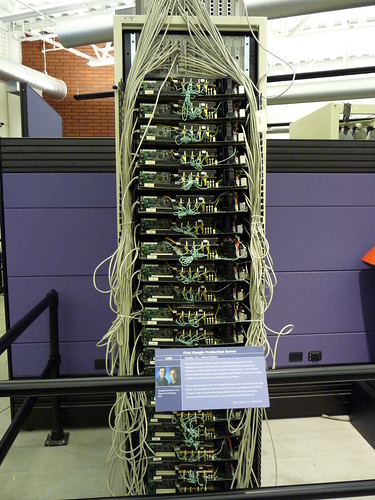
Google's first production server

Towards the end of a recent meeting with my supervisors I was asked a question that went something along the lines of: “do you buy the argument that if something is computational, that it is then necessarily reductive?” An excellent question I think. I suggested at the time, and still believe, there are two answers to this question that go together. First, by virtue of what computing ‘is’, as a machine-enabled set of processes that rely by and large on languages based in a formal logic, we must answer ‘yes’. Second, ‘computing’ as an activity and ‘computers’ as devices do not exist in a vacuum they are a part of our lives. I am writing a blog post using my laptop, connected to a network of other computers, run and maintained by people, allowing me to ‘publish’ my thoughts on a web site held on yet another computer, and hopefully some other people are reading this! Therefore, computing is definitely a part of the ‘politics of things‘, as suggested by Latour, with and by which we and others socialise.

My two answers are not mutually exclusive, “either/or”, they go together such that, I argue, we must increasingly see ‘computing’ as a connective capacity. Computing connects people with other people, people with ideas, information with things, etc etc. In this way, I have some sympathy for those, like Adam Greenfield, that suggest that “ubiquitous computing”, or something like it, was somewhat inevitable. However, I think hindsight definitely smoothes out the errors and stumblings along the way. If we think about ubiquitous computing as “the application of computational tools to human activity regardless of the shape and form of those tools”, following Scott Carter (whom I interviewed this summer), I think we can see computing as an ‘affordance’, the capacity to enable possible actions, which is innately connective. Here we might start looking to Gregory Bateson or Deleuze and Guattari to theorise such a connective capacity.

Why do I blog this? It is useful to keep probing concepts central to, and perhaps assumed, in one’s arguments, and I don’t want to lose sight of the fact that the idea of ‘computing’ is not neccesarily fixed.

Image: Google’s first server, held in the Computer History Museum, CA, taken by me.