Margaret Hamilton, Nasa software engineer & her ‘code’ printed out

I’ve put this picture on my office door:

Margaret Hamilton is an inspirational figure and we really should know more about her and her work!

Hamilton is now 78 and runs Hamilton Technologies, the Cambridge, Massachusetts-based company she founded in 1986. She’s lived to see “software engineering” – a term she coined – grow from a relative backwater in computing into a prestigious profession.

In the early days, women were often assigned software tasks because software just wasn’t viewed as very important. “It’s not that managers of yore respected women more than they do now,” Rose Eveleth writes in a great piece on early women programmers for Smithsonian magazine. “They simply saw computer programming as an easy job. It was like typing or filing to them and the development of software was less important than the development of hardware. So women wrote software, programmed and even told their male colleagues how to make the hardware better.”

“I began to use the term ‘software engineering’ to distinguish it from hardware and other kinds of engineering,” Hamilton told Verne’s Jaime Rubio Hancock in an interview. “When I first started using this phrase, it was considered to be quite amusing. It was an ongoing joke for a long time. They liked to kid me about my radical ideas. Software eventually and necessarily gained the same respect as any other discipline.”

Right on, Margaret.

The above quote is from this piece on vox.com by Dylan Matthews is worth reading – it contains lots of interesting bits and pieces, not least the fact that Apollo code was literally ‘hard wired’: it was woven in wire… astonishing to anyone who simply fires up a text editor and then uploads via ftp etc. etc. now…

The process of actually coding in the programs was laborious, as well. The guidance computer used something known as “core rope memory”: wires were roped through metal cores in a particular way to store code in binary. “If the wire goes through the core, it represents a one,” Hamilton explained in the documentary Moon Machines. “And around the core it represents a zero.” The programs were woven together by hand in factories. And because the factory workers were mostly women, core rope memory became known by engineers as “LOL memory,” LOL standing for “little old lady.”

BBC’s “Future-proofing” radio programme on blockchain – pretty good!

I happened to be driving at around 8ish last night and the car radio was by default on Radio 4 so I caught a bit of the latest programme in the ‘FutureProofing‘ series. Ordinarily such things tend to annoy me, cos I am grumpy, but listening to the programme about block chain last night I confess I was rather impressed. Timandra Harkness and Leo Johnson present an interesting account.

Blockchain is a difficult thing to explain and harder still to attempt to articulate how it might be used, beyond the libertarian goals of particular uses of crypto-currencies. The programme last night excelled in this regard covering lots of interesting angles. They end up having an interesting debate about politics and government.

There’s some interesting interviewees too:

Janina Lowisz (‘blockchain girl’) – ‘ambassador for bitnation‘

Mike Hearn – software developer & bitcoin advocate

Nathaniel Popper –journalist, author of ‘digital gold’

Susanne Tarkowski Tempelhof – CEO of bitnation

Steven Lukes – Prof. of Sociology at NYU

Vinay Gupta – of the Ethereum (blockchain) project

IEEE story: “Computer Scientists Find Bias in Algorithms”

The IEEE Spectrum website reports ‘Computer Scientists Find Bias in Algorithms‘ [no! really?!], which makes me chuckle after (finally) recently getting down some thoughts about how we variously talk about and may study the things we call algorithms.

The following excerpt demonstrates the ways in which a particular understanding of acceptable knowledge (i.e. ‘science’, to the exclusion of other ways of knowing the world) and a kind of anthropomorphic slip reveal how even the idea of ‘bias’ here is firmly situated in a particular discursive regime:

Understanding how an algorithm becomes biased is fascinating, says Venkatasubramanian. The bias is germinated innocently enough within a simple processing system, and develops in a carefully controlled setting. But the self-improving nature of learning algorithms raises concern. Venkatasubramanian and his colleagues wonder whether we can ever trust the fairness of algorithms. To that end, they have begun stockpiling relevant information about where and how they go wrong. He also hopes that the study will help lawmakers understand how algorithms and big data should be treated in a legal case.

Many people believe that an algorithm is just a code, but that view is no longer valid, says Venkatasubramanian. “An algorithm has experiences, just as a person comes into life and has experiences.”

Some thoughts about how ‘algorithms’ are talked about & what it might mean to study them

A while ago, in a grump, I tweeted something along the lines of “I’m fairly convinced that most social scientists who write about algorithms do not understand what that term means”… Provocative I know, but I was, like I said, in a grump. Rob Kitchin tweeted me back saying that he looked forward to the blogpost – well here it is – finally.

I’m afraid its not going to be a well-structured and in-depth analysis of what one may or may not mean by the word algorithm because, well, other people have already done that. What I want to offer here is an expression of the anxiety that lay behind my grumpy tweet and means of mitigating that. So, this is a post that uses other people’s work to address:

  • what is an algorithm?
  • how/should we analyse/study them?

To be totally open from the start, my principle sources here are:

So, what do we mean when we use the word ‘algorithm’?

To begin with a straight-forward answer from Paul Ford:

“Algorithm” is a word writers invoke to sound smart about technology. Journalists tend to talk about “Facebook’s algorithm” or a “Google algorithm,” which is usually inaccurate. They mean “software.”

Algorithms don’t require computers any more than geometry does. An algorithm solves a problem, and a great algorithm gets a name. Dijkstra’s algorithm, after the famed computer scientist Edsger Dijkstra, finds the shortest path in a graph. By the way, “graph” here doesn’t mean  but rather 

Or, as Rob Kitchin notes in his working paper it is (following Kowalski) “logic+control“, such that (citing Miyazaki) the term denotes a form of:

specific step-by-step method of performing written elementary arithmetic… [and] came to describe any method of systematic or automatic calculation.

This answers a simple definitional question: “what is an algorithm?” but doesn’t quite answer the question I’ve posed: “what do we mean when we use the word algorithm?”, which Ford gestures towards when suggesting journos (and one might include a lot of academics here) use the word ‘algorithm’ when they mean ‘software’. As Gillespie notes

there is a sense that the technical communities, the social scientists, and the broader public are using the word in different ways

There isn’t a single/singular meaning of the word then (of course!) and after decades of post-structuralism that really shouldn’t be a surprise… nevertheless there is a kind of discursive politics being performed when we (geographers, social scientists etc etc) invoke the term and idea of an ‘algorithm’, and we perhaps need to reflect upon that a little more than we do. I may be wrong, perhaps we just need to let the signifier/signified relation flex and evolve – my main motivation for addressing this question is that I think we do already have useful words that address what is being suggested in the use of the word ‘algorithm’ – amongst these words are: code, function (as in software function), policy, programme, protocol (e.g. Ã  la Alexander Galloway), rule and software.

What is salient about the technical definition of an algorithm to how we might use the word more broadly is the sense of a (logical) model of inferred relations between things formally defined in code that is developed through iteration towards a particular end. As Gillespie notes:

Engineers choose between them based on values such as how quickly they return the result, the load they impose on the system’s available memory, perhaps their computational elegance. The embedded values that make a sociological difference are probably more about the problem being solved, the way it has been modeled, the goal chosen, and the way that goal has been operationalised.

What quickly takes us away from simply thinking about a function defined in code is that the programmes or scripts upon which the algorithms are founded need to be validated in some way – to test their effectiveness, and this involves using test data (another word that has become fashionable). The selection of the data also necessarily has embedded assumptions, values and workarounds which, as Gillespie goes on to suggest: “may also be of much more importance to our sociological concerns than the algorithm learning from it.” The code that represents the algorithm is instantiated either within a software programme – a collection of instructions, operations, functions etc. etc. – that is bundled together as what we used to call an ‘application’ or it might exist in a ‘script’ of code that gets pulled into use as and when – for example: in the context of a website. As Gillespie argues:

these exhaustively trained and finely tuned algorithms are instantiated inside of what we might call an application, which actually performs the functions we’re concerned with. For algorithm designers, the algorithm is the conceptual sequence of steps, which should be expressible in any computer language, or in human or logical language. They are instantiated in code, running on servers somewhere, attended to by other helper applications (Geiger 2014), triggered when a query comes in or an image is scanned. I find it easiest the think about the difference between the “book” in your hand and the “story” within it. These applications embody values as well, outside of their reliance on a particular algorithm.

This is often missed when algorithms are invoked, all-too-quickly, in the discussion of contemporary phenomena that involve the use of computing in some way. Like Kitchin says in his working paper:

As a consequence, how algorithms are most often understood is very narrowly framed and lacking in critical reflection.

Indeed, I’d go further, there’s a weird sense in which some discussions of ‘algorithms’ connote the dystopian sci-fi of The Matrix, or The Terminator. Ian Bogost has gone so far as to suggest that this is a form of ‘worship’ of the idea of an ‘algorithm’, suggesting

algorithms hold a special station in the new technological temple because computers have become our favorite idols.


And as Gillespie noted in an earlier piece:

there is an important tension emerging between what we expect these algorithms to be, and what they in fact are

Yet, as with production of religious texts, there are people making decisions every step of the way in the production of software. On top of that, there were decisions made by people in all of the steps of the development and production of the other technologies and infrastructures upon which that software rely.

What we mean when we use the word ‘algorithm’ is, as Gillespie argues (much better than I), a synecdoche: “when we settle uncritically on this shiny, alluring term, we risk reifying the processes that constitute it. All the classic problems we face when trying to unpack a technology, the term packs for us”.

Calling the complex sociotechnical assemblage an “algorithm” avoids the need for the kind of expertise that could parse and understand the different elements; a reporter may not need to know the relationship between model, training data, thresholds, and application in order to call into question the impact of that “algorithm” in a specific instance. It also acknowledges that, when designed well, an algorithm is meant to function seamlessly as a tool; perhaps it can, in practice, be understood as a singular entity. Even algorithm designers, in their own discourse, shift between the more precise meaning, and using the term more broadly in this way.

How should we study algorithms?

Here, I’m not totally sure I can add much to what Kitchin has written in his working paper. This has been adroitly summarised by John Danaher on his blog, and he produced this brilliant graphic:
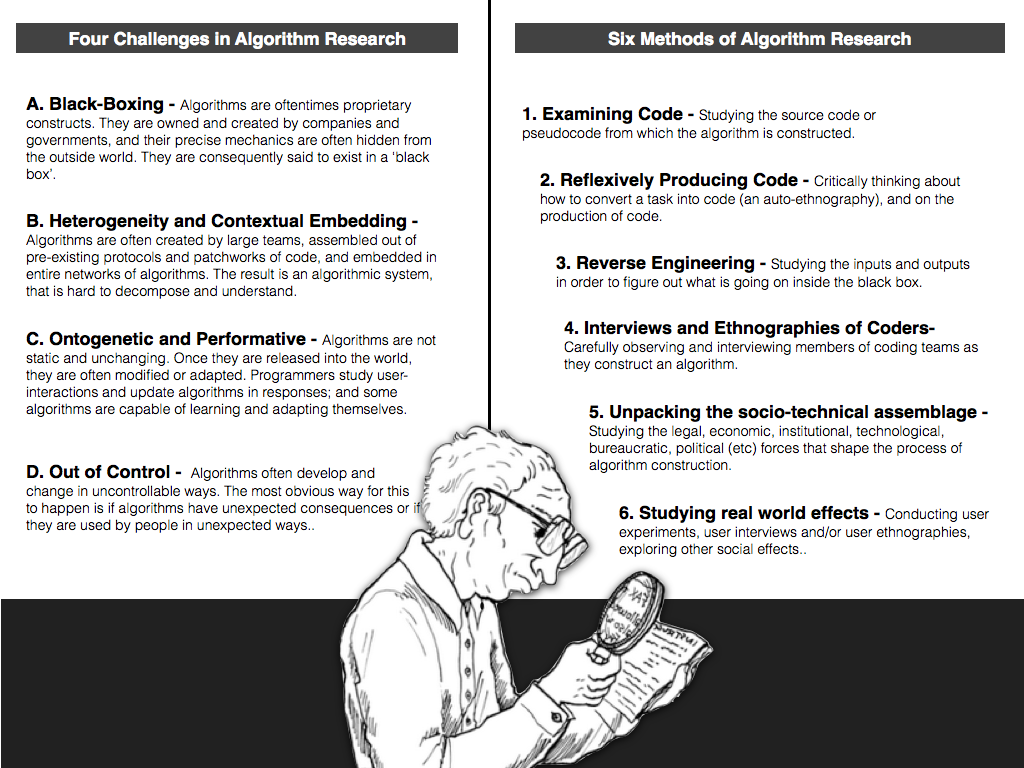
The challenges and methods for studying algorithms


We need to be alive to the challenge that most software we may be interested in is proprietary, although not always and we can look to repositories like GitHub for plenty of open source code, and so it may actually prove impossible to gain access to the code itself –– and here we’d really want the code of the whole programme, and perhaps the training data too. Likewise, software like any complex endeavour may well be the result of collective authorship and maintained by lots of different people. So there are complex sets of relations between people, laws, protocols, standards and many other considerations to negotiate – they are contextually embedded. Furthermore, the programmes we’re calling algorithms here actually have a hand in producing the world within which they exist –– they may bring new kinds of entities and relationships into existence, they may formulate new and different forms of spatial relation and understanding. In this sense they are ontogenetic and performative. Added to this, once ‘in the wild’ this performativity can render the kinds of outcomes of a programme unexpected and peculiar, especially once it is fed all sorts of data, adapted and adopted in unexpected ways.

How can we go about studying these kinds of socio-technical systems then? Well, rather than treat as discrete the six techniques offered by Kitchin (summarised above) – I’d argue we need to combine most of these. Even so, it may prove extremely difficult to actually gain access to code. Further, even if one might reflexively produce code and/or attempt to reverse engineer software –– some systems are the product of companies with such extensive resources that it may well prove near-impossible to do so. Where social scientists might find more traction and actually be able to make a more valuable contribution is, as Kitchin suggests, looking t the full sociotechnical assemblage. We can look at the wider institutional, legal and political apparatuses (the dispositifs) and we can certainly look at the various kinds of relation the assemblages make and how they are enrolled in performing the world they inhabit.

Make no mistake – this kinds of research is necessarily hard. I’m not sure I can imagine papers in geography journals that tie the a/b testing logs of experiments in how a given system works and commit logs to version control systems (even if you could access them!) to particular forms of experience and/or their political consequences… but it might be worth a go. Perhaps this difficulty is why we see (and I am as guilty as any of this) papers written in abstract terms, focusing on the (social) theoretical ways we can talk about these sociotechnical systems in broad terms.

Like Bogost, I can see a kind of pseudo-theological romancing of the ‘algorithm’ and the agency of software in much of what is written about it, and its sort of easy to see why – it is so abundant and yet relatively hidden. We see effects but do not see the systems that produce them:

Algorithms aren’t gods. We need not believe that they rule the world in order to admit that they influence it, sometimes profoundly. Let’s bring algorithms down to earth again.

The algorithm as synecdoche is a kind of ‘talisman’, as Gillespie argues, that reveals something of what Stiegler calls our ‘originary technicity’ – the sense in which we (humans) have always already been bound up in technology and its the forgetting and then remembering of this that forges our ongoing reconstitution (transindividuation) of ourselves.

So, I’d like to end with Kitchin’s argument:

it is clear that much more critical thinking and empirical research needs to be conducted with respect to algorithms [and the software and sociotechnical systems in which they are necessarily embedded] and their work.

Addendum:

It is worth noting that both Gillespie and Kitchin draw on another paper that is very much worth reading by Nick Seaver, who reminded me of this on Twitter, take a look:

“Knowing Algorithms“, presented at Media in Transition 8, Cambridge, MA, April 2013 [revised 2014].

For these companies you, walking down the street, are a data point

I’ve been collecting the promotional videos of various companies that surveil ‘public’ spaces to garner information that, using the logics applied to web analytics, they see as valuable commercial intelligence.

The rationale that is common throughout is that the aggregate crowd on the street, in a shopping centre, or in any form of apparently ‘public’ space are fair game for surveillance measurement and in turn address (albeit by their commercial partners – retailers etc. etc.). In fact, this is merely a technical or perhaps social problem – not a political one. It’s a technical problem for them because as the chap from Placemeter says “it’s all data” and its ‘waiting’ to be harvested. It’s a social problem for them only insofar as it’s about improving ‘services’ for us as consumers (not as citizens, as families or any other part of our skein of identity). It is NOT a political problem for them – it’s not an issue of who has the right to the city, who has a right to privacy or what might constitute reasonable expectations of any of those things. It certainly is never couched in terms of there needing to be governance of these activities – at least in these kinds of videos.

So, the videos are interesting artefacts of the formulation of what pervasive media/ubiquitous computing and smart cities look like and how they are performed…

A reasonable article about Placemeter is in/on the Guardian Cities section.

Reblog> Data and the City

Mike Batty blogs about the ‘Data and the City’ event that is being convened by Rob Kitchin and the Programmable City team.

Data and the City

data-city
The Programmable City Project is holding a meeting on Data and the City in Maynooth from August 31- September 1st. You can get Rob Kitchin’s and Mike Batty’s papers from this blog but the programme is diverse and the Project web site contains details of the various contributions. I argue in my paper that we need to redefine big data in terms of the tools we use to interpret it and that size is not the main criterion as quite modest data sets in cities, particularly those dealing with transport and flows, are too large for most of current tools which involve statistical manipulation and visualisation. Here are two of the papers to be presented:

Michael Batty: Data About Cities: Redefining Big, Recasting Small

Rob Kitchin: Data-Driven, Networked Urbanism

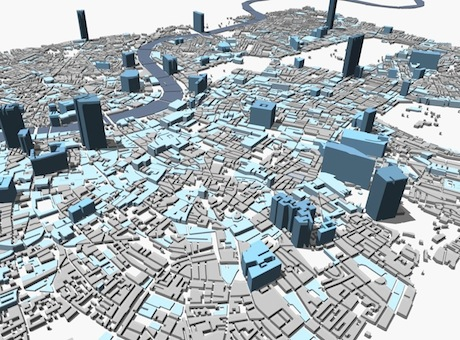
The image above was produced by Stephan Hugel and Flora Roumpani from their animation of tweets in London Using City Engine. Click here for the movie.

Reblog> New paper: Data-driven, networked urbanism

This looks good –– added to my ‘to read’ pile 🙂

New paper: Data-driven, networked urbanism

A new paper, ‘Data-driven, networked urbanism’, has been published by Rob Kitchin as Programmable City Working Paper 14.  The paper has been prepared for the Data and the City workshop to be held at Maynooth University Aug 31th-Sept 1st.

Abstract
For as long as data have been generated about cities various kinds of data-informed urbanism have been occurring.  In this paper, I argue that a new era is presently unfolding wherein data-informed urbanism is increasingly being complemented and replaced by data-driven, networked urbanism.  Cities are becoming ever more instrumented and networked, their systems interlinked and integrated, and vast troves of big urban data are being generated and used to manage and control urban life in real-time. Data-driven, networked urbanism, I contend, is the key mode of production for what have widely been termed smart cities.  In this paper I provide a critical overview of data-driven, networked urbanism and smart cities focusing in particular on the relationship between data and the city (rather than network infrastructure or computational or urban issues), and critically examine a number of urban data issues including: the politics of urban data; data ownership, data control, data coverage and access; data security and data integrity; data protection and privacy, dataveillance, and data uses such as social sorting and anticipatory governance; and technical data issues such as data quality, veracity of data models and data analytics, and data integration and interoperability.  I conclude that whilst data-driven, networked urbanism purports to produce a commonsensical, pragmatic, neutral, apolitical, evidence-based form of responsive urban governance, it is nonetheless selective, crafted, flawed, normative and politically-inflected.  Consequently, whilst data-driven, networked urbanism provides a set of solutions for urban problems, it does so within limitations and in the service of particular interests.

Key words: big data, data analytics, governance, smart cities, urban data, urban informatics, urban science

Download PDF

Reblog> Draft Translation of Fourquet and Murard’s “La Ville-Ordinateur”

Keith Harris has offered a draft translation of an interesting essay that forms part of a broader, very interesting, paper colloquium that included Deleuze, Guattari and Foucault. The paper is “La Ville-Ordinateur” (The Computer-City), very much worth reading and following-up Keith’s links. This is a great resource!

Draft Translation of Fourquet and Murard’s “La Ville-Ordinateur”

As I mentioned last week, this is the essay that kicked off Recherches 13 (1973) and is the context for the two conversations involving Deleuze, Guattari, Foucualt, and Fourquet that are published as texts 129 and 130 in Foucault’s Dits et Écrits (tome 2) and translated into English in Foucault Live (1996) under the title “Equipments of Power.”

This is a draft but I think it comes across fairly clearly. I would like to gather it along with a few of the other key contributions to this issue and putting it our for publication, perhaps along with portions of issue 14 (Stuart Elden provides some insight into issues 13 and 14 here and here). Any advice on how to undertake that or journals you believe might be interested in such an endeavor would be greatly appreciated, as would any comments on the translation itself (or if you know of any postdocs where one could concentrate on this kind of work, I would be interested in that too!).

Read the whole blogpost & translation.

Clive Barnett – new paper on segmentation practices & policy

My colleague Clive Barnett has blogged about a new paper he has coming out with Nick Mahoney in Policy and Politics concerning segmentation methods for marking practices and how these are used in the public and ‘third’ sectors.

Clive says, on his blog:

This paper seeks to open up some interpretative space for exploring what is going on when marketing practices get used in non-commercial sectors, without presuming in advance that what is going on is something to be called ‘neoliberalism’.

I find the paper interesting not only for this reason, but also because when preparing my article “Memory Programmes” I briefly looked into segmentation systems (like MOSAIC and Tapestry) when looking at supermarket loyalty card schemes like Tesco’s ‘Clubcard’ – and the sorts of (monitoring/ surveillance) apparatus they construct.

As Clive and his co-author argue, there is:

a shared rationale underlying the strategic use of segmentation methodologies. First, across these varied fields, segmentation methods are used to generate relatively stable images of public attitudes and values. Second, these images are used to inform strategies that seek to either change these dispositions or to mobilise them in support of new behaviours.

This stabilising of categories of attitude and value that can then be used as a parameter in/with a dataset that is continually interrogated and processed in order to attempt to gain ‘insights’ that may influence behaviour. I argued in my article that:

The geographical imaginary Clubcard invokes is of populations of consumers, segmented by lifestyle preferences and socio-economic factors, distributed and delimited (or ‘bordered’) through particular categorisations of space. The consumer is thus enrolled into an industrial system that retains habits of consumption in significant detail, both at an individual and collective scale, and operates on that historiography in order to influence prospective future habits.

In addressing the public sector use of segmentation Clive and Nick Mahoney argue that

the configuration of fields of agency should be the core focus of further research focussed on the critical evaluation of the deployment of ‘dividing practices’ such as segmentation methods

I think this call probably stands for the commercial use of segmentation too…