Prof. Louise Amoore awarded Leverhulme Major Research Fellowship for study: ‘Ethics of Algorithms’

This is lovely news – sounds like a really interesting project and I look forward to following this with great interest!

Professor Louise Amoore has been awarded a Leverhulme Major Research Fellowship (2016-2018) for a study of the Ethics of Algorithm

Ethics of Algorithm

Living in a world that is increasingly saturated with algorithmic processes has profound implications for ethics. The scholarly and public accounts of the ethical dimensions of algorithm have overwhelmingly placed the human being as the locus of ethical deliberation. Thus, philosophers and scientists search for ethical frameworks or guidelines for the human designers of software; legal scholars remind us that the protection of humans from “automated decisions made about them” by algorithms is enshrined in data protection law; and social scientists urge that the “black box” of algorithmic decisions be opened to critical scrutiny. Yet, the idea of an ethics that opens the algorithm to human scrutiny has important limits, not only because many algorithms are proprietary and secret, but more significantly because they can operate at a speeds and scales beyond the threshold of human perceptibility.

Louise’s Leverhulme Major Research Fellowship provides an account of the potential for an ethics of algorithm. In a tradition of ethics as the situated giving of an account of one’s actions at the limits of intelligibility – “I cannot give an account of myself without accounting for the conditions under which I emerge” (Judith Butler 2005) – the research excavates how the algorithm might give an account of itself and its emergence. The research develops six conceptual themes – to form the chapters of a book – opening up dimensions of the relation of algorithm to ethics: undecidability; doubt; cognition; perception; association; automation.

Algorithmic catastrophe–the revenge of contingency, new paper by @digital_objects

A new issue of Parrhesia is out and it contains a new paper from Yuk Hui.


All catastrophes are algorithmic, even the natural ones, when we consider the universe to be governed by regular and automated laws of motion and principles of emergence.

It begins with this bold statement qualified through a reading of Aristotle that leads us to:

But these material, technological catastrophes are not examples of what I am proposing here to call algorithmic catastrophes. Algorithmic catastrophe doesn’t refer to material failure, but rather to the failure of reason.

And it is this form of catastrophe to which the discussion tends. Through a reading of the work of Bernard Steigler, in relation to Martha Nussbaum and Plato/Socrates, Hui argues that the history of Occidental philosophy has the techno-logical ‘accident’:

This resonates with the two senses of accident that we have explained above: on one hand, the revelation of substance through accidents, meaning the accidents become necessary; on the other hand, the overcoming of the irrational through reason.

Hui then expertly dissects understandings of accident and contingency in relation to what is thought of as ‘automatic’, which leads to this lovely passage:

As an engineer and designer, one has to be assured that it is normal to have a catastrophe. If catastrophe is thus anticipated and becomes a principle of operation, it no longer plays the role it did with the laws of nature. This use of anticipation to overcome catastrophes can never be completed, however, and indeed accident expresses itself in a second level of contingency generated by the machines’ own operations. Herein also lies the second difference between the algorithmic contingency and the contingency of laws of nature, which we would like to approach in the next section. It doesn’t mean that the algorithm itself is not perfect, but rather that the complexity it produces overwhelms the simplicity and clarity of algorithmic thinking. This necessity of contingency takes a different form from the necessity in tragedy and in nature…

Automisation then becomes the target of deconstruction, with a haunting of Virilio, explicated through the ‘Flash Crash’. Nevertheless, the tendency here is towards automation that exceeds the human capacity to react, as Hui has it:

The automation of machines will be much faster than human intelligence, and hence will lead to a temporal gap in terms of operation. The gap can produce disastrous effects since the human is always too late, and machines won’t stop on their own. In face of our inability to fully understand the causality, Wiener warns us that “if we adhere simply to the creed of the scientist, that an incomplete knowledge of the world and of ourselves is better than no knowledge, we can still by no means always justify the naive assumption that the faster we rush ahead to employ the new powers for action which are opened up to us, the better it will be.”

The paper moves on to consider a speculative aesthetics of the accident, through a reading of Meillassoux’s ‘speculative realism’. Just as Meillassoux attempts to reach back beyond the ‘ancestrally’ of the human, Hui argues that we are challenged by atomisation, in the figure of algorithms:

exteriorized reasons, where we find more and more that human reason is becoming less and less capable of understanding the system that it has succeeded in constructing.

Thus:

In the digital age, accidents in both senses come to the fore and beyond, as indicated by the contingency, the unknown, which also comes to the front.

…

The algorithmic catastrophe also resonates with current research on speculative reason, especially what Meillasoux proposes as the absolutization of contingency, which reinvents the metaphysical concept of contingency as necessity while it renounces the subjectivist approach towards knowledge. The celebration of speculative reason seems to be an appropriation of the catastrophic aesthetics of our time, where the unknown and black box become the sole explanations.

It is certainly an interesting, if dense, article and probably requires some knowledge of

I am left wondering, as a less-sophisticated non-philosopher, how one might square this argument with technics as the ‘horizon of all possibility to come and all possibility of a future’, pace Stiegler in Technics and Time – the computational ‘transindividuations’ (the becomings of trans-individual assemblages) that we initiate and cultivate through digital ‘industry’ may begin to probe their way into possibilities outside of our sensory or conscious capacities but they remain, at present, limited precisely by their foundation in a human phenomenological domain. Nevertheless, as Hui argues in his final paragraph:

it would be ignorant to just dismiss the algorithmic catastrophe as something from science fiction. The words of the physicists [Hawking et al. warning about the risks of AI] also remind us of Book III of Plato’s Republic, where the physicians return as guardians of the polis. Should these guardians be scientifically well-trained philosophers or philosophically trained physicians is not a question without importance, since it means a new pedagogical program and a new conception of responsibility. Beyond the reach of this single article, what Virilio proposes as a rethinking of responsibility remains largely undiscussed.

I probably don’t know enough of the references Hui is drawing upon to be able to offer a cogent response to this, but it is a very interesting article and worth a read [it is open access!].

IEEE story: “Computer Scientists Find Bias in Algorithms”

The IEEE Spectrum website reports ‘Computer Scientists Find Bias in Algorithms‘ [no! really?!], which makes me chuckle after (finally) recently getting down some thoughts about how we variously talk about and may study the things we call algorithms.

The following excerpt demonstrates the ways in which a particular understanding of acceptable knowledge (i.e. ‘science’, to the exclusion of other ways of knowing the world) and a kind of anthropomorphic slip reveal how even the idea of ‘bias’ here is firmly situated in a particular discursive regime:

Understanding how an algorithm becomes biased is fascinating, says Venkatasubramanian. The bias is germinated innocently enough within a simple processing system, and develops in a carefully controlled setting. But the self-improving nature of learning algorithms raises concern. Venkatasubramanian and his colleagues wonder whether we can ever trust the fairness of algorithms. To that end, they have begun stockpiling relevant information about where and how they go wrong. He also hopes that the study will help lawmakers understand how algorithms and big data should be treated in a legal case.

Many people believe that an algorithm is just a code, but that view is no longer valid, says Venkatasubramanian. “An algorithm has experiences, just as a person comes into life and has experiences.”

Some thoughts about how ‘algorithms’ are talked about & what it might mean to study them

A while ago, in a grump, I tweeted something along the lines of “I’m fairly convinced that most social scientists who write about algorithms do not understand what that term means”… Provocative I know, but I was, like I said, in a grump. Rob Kitchin tweeted me back saying that he looked forward to the blogpost – well here it is – finally.

I’m afraid its not going to be a well-structured and in-depth analysis of what one may or may not mean by the word algorithm because, well, other people have already done that. What I want to offer here is an expression of the anxiety that lay behind my grumpy tweet and means of mitigating that. So, this is a post that uses other people’s work to address:

  • what is an algorithm?
  • how/should we analyse/study them?

To be totally open from the start, my principle sources here are:

So, what do we mean when we use the word ‘algorithm’?

To begin with a straight-forward answer from Paul Ford:

“Algorithm” is a word writers invoke to sound smart about technology. Journalists tend to talk about “Facebook’s algorithm” or a “Google algorithm,” which is usually inaccurate. They mean “software.”

Algorithms don’t require computers any more than geometry does. An algorithm solves a problem, and a great algorithm gets a name. Dijkstra’s algorithm, after the famed computer scientist Edsger Dijkstra, finds the shortest path in a graph. By the way, “graph” here doesn’t mean  but rather 

Or, as Rob Kitchin notes in his working paper it is (following Kowalski) “logic+control“, such that (citing Miyazaki) the term denotes a form of:

specific step-by-step method of performing written elementary arithmetic… [and] came to describe any method of systematic or automatic calculation.

This answers a simple definitional question: “what is an algorithm?” but doesn’t quite answer the question I’ve posed: “what do we mean when we use the word algorithm?”, which Ford gestures towards when suggesting journos (and one might include a lot of academics here) use the word ‘algorithm’ when they mean ‘software’. As Gillespie notes

there is a sense that the technical communities, the social scientists, and the broader public are using the word in different ways

There isn’t a single/singular meaning of the word then (of course!) and after decades of post-structuralism that really shouldn’t be a surprise… nevertheless there is a kind of discursive politics being performed when we (geographers, social scientists etc etc) invoke the term and idea of an ‘algorithm’, and we perhaps need to reflect upon that a little more than we do. I may be wrong, perhaps we just need to let the signifier/signified relation flex and evolve – my main motivation for addressing this question is that I think we do already have useful words that address what is being suggested in the use of the word ‘algorithm’ – amongst these words are: code, function (as in software function), policy, programme, protocol (e.g. Ã  la Alexander Galloway), rule and software.

What is salient about the technical definition of an algorithm to how we might use the word more broadly is the sense of a (logical) model of inferred relations between things formally defined in code that is developed through iteration towards a particular end. As Gillespie notes:

Engineers choose between them based on values such as how quickly they return the result, the load they impose on the system’s available memory, perhaps their computational elegance. The embedded values that make a sociological difference are probably more about the problem being solved, the way it has been modeled, the goal chosen, and the way that goal has been operationalised.

What quickly takes us away from simply thinking about a function defined in code is that the programmes or scripts upon which the algorithms are founded need to be validated in some way – to test their effectiveness, and this involves using test data (another word that has become fashionable). The selection of the data also necessarily has embedded assumptions, values and workarounds which, as Gillespie goes on to suggest: “may also be of much more importance to our sociological concerns than the algorithm learning from it.” The code that represents the algorithm is instantiated either within a software programme – a collection of instructions, operations, functions etc. etc. – that is bundled together as what we used to call an ‘application’ or it might exist in a ‘script’ of code that gets pulled into use as and when – for example: in the context of a website. As Gillespie argues:

these exhaustively trained and finely tuned algorithms are instantiated inside of what we might call an application, which actually performs the functions we’re concerned with. For algorithm designers, the algorithm is the conceptual sequence of steps, which should be expressible in any computer language, or in human or logical language. They are instantiated in code, running on servers somewhere, attended to by other helper applications (Geiger 2014), triggered when a query comes in or an image is scanned. I find it easiest the think about the difference between the “book” in your hand and the “story” within it. These applications embody values as well, outside of their reliance on a particular algorithm.

This is often missed when algorithms are invoked, all-too-quickly, in the discussion of contemporary phenomena that involve the use of computing in some way. Like Kitchin says in his working paper:

As a consequence, how algorithms are most often understood is very narrowly framed and lacking in critical reflection.

Indeed, I’d go further, there’s a weird sense in which some discussions of ‘algorithms’ connote the dystopian sci-fi of The Matrix, or The Terminator. Ian Bogost has gone so far as to suggest that this is a form of ‘worship’ of the idea of an ‘algorithm’, suggesting

algorithms hold a special station in the new technological temple because computers have become our favorite idols.


And as Gillespie noted in an earlier piece:

there is an important tension emerging between what we expect these algorithms to be, and what they in fact are

Yet, as with production of religious texts, there are people making decisions every step of the way in the production of software. On top of that, there were decisions made by people in all of the steps of the development and production of the other technologies and infrastructures upon which that software rely.

What we mean when we use the word ‘algorithm’ is, as Gillespie argues (much better than I), a synecdoche: “when we settle uncritically on this shiny, alluring term, we risk reifying the processes that constitute it. All the classic problems we face when trying to unpack a technology, the term packs for us”.

Calling the complex sociotechnical assemblage an “algorithm” avoids the need for the kind of expertise that could parse and understand the different elements; a reporter may not need to know the relationship between model, training data, thresholds, and application in order to call into question the impact of that “algorithm” in a specific instance. It also acknowledges that, when designed well, an algorithm is meant to function seamlessly as a tool; perhaps it can, in practice, be understood as a singular entity. Even algorithm designers, in their own discourse, shift between the more precise meaning, and using the term more broadly in this way.

How should we study algorithms?

Here, I’m not totally sure I can add much to what Kitchin has written in his working paper. This has been adroitly summarised by John Danaher on his blog, and he produced this brilliant graphic:
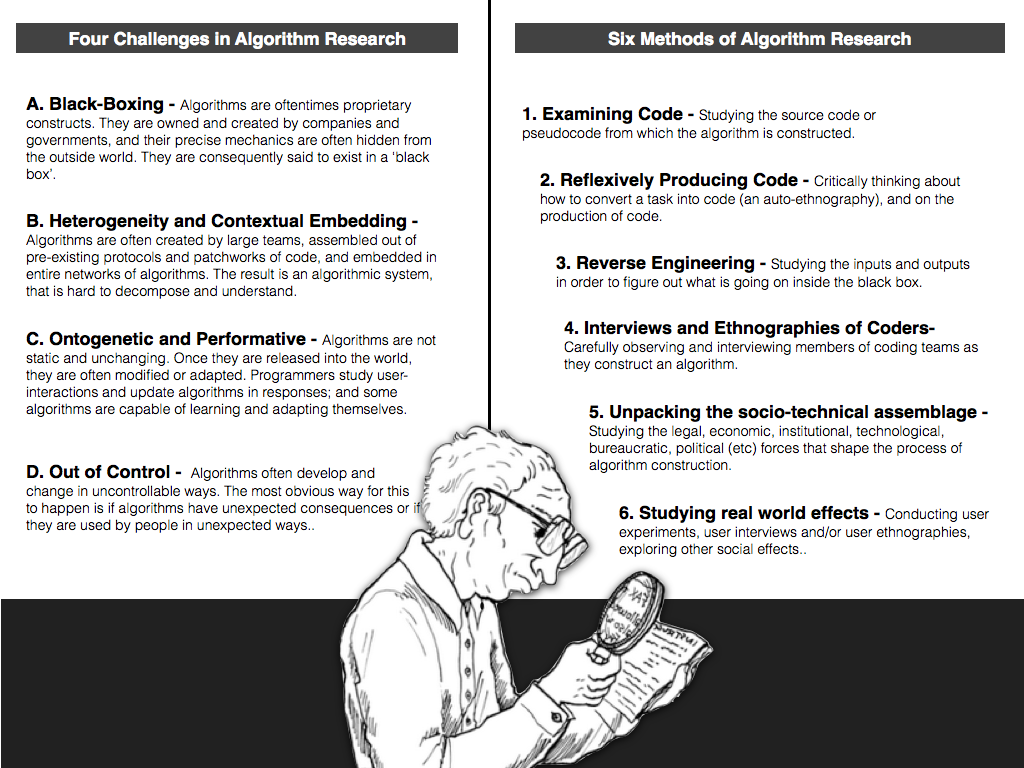
The challenges and methods for studying algorithms


We need to be alive to the challenge that most software we may be interested in is proprietary, although not always and we can look to repositories like GitHub for plenty of open source code, and so it may actually prove impossible to gain access to the code itself –– and here we’d really want the code of the whole programme, and perhaps the training data too. Likewise, software like any complex endeavour may well be the result of collective authorship and maintained by lots of different people. So there are complex sets of relations between people, laws, protocols, standards and many other considerations to negotiate – they are contextually embedded. Furthermore, the programmes we’re calling algorithms here actually have a hand in producing the world within which they exist –– they may bring new kinds of entities and relationships into existence, they may formulate new and different forms of spatial relation and understanding. In this sense they are ontogenetic and performative. Added to this, once ‘in the wild’ this performativity can render the kinds of outcomes of a programme unexpected and peculiar, especially once it is fed all sorts of data, adapted and adopted in unexpected ways.

How can we go about studying these kinds of socio-technical systems then? Well, rather than treat as discrete the six techniques offered by Kitchin (summarised above) – I’d argue we need to combine most of these. Even so, it may prove extremely difficult to actually gain access to code. Further, even if one might reflexively produce code and/or attempt to reverse engineer software –– some systems are the product of companies with such extensive resources that it may well prove near-impossible to do so. Where social scientists might find more traction and actually be able to make a more valuable contribution is, as Kitchin suggests, looking t the full sociotechnical assemblage. We can look at the wider institutional, legal and political apparatuses (the dispositifs) and we can certainly look at the various kinds of relation the assemblages make and how they are enrolled in performing the world they inhabit.

Make no mistake – this kinds of research is necessarily hard. I’m not sure I can imagine papers in geography journals that tie the a/b testing logs of experiments in how a given system works and commit logs to version control systems (even if you could access them!) to particular forms of experience and/or their political consequences… but it might be worth a go. Perhaps this difficulty is why we see (and I am as guilty as any of this) papers written in abstract terms, focusing on the (social) theoretical ways we can talk about these sociotechnical systems in broad terms.

Like Bogost, I can see a kind of pseudo-theological romancing of the ‘algorithm’ and the agency of software in much of what is written about it, and its sort of easy to see why – it is so abundant and yet relatively hidden. We see effects but do not see the systems that produce them:

Algorithms aren’t gods. We need not believe that they rule the world in order to admit that they influence it, sometimes profoundly. Let’s bring algorithms down to earth again.

The algorithm as synecdoche is a kind of ‘talisman’, as Gillespie argues, that reveals something of what Stiegler calls our ‘originary technicity’ – the sense in which we (humans) have always already been bound up in technology and its the forgetting and then remembering of this that forges our ongoing reconstitution (transindividuation) of ourselves.

So, I’d like to end with Kitchin’s argument:

it is clear that much more critical thinking and empirical research needs to be conducted with respect to algorithms [and the software and sociotechnical systems in which they are necessarily embedded] and their work.

Addendum:

It is worth noting that both Gillespie and Kitchin draw on another paper that is very much worth reading by Nick Seaver, who reminded me of this on Twitter, take a look:

“Knowing Algorithms“, presented at Media in Transition 8, Cambridge, MA, April 2013 [revised 2014].

Algorithmic Practices: Emergent interoperability in the everyday

This year the RGS-IBG Annual Conference will be coming to the University of Exeter, my institution, and there are some exciting sessions already in the pipelines. I wanted to bring one to the attention of those that happen to look at this website:

Algorithmic Practices: Emergent interoperability in the everyday

Sponsored by: the History and Philosophy of Geography Study Group
Convened by: Eric Laurier and Chris Speed (Edinburgh) and Monika Buscher (Lancaster)

An ever-increasing proportion of the interactions that we have with digital platforms, apps and devices are mediated according to complex algorithms. Whether it be the real time analytics that draw us into playing a game on our phone, or tailored recommendations built from our historical searching and buying habits, we structure our daily lives in response to ‘performative infrastructures’ (Thrift, 2005: 224), most of them hidden deliberately by their makers.

Yet, in responding to the summons, the predictions, the recommendations, the help, the calculations that occur as platforms try to anticipate our next actions, we are learning how they work and don’t work. In our ad hoc assemblies of devices, apps and screens we short cut and re-make algorithms. For instance, in disaster response, ad hoc interoperability and agile response are creating incentives for ‘systems of systems’ that allow locally accomplished convergence of diverse information systems, with implications for data surge capacity as well as protection and privacy (Mendonça et al 2007).

Described as “a structured approach to real-time mixing and matching of diverse ICTs to support individuals and organizations in undertaking response”, emergent interoperability maybe becoming common place in less dramatic daily practices as individuals negotiate the range of algorithms that “react and reorganize themselves around the users” (Beer 2009).

This panel invites papers and presentations that provide insight into conditions and settings in which emergent operability and interoperability occurs within society.

Areas of interest:

  • Dashboards, decongestion, security and the other promises of smart cities (Kitchin 2014
  • Wayfaring, wayfinding and other mobilities with map apps (Brighenti 2012)
  • Changing forms of participation and collaboration through social media algorithms
  • Responding to and attempting to manipulate predicted actions and recommendations
  • The production of calculated publics (Gillespie 2014)
  • Political contestation of algorithms
  • Ad hoc systems
  • Textures of communication in digital and traditional media

The deadline is Friday 6th February 2015.

Email speakers, title and abstract to eric [dot] laurier [at] ed.ac.uk

References:

Beer, D. (2009) Power through the algorithm? Participatory web cultures and the technological unconscious. New Media & Society. London: SAGE. Vol 11(6): 985–1002.

Brighenti, A. M. (2012). New Media and Urban Motilities: A Territoriologic Point of View. Urban Studies, 49(2), 399–414.

Gillespie, T (2014) The Relevance of Algorithms, pp167-194 in Media Technologies, Essays on Communication, Materiality and Society ed. Tarleton Gillespie, Pablo Boczkowski, and Kirsten Foot. Cambridge, MA: MIT Press.

Kitchin, R. (2014). Thinking critically about and researching algorithms. The Programmable City Working Paper 5, Maynooth

Mendonça, D., Jefferson, T., & Harrald, J. (2007). Emergent Interoperability: Collaborative Adhocracies and Mix and Match Technologies in Emergency Management. Communications of the ACM, 50(3), 44-9.

Thrift, N. (2005) Knowing Capitalism. London: Sage.