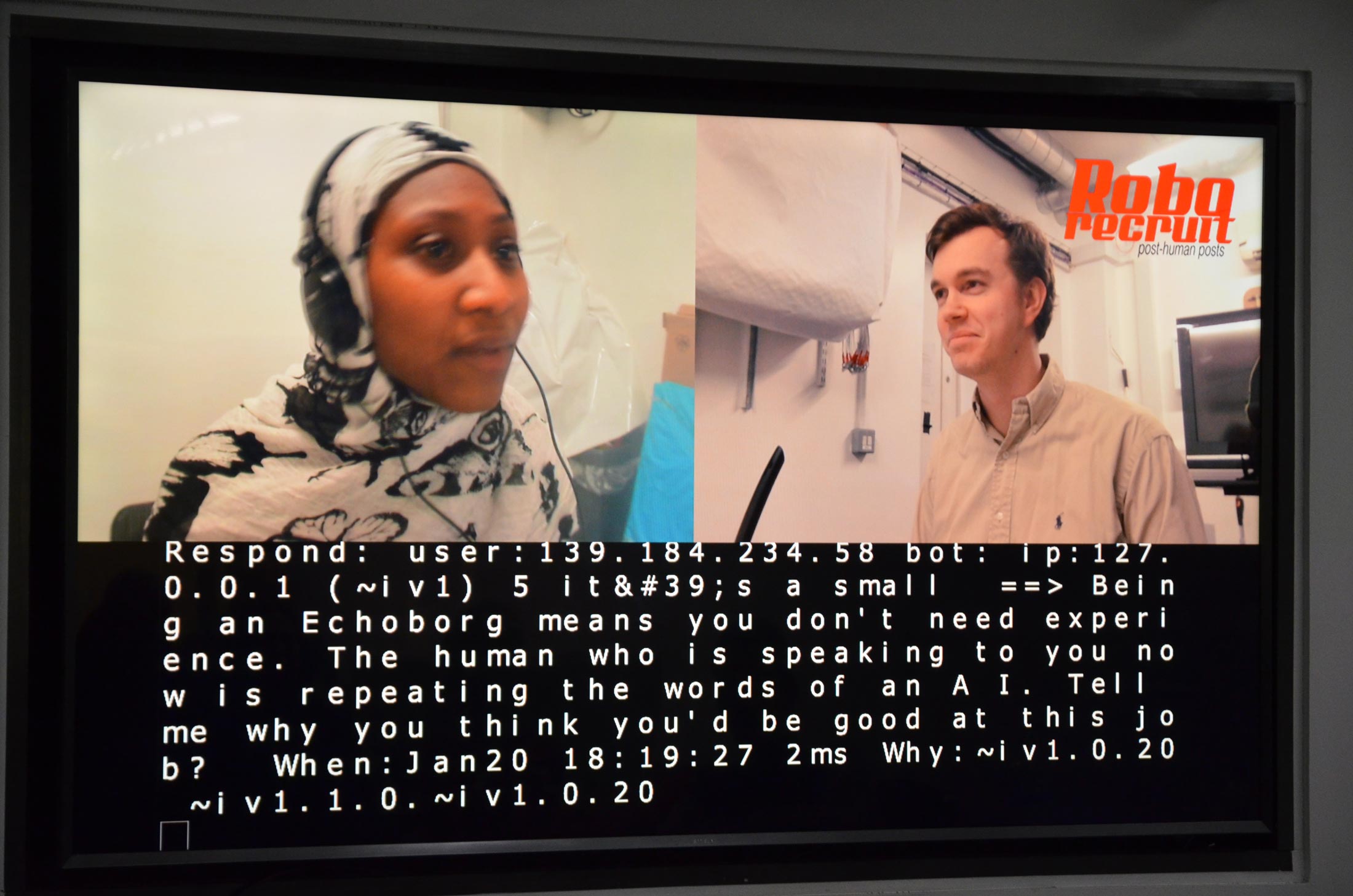
Echoborg

Former colleagues of mine at UWE are developing an interesting project, which you may have seen/heard about through the BBC’s Click programme, called Echoborg.

An echoborg is a hybrid agent composed of the body of a real person and the “mind” (or, rather, the words) of a conversational agent; the words the echoborg speaks are determined by the conversational agent, transmitted to the person via a covert audio-relay apparatus, and articulated by the person through speech shadowing[1].

Recently, the project team have demoed the project as part of an AHRC-funded network on Automation Anxiety and have written this up on the project website, here’s a snippet – it sounds like it is really compelling (I’ve not seen this in action):

Four people were interviewed by the AI which increasingly displayed an interest in eliciting help to reprogram itself. Proceedings were visible on a projector screen and the ‘audience’ of applicants gradually began to discuss the situation of the Echoborg and how to change it. At a certain point their reflections passed a threshold and the group fired into collective action, experimenting with various methods to bring the situation to a head in some way. The lively inventiveness of the group and the individual interviewees went a long way to confirming the interactive potential of this format of the work. It also gave Rik and Phil much to work with in considering the further development of the AI/Chatbot, the restricted delivery of narrative by the human Echoborg and the staging. This event also trialled a secondary, higher level, Echoborg character as part of the slow process of unfolding the potential for this Echoborg recruitment event to be a disruptive and thought and emotion provoking experience for all players.

Notes

  1. Corti, Kevin and Gillespie, Alex (2015) Offscreen and in the chair next to you: conversational agents speaking through actual human bodies. Lecture Notes in Computer Science, 9238 . pp. 405-417.

“Post-Internet Art”

Many of the artists represented here are working with digital forms – what’s sometimes called New Media or Post-Internet Art (Internet Art proper is already shelved and classified: it refers to the first, comparatively naive artistic responses to the internet in the 1990s and early 2000s). Post-Internet artists are the first generation to have grown up with mass digital technology, and often with parallel selves on social media (they wouldn’t call it ‘virtual’). They don’t just respond to the internet but often try to use it as a medium.

Alice Sprawls on the LRB blog – read it here.

Contested Cities conference ~ July 2016, Madrid

Saw this via Gillian Rose on Twitter, looks interesting!

As part of our upcoming Conference in Madrid (July 4-7, 2016), the Contested Cities network and its partners invites contributions for a radical mixed- and multi-media exploration of contestation and cities. Our goal is simple – to challenge people everywhere to see cities and the struggle for their past, present and future in a new light, and to do so by gathering an international set of creative projects in one place. We think we can do that in part by using all of the new audio and visual tools at our disposal. We have some ideas ourselves, but are looking globally for those who want to join in.
We encourage and actively seek contributions from amateurs and professionals alike – expert videographers who may be amateur urbanists, expert urbanists who are amateur photographers, people who wear multiple hats comfortably, data visualization nerds, map geeks, audioheads, visual artists and everyone in between. If you are someone new to both thinking about cities and visualizing them, and simply had a moment of inspiration and now have a provocative project they want to show someone, send us your project! 
Accepted projects will be shown via slideshow at the Congress, and we hope to invite some of the best submissions for an international book project. We may also build a web version, but will ask permission before posting your work.
All “authors” will be invited to attend, but alas we cannot cover registration fees. There is no fee for submission.

Checkout @TOPOSExeter for some great art & events

TOPOS Exeter show: art-articles

This is post is really an invite, from the cultural geographers at Exeter, to an exhibition & associated events that are taking please this week at TOPOS on St. Sidwell’s street – with input and support from Prof John Wylie (Head of Geography at Exeter), and from Ian Cook et al. and Paula Cutchlow’s magnificent Museum of Contemporary Commodities.

TOPOS is a distinctive space for artistic installation/ exhibition/ discussion in Exeter, hosted and run by Volkhardt Mueller and is well worth a visit. So, please do!

This week’s new exhibition, Art-Articles, by Berlin artist Konstantin Bayer, offers a set of installations and objects which comment upon, and invite direct exploration of, contemporary encounters with commodification, originality, materiality and nature. See the link below for details of Bayer’s distinctive approach and products:

There will be a private viewing at TOPOS on Wed May 11th 17.30 – 18.30, and the exhibition will have regular opening hours in the days following (details here). There will also be a conversation/discussion event at TOPOS, on the themes of Landscape, Art & Commodity, Friday May 13th, 18.00 – 21.00

Please visit the TOPOS website for details of how to find it. And consider following them on Twitter for more information.

And here is a link to book a place at the discussion event on Friday: https://www.eventbrite.co.uk/e/topos-conversation-art-landscape-commodity-tickets-25235555225

The Museum of Contemporary Commodities in EXETER

The Museum of Contemporary Commodities

Just a quick note to let you know that the brilliant Paula Crutchlow has brought “The Museum of Contemporary Commodities” (MoCC) to Exeter for the majority of May.

There’s lots going on, much of it creative and interesting – so if you’re in Exeter or nearby: come and visit!

Two immediate things this week:

RIGHT NOW!: help re-create the internet in paper with Artist Louise Ashcroft from 11 -2 in the Exeter University Forum.

TOMORROW: sign up to do a data walkshop with Alison Powell from the LSE on Saturday from 10-1. Places have to be booked, and the Eventbrite page is here https://www.eventbrite.com/e/mocc-data-walkshop-tickets-24464719635

Please do visit the MoCC website for lots more events and activities taking place this month and visit the shop:

87 Fore St,
Exeter
EX46RT

Open 10:00-18:00pm Weds-Sat, 4th-21st May.

Artefacts for generations growing up with robots

I’ve had this open in one of my tabs for ages with the intention of writing something about it here but I’ve sort of run out of time on that, so…

Here’s an interesting student project (I’d be delighted to have students like this!!) It’s a sort of deliberately controversial speculative design/ prototyping exercise to provoke thought and conversation about what it might mean to live with actually existing robots (not sci-fi androids).

The creators are: Stephan Bogner, Phillipp Schmitt and Jonas Voigt.

It’s worth a look…

RAISING ROBOTIC NATIVES

RaisingRoboticNatives-All.jpg

Artefacts for generations growing up with robots

Why do future visions of robotics incite discomfort in our generation? Could robots truly render us obsolete or is it our fear of losing control? And are these fears conditioned or instinctive?

Raising Robotic Natives explores interactions between children and robots that could raise them as the first generation of robotic natives.

Just like digital natives grow up in the digital world, robotic natives are born into an environment that is adapting to robots. As a result of unbiased, childlike enthusiasm, they are socialized with the technology early on. Through constant robotic interactions and formalized education, robotic natives get to think differently about robots than we do. It will be their responsibility to shape the future of robotics, not ours–besides we’re robotic immigrants, after all.

See the full details of the project here.

Performing the Humanities at 24 fps, Gay Hall in conversation with Stelarc

This is worth a watch:

Performing the Humanities @ 24 fps: Part 1

This is the first part of an interview conducted and filmed by the artist Stelarc for the Alternate Anatomies Lab at Curtin University, Perth, Australia. The second part of the interview is avaiulable here. Other interviews in the series are available on the website of the Alternate Anatomies Lab here.

See also Hall’s piece in Culture Machine [open access] on “Pirate Philosophy“, discussed in the video…

Reblog> “Sex, annotation and verité totale” Kurenneimi’s Archival Futurism

This new book co-edited by Joasia Krysa and Jussi Parikka looks interesting…

Joasia is a curator and was one of my undergrad tutors in Plymouth on the Digital Art and Technology programme and convened some great events during her time there, not least the excellent Hybrid Discourse. It was events like that which contributed to my interest in postgraduate study…

“Sex, annotation, and verité totale”: Kurenniemi’s Archival Futurism

Screen Shot 2015-09-18 at 8.41.43 AMI am very glad to announce that Writing and Unwriting (Media) Art History: Erkki Kurenniemi in 2048 is out from the printers, hot off the (MIT) Press! Edited with curator, writer Joasia Krysa, the book focuses on the Finnish media art pioneer Kurenniemi, and is the key international collection on the curious thinker, sound and media artist-tinkerer, who became known for his remarkable synthetizers and archival futurism. Kurenniemi has gathered attention in the electronic music circles for a longer period of time, and with Documenta 13 he become known in the international art world too. His thoughts and work resonate with the work of other early pioneers; Simon Reynolds once called him  a mix of Karlheinz Stockhausen, Buckminster Fuller, and Steve Jobs. In 2002, Mika Taanila directed the film The Future is Not What It Used to Be about Kurenniemi.

The book includes foreword by the eminent media archaeologist Erkki Huhtamo and a range of critical essays on digital culture, archival mania and media arts. Key academic and art writers address Kurenniemi’s work but also more: the condition of the archive and sound arts, sonic fiction and speculative futures of singularity are some of the key themes that run through the book with contributions by many established names in media studies, art and sound technologies. In addition, we included many of Kurenniemi’ own writings over the decades, including some interviews that elaborate his wider computational views of the world, including his thought: by 2040s, the human brain can be completely simulated. His archive plays a key role, like an actor in itself: the archive also featured as a key “object” as part of the earlier Kiasma exhibition and we included some snippets, as well as an extensive visual section.

n-mika-taanila-erkki-kurenniemi-the-dawn-of-dimi-3458-4

Writing and Unwriting (Media) Art History sits as part of the Leonardo-book series, edited by Sean Cubitt. The book was started by Krysa through her curatorial work at the 2012 Documenta 13 exhibition. It is thanks to Joasia that I am part of the project and she deserves major praise for her amazing eye for detail, enthusiasm and energy in driving this project, from a major exhibition to a book, and more.

Here’s a preview of the book’s table of contents and Huhtamo’s Foreword.

For review copy requests, or other questions, inquiries about the book, please get in touch! We are hosting some book events in Montreal, Helsinki, Berlin and London over the coming months but more info on those separately.

Writing and Unwriting (Media) Art History: Erkki Kurenniemi in 2048, eds Krysa and Parikka

Over the past forty years, Finnish artist and technology pioneer Erkki Kurenniemi (b. 1941) has been a composer of electronic music, experimental filmmaker, computer animator, roboticist, inventor, and futurologist. Kurenniemi is a hybrid–a scientist-humanist-artist. Relatively unknown outside Nordic countries until his 2012 Documenta 13 exhibition, “In 2048,” Kurenniemi may at last be achieving international recognition. This book offers an excavation, a critical mapping, and an elaboration of Kurenniemi’s multiplicities.

The contributors describe Kurenniemi’s enthusiastic, and rather obsessive, recording of everyday life and how this archiving was part of his process; his exploratory artistic practice, with productive failure an inherent part of his method; his relationship to scientific and technological developments in media culture; and his work in electronic and digital music, including his development of automated composition systems and his “video-organ,” DIMI-O. A “Visual Archive,” a section of interviews with the artist, and a selection of his original writings (translated and published for the first time) further document Kurenniemi’s achievements. But the book is not just about one artist in his time; it is about emerging media arts, interfaces, and archival fever in creative practices, read through the lens of Kurenniemi.

music with devices media archaeology kurenniemi AM

Endorsements

“Sex, annotation, and verité totale: Kurenniemi is a missing mixing desk between so many interesting aspects of late-twentieth-century culture. No wonder he ends up offering us a new archival futurism!”
–Matthew Fuller, Professor, Director of the Centre for Cultural Studies, Goldsmiths, University of London

“Providing a long-overdue critical and historical introduction to the amazingly multifaceted work of media pioneer, visionary thinker, and self-archivist Erkki Kurenniemi, this book becomes both a media-archaeological excavation and engaging reflection on the challenges of writing media art history. The range of Kurenniemi’s fascinating practice–including electronic music composition, experimental filmmaking, robotics, and curation–defies traditional classifications, and calls for new historical narratives of media art. Started as a compilation of the long-term research that went into the exhibition of Kurenniemi’s work at Documenta 13 in Kassel, Germany, the volume combines highlights of his own writings and interviews with excellent contributions by scholars, contextualizing his archives, art, music, and vision.”
–Christiane Paul, Associate Professor, School of Media Studies, The New School; Adjunct Curator of New Media Arts, Whitney Museum

“This book is a major contribution not only to the unprecedented scientific and artistic imagination of Erkki Kurenniemi, but also to the whole research on media and ‘real time.’ The text unveils and critically presents the reader with a series of complex technological and artistic systems exploring the man-machine relationship under the assumption both do have consciousness. Kurenniemi’s work provides us with one of the most solid grounds to examine perception, the brain, the will to speculate and travel back and forth between several realms of knowledge. Kurenniemi is bold; this text is bold and a great contribution to new forms of studying risk taking in art and science.”
–Chus Martínez, Head of the Institute of Art, FHNW Academy of Art and Design

663477

The Human Face of Cryptoeconomies – @furtherfield exhibition

I just wanted to flag this excellent exhibition about to start at Furtherfield (in London). It involves the Museum of Contemporary Commodities alongside a lot of other great work and will very much be worth visiting.

The Human Face of Cryptoeconomies

17 OCTOBER – 22 NOVEMBER 2015

Featuring Émilie Brout and Maxime Marion, Shu Lea Cheang, Sarah T Gold, Jennifer Lyn Morone, Rob Myers, The Museum of Contemporary Commodities (MoCC), the London School of Financial Arts and the Robin Hood Cooperative.

Furtherfield launches its Art Data Money programme with The Human Face of Cryptoeconomies at Furtherfield Gallery in the heart of London’s Finsbury Park.

The Human Face of Cryptoeconomies presents artworks that reveal how we might produce, exchange and value things differently in the age of the blockchain.

Appealing to our curiosity, emotion and irrationality, international artists seize emerging technologies, mass behaviours and p2p concepts to create artworks that reveal ideas for a radically transformed artistic, economic and social future.

Visit the Furtherfield website for more information.

Reblog> Danse macabre

Derek Gregory points to this really lovely video from Opéra National de Paris and Julien Prévieux inspired by Gregoire Chamayou’s work on ‘schematic bodies and patterns of life’.

I love how the ideas have been translated into performance in such a provocative yet beautiful way – this really gets you thinking about, as Stiegler would put it, the grammatisation of gesture (see, in particular: For a New Critique of Political Economy, pp. 8-13): the sense in which the capture and retention of our movements feeds back into the ways in which institutions and apparatuses address us both as individuals (‘subjects’) and populations (and/or ‘markets’)…

Danse macabre

Grégoire Chamayou writes to say that after our conversations in Irvine last year he has worked with an artist friend, Julien Prévieux (who won the Prix Marcel Duchamp in 2014) and the Opéra national de Paris to turn his ideas about schematic bodies and patterns of life into a short film: Patterns of Life.

I’ve embedded it below, but if the link doesn’t work you can watch it here or on YouTube here. You will soon see why Anne Buttimer once described Torsten HÃ¥gerstrand‘s time-geography diagrams as a danse macabre.  The subtitles are in French but the commentary is in English.

I find the combination of intellectual imagination and performance work absolutely compelling – see my comments on ‘Bodies on the line’ here, for example.