The Assemblage Brain – new book from Tony Sampson

Via Virality : Looks interesting…

Part of Minnesota’s spring catalogue – Out early Feb


“The Assemblage Brain provides a much-needed critique of the black-box, computational brain that has been a staple in philosophy, science, and the arts and connects the dots between recent innovations in science, dystopian literature, and theoretical developments in contemporary philosophy.”
David Gunkel, author of The Machine Question: Critical Perspectives on AI, Robots and Ethics

“‘Tap my head and mike my brain’; Tony Sampson’s new book might silently echo Pynchon’s famous lines, but this is also an original, inspiring, and theoretically savvy take on the culture of the affective brain, from sciences to business, cybernetics to political power. Warmly recommended.”
Jussi Parikka, author of Insect Media: An Archaeology of Animals and Technology

Blurb

Once upon a time, neuroscience was born. A dazzling array of neurotechnologies emerged that, according to popular belief, have finally begun to unlock the secrets of the brain. But as the brain sciences now extend into all corners of cultural, social, political, and economic life, a yet newer world has taken shape: “neuroculture,” which goes further than ever before to tackle the profound ethical implications we face in consequence.The Assemblage Brain unveils a major new concept of sense making, one that challenges conventional scientific and philosophical understandings of the brain. Drawing on Deleuze and Guattari, Tony D. Sampson calls for a radical critical theory that operates in the interferences between philosophy, science, art, and politics. From this novel perspective the book is structured around two questions: “What can be done to a brain?” and “What can a brain do?” Sampson examines the rise of neuroeconomics in informing significant developments in computer work, marketing, and the neuropharmaceutical control of inattentiveness in the classroom. Moving beyond the neurocapitalist framework, he then reestablishes a place for proto-subjectivity in which biological and cultural distinctions are reintegrated in an understanding of the brain as an assemblage.

The Assemblage Brain unravels the conventional image of thought that underpins many scientific and philosophical accounts of how sense is produced, providing a new view of our current time in which capitalism and the neurosciences endeavor to colonize the brain.

Full details

https://www.upress.umn.edu/book-division/books/the-assemblage-brain

Where’s the geography in the ‘end of globalisation’ trope pushed by the commentariat?

[T]here are abundant signs that localism and nationalism have become stronger precisely because of quest for security that place always offers in the midst of all the shifting that [globalisation] implies – The Condition of Postmodernity (adapted), David Harvey, p. 306.

Globalisation as ‘…a hegemonic ideology supporting the necessity and inevitability of the free movement of capital and goods, helped to create the institutional conditions which then contributed to making the free movement of capital and goods a reality’ – Paul Hirst “The global economy – myths and realities.” (1999), p. 424.

Actually existing globalisation is not the globalisation of neoliberal visions, the Utopia of friction-free global markets or Internet-driven virtual worlds, but the contingent and unsteady symbiosis of imperfectly transnational networks, institutions and firms, and the ‘ramshackle diversity’ of international bureaucracies, states, police, mafias and other sources of power struggling for shifting territorial authority in the post-cold war world. – Gerard Ó Tuathail “Political geography III: dealing with deterritorialization.” (1998) p. 87.

An all-to-brief and idle thought: Whatever happened to critique of ‘globalisation’? There was a time not long ago when commentators would’ve been on the side of those they seek to blame for voting for Brexit and Trump… the apparent ‘losers’ in the last thirty-odd years of ‘globalisation’ (or, perhaps, more specifically what Peter Dicken called a new international division of labour in his “Global Production Networks” framework in Global Shift).

When critical discussion of globalisation was a thing in geography people like David Harvey and Doreen Massey had something to say about this… indeed, this used to be a staple of a geography sylabus. I can’t help wondering what Massey would say about the last six months… Nevertheless, I haven’t seen any kind of comment by Harvey (if there has been, please point to what I’ve missed in the comments below).

Critical reflections on the rise of economic globalisation, the rise of TNCs, global commodity chains, off-shoring and so on brought about a critical discourse of globalisation that seems to be missing from the current commentary. Instead, we seem to see a conflation of a generalised (to the point of being unclear) idea of ‘neoliberalism’ and ‘globalisation’ and, depending on your standpoint, the recent popular vote for Brexit in the UK and the narrow victory of Trump are meant to signify a backlash to this. Perhaps because of the toxic racist and misogynistic undertones of the ‘Leave’ and Trump campaigns, some commentators seem to be implying that actually the status quo of economic globalisation and ‘neoliberalism’ should’ve been retained (i.e. vote of ‘remain’ & Clinton, resulting in TTIP etc ). Maybe (I hope) I’m misreading the arguments (I’m not getting much sleep due to baby/child sleeplessness!), maybe this is a plea for global solidarity, but maybe, also, the rush to get into print is leading to forms of scapegoating too…

Either way, it seems to me that it might be prudent for more of us to revisit ‘globalisation’ in our research and teaching (I have no doubt that there is some great work going on that I don’t know about here).

A new ‘ethics’ section of Area (the journal)

From a recent circular email via the RGS-IBG, originating from the Area  editorial board:

Following a successful discussion forum at the RGS-IBG conference in the summer, we are launching a new, regular feature of Area: ‘Ethics in/of Geographical Research’. We welcome contributions from across the discipline (and beyond), which reflect on ethics in the widest sense. It is our intent that we publish at least one piece in this feature per issue. We are open to submissions of different kinds – from commentaries and symposia to full articles and proposals for special sections.

We encourage prospective authors to get in touch with any of the Editors to discuss ideas for potential contributions.

For further details, please see: http://onlinelibrary.wiley.com/journal/10.1111/(ISSN)1475-4762/homepage/ethics_in_of_geographical_research.htm (please copy and paste into your browser if the link does not work)

We also discuss our aspirations for this new feature in more detail in the Editorial of the latest issue of Area, hot off the press and publishedon Tuesday: http://onlinelibrary.wiley.com/doi/10.1111/area.12310/full

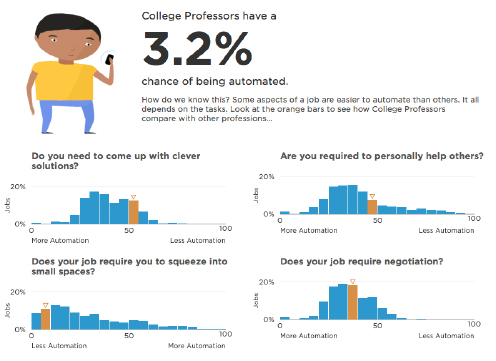
Do ‘robots’ replace (‘human’) jobs?

prof-automation

‘Robots’ (or automated systems for manufacturing and distribution) seem to be on-trend amongst social scientists[1] (following on the heels of economists [especially those trying to peddle reports predicting futures] and tech evangelists), so here’s a deceptively simple question:

Do ‘robots’ (i.e. automation) replace/destroy jobs?

Lots of coverage across various media will give you an answer that is pretty much a categorical ‘yes’. In specific industries this is true, up to a point. It is true that jobs in specific manufacturing firms that bring in ‘robots’ do become redundant.

As this AP story on Yahoo (based on bits from Rand and some academic economists) suggests: “General Motors, for instance, now employs barely a third of the 600,000 workers it had in the 1970s. Yet it churns out more cars and trucks than ever.” However, as another bit of economic research from Deloitte attests that between 1992 & 2014 total employment rose by 23%. Indeed, academic economists Georg Graetz and Guy Michaels argue in a paper that “robots had no significant effect on total hours worked, [however] there is some evidence that they reduced the hours of both low-skilled and middle-skilled workers”.

So, what of this apparent paradox? Well, apparently, the jobs being replaced by automated processes are in specific sectors and at the same time those processes have removed jobs we have had a larger growth in other sectors, such as care (at least according to Deloitte). Bodily energy, in the wielding of a hammer etc. has been replaced by an automated machine process but various ‘caring’, ‘cognitive’ and ‘creative’ forms of work have massively grown in number [2].

I’m not an economist and neither can I necessarily verify the numbers and so on, but I am interested in the ways we use this information and these ideas of creation and destruction of jobs/work to tell stories about our social/economic future [3]. We are asked to buy into various forms of technological determinism. A particularly pungent example of this is the ways in which ‘algorithms‘, and the kinds of agency of computer system that word connotes, are said to have particular (mostly problematic or sinister) effects. Following Sally Wyatt’s excellent work on technology development we can point out some of the ways this determinism is functioning:

  1. We can be selectively descriptive in our technological determinism – explain and define specific processes as having an origin and impulse from particular technologies. Here, the story about GM above, is a kind of what Wyatt terms descriptive technological determinism.
  2. We can simply assume the technology leads in a particular direction as a kind of common sense. Many of us cannot imagine life without some of our technological supports: e.g. electric power, artificial light and so on. We already have things like this, so they will surely lead to other (faster, ‘smarter’, more sophisticated etc etc) things. Some robots have existed in manufacturing for some time, so that surely means we will have more, and perhaps in other parts of our life (automated home here we come!). This is a form of what Wyatt terms normative technological determinism.
  3. The most readily understood version of determinism in relation to technology is when we say: “x” will happen because of technology developments (in particular ways). This is rather common in relation to ‘robots’ – for instance Deloitte in another report on “the state of the State” suggest around 865k jobs will be lost to automation by 2030. This is what Wyatt calls justifactory technological determinism.
  4. We have methods for making claims about the world and these make particular kinds of normative and epistemological assumptions about technology development, innovation and use. In this way there are forms of what Wyatt calls methodological determinism (and maybe that’s part of what I’m doing here too).

Of course, this isn’t only about the rationale of future orientation – it is also about the kinds of imagination that rationale both draws upon and produces. If we tell stories about the apparent destruction of working time then we can also tell stories about how that may lead to an increase in leisure time – as JM Keynes famously argued in his Economic Possibilities for Our Grandchildren. 

One of the more interesting arguments in the imagining of an automated future is what a given society should do with the apparent wealth of time freed up by the robots. The ‘universal basic income‘ is one such story – that everyone should be granted a share of the wealth of the productivity gains through the granting of a universal stipend that covers the basic cost of living. Here we enter the realm of (depending on your standpoint) attempting to think beyond capitalism – in the vein of ‘accelerationism‘ and so on (and, of course, there are critiques of this).

Like many forms of discussion about the development of technology, the gap in thinking about automation, I think, is  the easy slip into affirming the stories we are told about technological development without questioning the assumptions and rationale of those stories and without attempting to tell our own. For example, while I am a great admirer of Bernard Stiegler’s work I think he falls into this trap when building parts of his narrative about an economy of contribution. It seems to me that there is perhaps some thinking to be done on what I’ve begun to call (for my own thinking purposes) the ‘automative imaginary’, the work it does and the ways it might be put into question.

We, geographers and social scientists, can and should collaborate in the study and development of automation, algorithms, robots, and so forth. However, we should retain our critical stance on all generalised attempts to declare that these technologies and systems have done this or that to young people, leisure time, jobs, and so on. This doesn’t preclude seeing how automating systems can be used to increase what gets measured as productivity, for example as the GM case discussed above does, or to determine behavior, for example as Natasha Schüll does in reference to Las Vegas slot machines. However, such instances usually depend upon a very specific context that we need to unpick. We should speak up for a critical and playful perspective to counter the rise of the apparent certainty that a particular version of modeling will ‘predict’ technological futures. We can and should be provocative [4].

Notes

  1. See for example the articles and upcoming conference sessions on robots in human geography: Social Geography II: Robots, robotic futures, digital\\human\\labour.
  2. It is interesting to note that for a while now, there has been a compelling counter narrative to the ‘robots are taking/will take our jobs’ story, which is a rather more familiar one: globalisation and post-Fordism. This story argue that rather than ‘re-shoring’ manufacturing to automated hi-tech plants, manufacturers are still paying for cheap labour ‘off shore’ and instituting ever leaner practices through ‘supplemental’ (to traditional human labour) robots. Likewise, Amazon, the apparent champion of robotising their processes, have a growing workforce, and have had for several years.
  3. It is depressingly predictable that these claims seem to rely upon the systematic dismissal or forgetting of work more-often-than-not identified as in some way female (such as care work), which has actually significantly grown, when focussing upon traditionally normative male work, like manual labour. Likewise, there is no accounting for the quality of work being generated by automation, which may be badly paid,  more precarious and less regular.
  4. For example: Counting Sheep, The Museum of Contemporary Commodities, Uninvited Guests

Ambient literature – new research project

Former colleagues at UWE in the Digital Cultures Research Centre are formally launching their project on what they call ‘ambient literature’ this Friday.

There’s some info on the project copied below, it follows on from a trajectory you can trace through the ‘pervasive media’ canon (with the lovely people from Calvium [many formerly of HP Labs Bristol] instrumental in how this has been technically achieved), from the Mobile Bristol RIOT! 1831 project, Duncan Speakman’s subtle mobs, the fabulous Fortnight project from Proto-type, Curzon Memories, REACT projects like These Pages Fall Like Ash and (my colleague Nicola Thomas’) Dollar Princess – a rich and varied history of work…

Ambient Literature is a two-year collaboration between the University of West England, Bath Spa University, the University of Birmingham, and development partners Calvium, Ltd. established to investigate the locational and technological future of the book. Funded through a grant from the Arts and Humanities Research Council, the project is focused on the study of emergent forms of literature that make use of novel technologies and social practices in order to create robust and evocative experiences for readers.Launched in London, Bristol and online in June 2016, the project draws on the REACT Hub’s experience working with creative industries in order to produce three experimental projects from three different authors. Forming the heart of the project, these commissioned pieces allow researchers to study the processes of innovation and negotiation that become visible as established authors work in the new forms opened up by the idea of Ambient Literature. Combining practice-based, empirical and theoretical research, the project seeks to test out new literary forms and develop a grammar for writing Ambient Literature.

This is an interdisciplinary project focused on understanding how the situation of reading is changing through pervasive and ubiquitous computing. Drawing on literary studies, creative writing, design, human-computer interaction, performance and new media studies, the research being developed looks to engage with the history of the book and see what that history is able to tell us about its future.

Reblog> Postdoc job on ProgCity project – great opportunity

This is a great opportunity for someone broadly working in the areas of interest specified below…

Post advertised: Postdoc on ProgCity project

We are seeking a postdoctoral researcher (14 month contract) to join the Programmable City project.  The researcher will critically examine:

  • the political economy of smart city technologies and initiatives; the creation of smart city markets; the inter-relation of urban (re)development and smart city initiatives; the relationship between vendors, business lobby groups, economic development agencies, and city administrations; financialization and new business models; and/or,
  • the relationship between the political geography of city administration, governance arrangements, and smart city initiatives; political and legal geographies of testbed urbanism and smart city initiatives; smart city technologies and governmentality.

There will be some latitude to negotiate with the principal investigator the exact focus of the research undertaken. While some of the research will require primary fieldwork (Dublin/Boston), it is anticipated it will also involve the secondary analysis of data already generated by the project.

More details on the post and how to apply can be found on the university HR website.  Closing date: 5th December.

The awkwardness of data debates, or how social scientists & policymakers don’t talk

I feel prompted to write something I’ve been puzzling over for a while because of a tweet and post on medium [The commodification of data, by Ade Adewunmi] I saw recently:

It’s a good post, but for some academic social scientists this is now an established argument that’s been developed, been the subject of conferences and books and so on. For a while now, I’ve had a sense of an awkward gap between the conversations about the various concerns for ‘data’ I witness through social media. In particular, I’ve been struck by how different the conversations are between (social sciences) academics from those involved in the development and running of ‘digital’ government services*. I recognise that the following is a bit of a caricature but the quick characterisation serves to assist the wider point I’m interested in exploring.

The fellow academics I follow (mostly in geography but from across the social sciences) have a relatively developed set of political and ethical arguments about the analysis (commercial & governmental–often blurred), big-ness,  collecting/gathering, transformation and so on of digital ‘data’, more often than not with reference to tropes around governance, labour, privacy and surveillance and ‘subjectivity’ (usually in the frame of how we are made individual subjects). So, ‘data’ in this set of debates may signal, for some, negative connotations of commercial or institutional ‘big brother’ and so on. There, of course, plenty of reasons to feel this way.

The digital government services folk, and some of the digital research services people (e.g. from JISC), that I follow often have more diverse and opaque (to me) views. A common foundation for many is the broadly liberal set of arguments for ‘open‘ networked services, somewhere between Stewart Brand’s libertarianism (in the vein of the arguments around “information wants to be free“) and the systematic optimistic liberalism of the W3C: “web for all, web on everything“. Some blog and tweet about the challenges of implementing that ethos and the various systems/techniques developed as a result within the auspices of government. Others write about what is and can be achieved by pursuing the ‘open’ agenda in government. More often that not, there is a positive and ‘progressive’ slant to the debate – developing a ‘common good’ (for want of a better phrase).

The debates do not crossover in my experience. They have their own  pet concepts and specialist terminology, with academics (like me) banging on about ‘dataveillance’, ‘discipline’ and ‘control’, governmentality, and, of course, ‘neoliberalism’; whereas the digital government folk I follow can talk about ‘digital’ and ‘open’ (as nouns), ‘agile‘ and ‘lean‘ (also sometimes nouns) practices. I am not saying any of this is representative, simply pointing out that the kinds of conversation are rather different. Neither of these groupings (as I characterise them) talk about or suggest policy in any detail, which is interesting. Social scientists studying ‘data’ (etc) often discuss methodological technique and diagnose what are perceived to be negative aspects of digital systems, whereas digital government folk are often highlighting progress being made in making ‘public’ data and associated services ‘open’ and more accessible. This may be an issue of ‘methods’. To be (perhaps overly) general – the social scientists I follow do particular kinds of, often, politically inflected research, whereas the digital government folk I follow are attempting to build politically neutral services. So, here, the academics are looking for expressions of power and politics, the digital government folk are attempting to minimise their effects.

We are left with what appears to be an unfortunate gap in a possibly fruitful conversation – there are constructive ways that academic researchers can offer insights into how opaque power structures can operate and, likewise, the digital government folk actually have experience of making complex digital systems for government. At present, in my Twitter stream I see (at best) mutual suspicion and often just totally separate conversations. There are moments though and some academics are clearly engaging albeit ‘critically’, e.g.

I recognise my partiality – that there are more than likely more in-depth conversations going on that I’m missing and I do think there’s some really positive work going on, for example as part of the Programmable City project – for example see the great talk by Sung-Yueh Perng below, that is attempting to look at what it means to build digital public services and the kinds of contributions social scientists (like me – there are lots of other kinds of course!) can make.

I welcome suggestions and comments about this, so please do get in touch.

Sung-Yueh Perng – Creating infrastructures with citizens: An exploration of Beta Projects, Dublin City Council from The Programmable City on Vimeo.

* I am not claiming that those I follow on Twitter and are pigeonholing with this category are representative in any way, this just works for this broad example.

A quantitative ideology? James Bridle on an algorithmic imaginary

The excellent artist James Bridle has written something for the New Humanist, which is published on their website, entitled “What’s wrong with big data?” Perhaps he’s been reading Rob Kitchin’s The Data Revolution? 🙂 Anyway, it sort of chimes with my previous post on data debates and with the sense in which the problems Bridle so incisively lays out for the readers of his article are not necessarily practical problems but rather are epistemological problems – they pertain to the ways in which we are asked to make sense of the world…

This belief in the power of data, of technology untrammelled by petty human worldviews, is the practical cousin of more metaphysical assertions. A belief in the unquestionability of data leads directly to a belief in the truth of data-derived assertions. And if data contains truth, then it will, without moral intervention, produce better outcomes. Speaking at Google’s private London Zeitgeist conference in 2013, Eric Schmidt, Google Chairman, asserted that “if they had had cellphones in Rwanda in 1994, the genocide would not have happened.” Schmidt’s claim was that technological visibility – the rendering of events and actions legible to everyone – would change the character of those actions. Not only is this statement historically inaccurate (there was plenty of evidence available of what was occurring during the genocide from UN officials, US satellite photographs and other sources), it’s also demonstrably untrue. Analysis of unrest in Kenya in 2007, when over 1,000 people were killed in ethnic conflicts, showed that mobile phones not only spread but accelerated the violence. But you don’t need to look to such extreme examples to see how a belief in technological determinism underlies much of our thinking and reasoning about the world.

…

Quantified thinking is the dominant ideology of contemporary life: not just in scientific and computational domains but in government policy, social relations and individual identity. It exists equally in qualified research and subconscious instinct, in the calculations of economic austerity and the determinacy of social media. It is the critical balance on which we have placed our ability to act in the world, while critically mistaking the basis for such actions. “More information” does not produce “more truth”, it endangers it.

You can read the whole article on the New Humanist website.

Event> Abbinnett & Fuller: The philosophy of Bernard Stiegler – capitalism, technology & politics of spirit

Birmingham’s Contemporary Philosophy of Technology group have an event with Ross Abbinnett and Steve Fuller in conversation. Abbinnett is asserting himself as one of the few anglophone interpreters* of Stiegler’s work, with a monograph due out fairly soon and a punchy article in Theory, Culture & Society interpreting Stiegler’s project in terms of a politics of spirit (in the vein of Ars Industrialis).

I suspect it’ll be a rather muscular affair, so if that’s your thing here’s the info:

* I use ‘interpreter’ purposefully, I don’t think Dr Abbinnett translates Stiegler’s works.