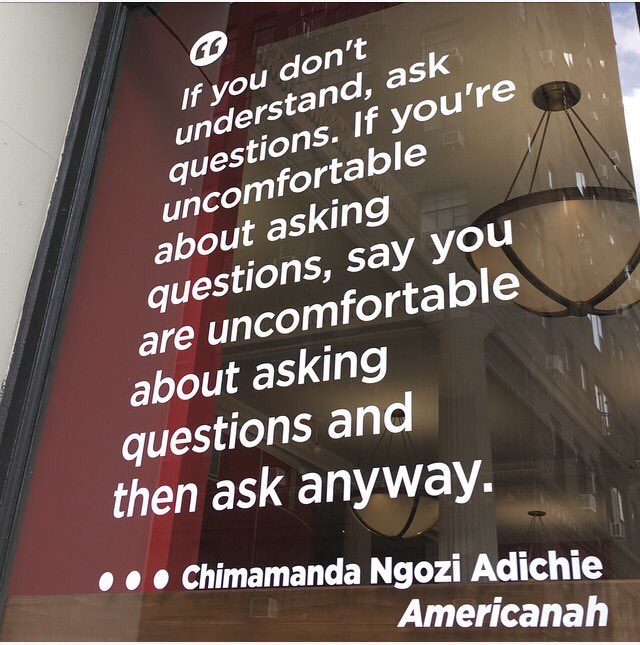
Advice worth heeding from Chimamanda Ngozi Adichie printed on a window at the NYU Centre for Arts and Science:

Spatial Machinations
Advice worth heeding from Chimamanda Ngozi Adichie printed on a window at the NYU Centre for Arts and Science:

Thinking back to Jason Luger’s engaging blogpost about ‘the comeuppance’ of Florida’s evolution of his “creative class” thesis, this interview in the grauniad with Florida is sort of interesting to read… ‘Everything is gentrification now’: but Richard Florida isn’t sorry.
“I’m not sorry,” he barks, sitting in a hotel lobby in Mayfair, wearing a leather jacket and black T-shirt. “I will not apologise. I do not regret anything.”
*cough*

From John Danaher’s Philosophical Disquisitions.
Danaher offers his incisive analysis of recent additions to the debate on legal personhood re. “robots”. Seems interesting (to me) in relation to two things: agency, and how we imagine automation – since we don’t actually have such ‘robots’ at the moment. It’s quite a long post (so only a snippet below), but worth working through… not least because in geographyland it seems to me many of us have a very narrow understanding of these sorts of things from a fairly narrow (simplified) post-structuralist account of ‘subjectivity‘.
The EU parliament attracted a good deal of notoriety in 2016 when its draft report on civil liability for robots suggested that at least some sophisticated robots should be granted the legal status of ‘electronic personhood’. British tabloids were quick to seize upon the idea — the report came out just before the Brexit vote — as part of their campaign to highlight the absurdity of the EU. But is the idea really that absurd? Could robots ever count as legal persons?
A recent article by Bryson, Diamantis and Grant (hereinafter ‘BDG’) takes up these questions. In ‘Of, for and by the people: the legal lacuna or synthetic persons’, they argue that the idea of electronic legal personhood is not at all absurd. It is a real but dangerous possibility — one that we should actively resist. Robots can, but should not, be given the legal status of personhood.
BDG’s article is the best thing I have read on the topic of legal personhood for robots. I believe it presents exactly the right framework for thinking about and understanding the debate. But I also think it is misleading on a couple of critical points. In what follows, I will set out BDG’s framework, explain their central argument, and present my own criticisms thereof.

Via Clive. This will be worth going to if you’re going to the AAG in 2018…
I’m delighted to announce that the very wonderful Michael Samers has arranged an Author Meets Critics session on The Priority of Injustice, my new book (did I mention that?) at the annual meeting of the Association of American Geographers in New Orleans in April. It’s a great panel, with Joshua Barkan (U. of Georgia), Jennifer Fluri (U. of Colorado, Boulder), Leila Harris (UBC), and Kirsi Kallio (University of Tampere) all commenting on the book. The session is sponsored by AAG’s Political Geography Specialty Group and Ethics, Justice, and Human Rights Specialty Group. There’s a nice symmetry about the prospect of discussing the book in New Orleans – the last time the conference was there, in 2003, I presented a paper on theories of radical democracy that was my first post-Culture and Democracy effort at articulating the limits of broadly post-structuralist approaches to that topic, an effort that led eventually to the shape of The Priority of Injustice (yes, I’m a slow thinker).

From the Programmable City team, looks interesting:
The modern retail store is a complex coded assemblage and data-intensive environment, its operations and management mediated by a number of interlinked big data systems. This paper draws on an ethnography of a superstore in Ireland to examine how these systems modulate the functioning of the store and working practices of employees. It was found that retail work involves a continual movement between a governance regime of control reliant on big data systems which seek to regulate and harnesses formal labour and automation into enterprise planning, and a disciplinary regime that deals with the symbolic, interactive labour that workers perform and acts as a reserve mode of governmentality if control fails. This continual movement is caused by new systems of control being open to vertical and horizontal fissures. While retail functions as a coded assemblage of control, systems are too brittle to sustain the code/space and governmentality desired.
Access the PDF here

Issue 1 of the new journal Media Theory is up. Several ‘usual suspects’ amongst the authors list but then that’s to be expected to draw a crowd perhaps. I feel a little squeamish about the “manifestos” line but I haven’t read all of that bit yet, so let’s see… Only one ‘duff’ paper in there so far in my reading 🙂
Here’s a quote from Simon Dawes introductory paper “What is Media Theory” that I think nicely summarises the ethos, which is interesting (to me anyway):
With the relative ease with which new journals can now be established, the launch of a new journal of media theory obliges us all the more to justify the need for such an endeavour (Cubitt, this issue), to argue that we do indeed need yet another journal theorising media (Shome, this issue), and to convince at least some readers that the journal deserves the name, Media Theory (Mitchell, this issue). For this launch issue of the journal, editorial and advisory board members were invited to set out their own views on the importance of (a new journal of) media theory. While the journal can hardly satisfy the occasionally conflicting and contradictory wishes of everyone on the boards, this special issue represents a pluralistic manifesto for the journal – manifestos for various possibilities and directions for Media Theory. […]
Media Theory is not, therefore, a journal that privileges any particular theoretical approach, perspective or tradition to the study of media, but nor is it simply a matter of disinterestedly presenting their diversity or that of the range of theoretical concepts or tools proposed or applied in media research. Rather, in emphasising ‘media’, ‘theory’ and ‘media theory’, the journal aims to deprovincialise media theory by bringing into dialogue and debate the diversity of ways in which media are theorised. For despite the inherently interdisciplinary histories of the various disciplines in which media is studied internationally, there remains a tendency to restrict one’s reading to one’s own field or disciplinary, geographical or linguistic bubble, applying and developing theories without sufficient knowledge of how those theories have already been debated and developed elsewhere.
My colleague Prof. Clive Barnett’s excellent new book is out. He introduces it in a recent blogpost:
 So, finally, the book that I have been writing, on and off, for the last four years, The Priority of Injustice, has been published – or at least, it’s real, since the formal publication date is next month (so I reserve the right to blog further about it as and when). It arrived earlier this week – a rather hectic week, which has oddly meant I have been too busy to experience the strange sense of anti-climax that often accompanies the arrival of the finished form of something that you have been making for so long.
This is, in one sense, my Exeter book – the first thing I did in my very first week here, four years ago, was write the proposal and send it off to prospective publishers, It’s also, though, my Swindon book, a book which attempts to articulate an approach to theorising in an ordinary spirit which has been published just a few weeks after moving away from that very ordinary town where I have lived while writing it.
 It’s a beautiful object, with a great cover image, by Helen Burgess (I bought one of her pictures once, in one of those open-house art trail events that you get in places like Bishopston in Bristol, so that’s why I knew of her work; it turns out she is part of a geography-friendly network of artists). And I am honoured and humbled to have the book published in University Georgia Press’s very excellent Geographies of Justice and Social Transformation series.
I’m now faced with the challenge of promoting the book. I’m quite fond of the Coetzee-esque principle that books should have to make their own way in the world without the help of the author; on the other hand, I have some sense of responsibility towards the argument made in the book, a responsibility to help project it into the world. I’ve already realised that it’s not the sort of book that lends itself to an easy press release – ‘THEORY COULD BE THEORISED DIFFERENTLY’, SAYS THEORY-BOY doesn’t really work as a headline, does it?.

An interesting general (non-academic, non-technical) discussion about what “AI” is, what it means culturally and how it is variously thought about. Interesting to reflect on the way ideas about computation, “algorithms”, “intelligence” and so on play out… something that maybe isn’t discussed enough… I like the way the discussion turns around “thinking” and the suggestion of the word “reckoning”. Worth a listen…

The AI Now Institute have published their second annual report with plenty of interesting things in it. I won’t try and summarise it or offer any analysis (yet). It’s worth a read:
The AI Now Institute, an interdisciplinary research center based at New York University, announced today the publication of its second annual research report. In advance of AI Now’s official launch in November, the 2017 report surveys the current use of AI across core domains, along with the challenges that the rapid introduction of these technologies are presenting. It also provides a set of ten core recommendations to guide future research and accountability mechanisms. The report focuses on key impact areas, including labor and automation, bias and inclusion, rights and liberties, and ethics and governance.
“The field of artificial intelligence is developing rapidly, and promises to help address some of the biggest challenges we face as a society,” said Kate Crawford, cofounder of AI Now and one of the lead authors of the report. “But the reason we founded the AI Now Institute is that we urgently need more research into the real-world implications of the adoption of AI and related technologies in our most sensitive social institutions. People are already being affected by these systems, be it while at school, looking for a job, reading news online, or interacting with the courts. With this report, we’re taking stock of the progress so far and the biggest emerging challenges that can guide our future research on the social implications of AI.”
There’s also a sort of Exec. Summary, a list of “10 Top Recommendations for the AI Field in 2017” on Medium too. Here’s the short version of that:
- 1. Core public agencies, such as those responsible for criminal justice, healthcare, welfare, and education (e.g “high stakes” domains) should no longer use ‘black box’ AI and algorithmic systems.
- 2. Before releasing an AI system, companies should run rigorous pre-release trials to ensure that they will not amplify biases and errors due to any issues with the training data, algorithms, or other elements of system design.
- 3. After releasing an AI system, companies should continue to monitor its use across different contexts and communities.
- 4. More research and policy making is needed on the use of AI systems in workplace management and monitoring, including hiring and HR.
- 5. Develop standards to track the provenance, development, and use of training datasets throughout their life cycle.
- 6. Expand AI bias research and mitigation strategies beyond a narrowly technical approach.
- 7. Strong standards for auditing and understanding the use of AI systems “in the wild” are urgently needed.
- 8. Companies, universities, conferences and other stakeholders in the AI field should release data on the participation of women, minorities and other marginalized groups within AI research and development.
- 9. The AI industry should hire experts from disciplines beyond computer science and engineering and ensure they have decision making power.
- 10. Ethical codes meant to steer the AI field should be accompanied by strong oversight and accountability mechanisms.
Which sort of reads, to me, as: “There should be more social scientists involved” 🙂

A thought experiment based upon flippant suggestion:
Object Oriented Ontology is to philosophy what Uber is to tech development.
Both ‘disruptive’, Uber and OOO have both expanded beyond their initial context, which is by several measures ‘success’. Both have become like discursive shortcuts for a particular set of ideas – ‘gig economy’ and ‘automation’ for Uber and ‘speculative realism’ and maybe even ‘metaphysics’ for OOO (and there’s possibly other associations for these terms too).
Neither OOO or Uber came up with the ideas they propound first, they ‘innovated’ from others (not necessarily a problem) and then made grand claims based on that (maybe a problem).
Neither of the groups involved in the development of Uber or OOO has acted especially ethically, although Uber is almost certainly significantly worse (this isn’t a like-for-like comparison). This is one of the other ways in which these words have become pregnant with meaning. Uber has been variously documented as having a problem with misogyny in the workplace and has also teetered on the edge of legality through ‘greyball’. Some of the proponents of OOO have been accused of bullying graduate students online and at conferences (I recognise gossip can be pernicious but I’ve heard this from several unrelated sources). It has also been suggested some of these folks are garnering a reputation for being somewhat ‘macho’ in attitude – it probably doesn’t help that the lead figures are all male, that they write lots of earnest manifestos or that they succumb to profiles in newspapers that call them “philosopher prophet“. Of course, neither OOO or Uber are unique in this, similar observations/ accusations have been made of antecedent tech firms and philosophical movements, one need only look to TV programmes like “Silicon Valley” or open up the ‘theory boy‘ can of worms.
Finally, there is also a sense that the success both Uber and OOO are easily co-opted into these (pejorative) narratives. There are grounds for this, well – certainly for Uber, but the visibility that success brings makes it easier to tell these stories. I have no doubt that such alleged behaviour is not limited to those involved in Uber or OOO. Likewise, those categories may be contested and we shouldn’t tar everyone who works for a company or does a particular branch of theory with the same brush. Goodness knows there are plenty of “tech bros” and, for want of a better term, “theory bros” outside of Uber and OOO.
Such a critique, however flippant, can come across as a bit pompous or sly. I cannot stand outside this, I am, to a degree, complicit. For example, the citational practices used by “theory bros”, cartel-like, are easy to slip into – many of us have succumbed. To recognise stupidity, as both Ronell and Stiegler point out, is to recognise my own stupidity – the lesson, perhaps the ‘ethic’, is to pass through it towards knowledge. Not the reproduction of the same knowledge (that’s patriarchy), and not always, I think, difference for it’s own sake (isn’t that what the “tech bros” call “disruption”? and doesn’t that always require being in a privileged position?) but perhaps a thoughtful defiance – not ‘laughing along’. This could mean more “no’s” (following Sara Ahmed). Maybe even something like a NO movement – “No Ontology”, at least the kinds of ontology that get used as authority in the kinds of theory top trumps that get played by some of us in the social sciences and humanities… of course this isn’t a novel suggestion either, it’s somewhat akin to feminist standpoint theory.
Perhaps I’m being unkind to OOO and those who do/use it. Success breeds contempt and all that… but the thought experiment was interesting to run through, in my own ham-fisted way…