Two excellent reflections on ethics in relation to Google’s AI principles

Holly from the UK TV programme Red Dwarf

Two excellent pieces by Anab Jain and Lucy Suchman that I recommend you read if you’re interested in studying technology (not just AI) that reflect upon Google’s announcement of its ‘AI principles’ and its apparent commitment not to work on the US Government’s “project Maven”.

Here’s a couple of quotes that stood out, but you should definitely read both pieces:

Corporate Accountability – Lucy Suchman

The principle “Be accountable to people,” states “We will design AI systems that provide appropriate opportunities for feedback, relevant explanations, and appeal. Our AI technologies will be subject to appropriate human direction and control.” This is a key objective but how, realistically, will this promise be implemented? As worded, it implicitly acknowledges a series of complex and unsolved problems: the increasing opacity of algorithmic operations, the absence of due process for those who are adversely affected, and the increasing threat that automation will translate into autonomy, in the sense of technologies that operate in ways that matter without provision for human judgment or accountability. […]

Tackling the Ethical Challenges of Slippery Technology – Anab Jain

The overriding question for all of these principles, in the end, concerns the processes through which their meaning and adherence to them will be adjudicated. It’s here that Google’s own status as a private corporation, but one now a giant operating in the context of wider economic and political orders, needs to be brought forward from the subtext and subject to more explicit debate.

Given the networked nature of the technologies that companies like Google create, and the marketplace of growth and progress that they operate within, how can they control who will benefit and who will lose? What might be the implications of powerful companies taking an overt moral or political position? How might they comprehend the complex possibilities for applications of their products? […]

How many unintended consequences can we think of? And what happens when we do release something potentially problematic out into the world? How much funding can be put into fixing it? And what if it can’t be fixed? Do we still ship it? What happens to our business if we don’t? All of this would mean slowing down the trajectory of growth, it would mean deferring decision-making, and that does not rank high in performance metrics. It might even require moving away from the selection of The Particular Future in which the organisation is currently finding success.

CFP > Critically Queer – 20/21 Sept. Bristol.

Queer Activists in South Africa

Saw this CFP via twitter. Looks like an interesting conference… may be of interest, see tweet below. More information about the working group organising the conference is on their website.

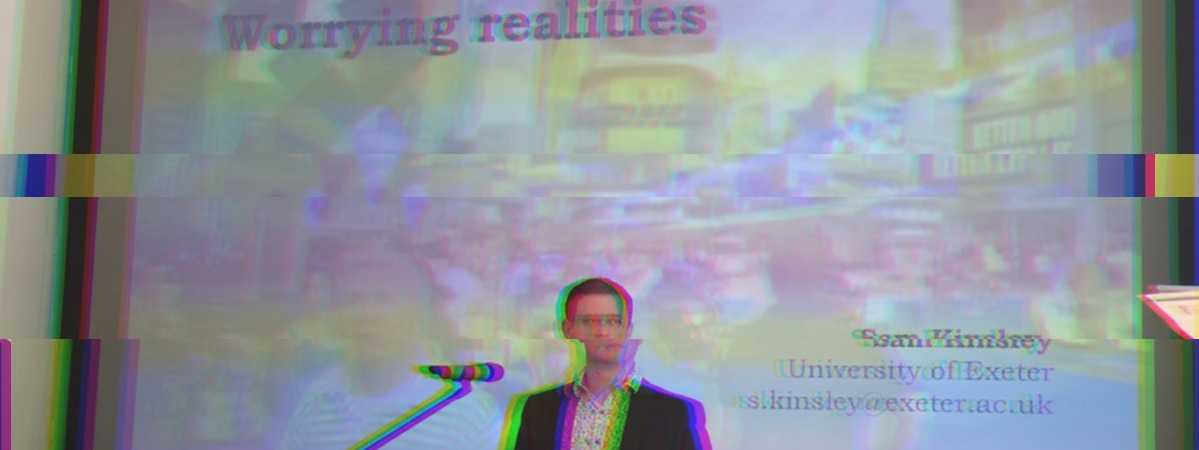
Worrying realities – doing spatial theory for digital geographies

worrying realities - kinsley 2018

I wrote something new… haven’t done that in a while for lots of reasons.

I was compelled to do it because I accepted the kind invitation of colleagues at the wonderful Leibniz Institute for Research on Society and Space for their Spring Academy 2018, themed: “virtuality and socio-materiality”.

I gave a talk called “Worrying realities – doing spatial theory for digital geographies”. In the talk I concerned myself, and maybe those listening, with the ways in which forms of spatial theory get ‘done’ in relation to ‘digital’ or ‘virtual’ phenomena, sometimes generalised as proper nouns… ‘the digital’ and so on. I was not interested, and I still am not, with ‘policing’ the correct theory here, instead I pointed out some habits of theorising space in relation to mediation that I think are interesting and that perhaps those of us interested in doing, talking about and writing about ‘digital geographies’ maybe need to reflect upon sometimes. In particular, I think what Theodore Adorno diagnoses as an ‘ontological need’ pertains, and we perhaps need to be a little more reflexive about how that plays out.

So, I’m sharing a PDF of the slides with the notes I’ve written up. [Now the revised PDF.]

In any case, I don’t know what to do with this… I’d like to write it up, not sure where it would go..? Any comments or arguments, or suggestions for venues to which it might be submitted, are gratefully received 🙂

Please take this material in the spirit in which it is shared – as an attempt to open a conversation. Please also give credit where it’s due – this is not (yet) published but these are my current ideas and I’m sharing them in good faith.

Tarleton Gillespie on “Custodians”

Facebook logo reflected in a human eye

Custodians of the Internet – Tarleton GillespieOver on the Culture Digitally site Tarleton Gillespie discusses his new book Custodians of the Internet, reflecting on some of the meanings of “custodian” and how they variously relate to the topic of the book – content moderators for social media services. Gillespie is an astute observer and analyst of contemporary ‘digital culture’ (I struggle to think of another noun right now) and the issue of moderation is certainly timely.

 I thought I would explain the book’s title, particularly my choice of the word “custodians.” This title came unnervingly late in the writing process, and after many, many conversations with my extremely patient friend and colleague Dylan Mulvin. “Custodians of the Internet” captured, better than many, many alternatives, the aspirations of social media platforms, the position they find themselves in, and my notion for how they should move forward.

Read more on Culture Digitally.

Data materiality – a new project by Scott Rodgers

A huge array of overhead wires on a street

This new project at Birkbeck by Scott Rodgers & Joel McKim looks really interesting:

Data Materiality: collaborative BIRMAC/Vasari project

[…]

Data Materiality

The expanded presence and impact of data, and arrival of so-called Big Data, has become an accepted, background feature of contemporary life. But while data clearly matters, the question arising now is: just how does data come to ‘matter’? What are the sometimes unseen material infrastructures that bring data into being, into circulation and into action? What are the social and political structures, policies and institutions through which data comes to have effects? And what might it mean to think about data – as suggested by Sarah Pink and others – as ‘broken’: as always already implicated in ordinary processes of maintenance and repair?

Data Materiality – a three-year collaborative project co-sponsored by the Birkbeck Centre for Interdisciplinary Research in Media and Culture, and the Vasari Centre for Art and Technology – seeks to address these questions. By data ‘materiality’ we mean not only the ways in which data crystallises into physical forms and depends on material technical and social infrastructures, but also the related ways in which data comes to matter, in and through practical action, collective imaginaries, or biological conditions. So we are interested in questioning the proliferating network of data centres, fibre-optic cables and server farms that underpin our data usage, but we also wish to explore perhaps less tangible or apparent infrastructures of data – materialities that might include, for instance, digital objects and artefacts, from network protocols to markup languages, as well as the labour and organizational structures putting data to work.

Our key aim in exploring data materiality is to get beyond the idea of data as a raw or unprocessed and, as Lisa Gitelman has suggested, understand the ordinary material conditions under which data is induced and deduced. We wish to ask, in other words, how does data leave its traces on the world? And how does the world leave its traces on data?

Read more on Scott’s website.

Some podcasts…

cartoon of an old fashioned microphone

I blogged about the BBC’s unpopped podcast a while ago, and in reply Scott kindly made a further recommendation (below). I’ve also recently begun to listen to a few more podcasts and so I thought I’d do another quick post that recommends some podcasts that some of the readers of this blog may find interesting…

99% invisible podcast

Scott Rodgers recommended the podcast 99% Invisiblewhich is ostensibly about design but covers all sorts of things and I’ve enjoyed listening to this over the last couple of months. They have a website with lots of additional info and articles based on the topics of each show. The show is part of the Radiotopia stable, which has quite a few well-regarded podcasts.

Everyone Else podcastOne of the recommendations that I’ve been incredibly thankful for, actually from the BBC’s Podcast Radio Hour, is the sublime Everyone Else – a podcast ‘telling the stories of strangers’. One of the many things I love about the podcast is the sound design – there are all sorts of wonderful atmospheric effects and incidental music. The stories themselves are fascinating, often moving and always evocative of a very human experience of life.

the Tip Off podcastAnother recommendation from Podcast Radio Hour is The Tip Off – a podcast concerning investigative journalism.  Maeve McClenaghan from The Bureau of Investigative Journalism takes you through the processes of investigative journalism. Again, some really evocative audio production and some gripping stories.

Whilst I’m thinking about it, and maybe I’ll blog about this another day – one thing I am beginning to find a little frustrating about the majority of recommendations from the BBC’s Podcast Radio Hour and other folks who are, for want of a better word, podcasting ‘insiders’ is what I’ve come to think of as a weird kind of fetishisation of a privileged position as a listener being party to some kind of apparently authentic or intimate story or truth. These sorts of podcasts are becoming the norm – a presenter, often a comedian for some reason, talks to someone else and apparently intimate or frank conversations ensue. Either that or we are invited into an otherwise hard-to-access or ‘edgy’ context, such as a prison, and allowed to gawp. Most of the time, in my limited and partial experience, recommendations of podcasts (and sometimes the podcasts themselves) presuppose a white middle-class audience, who most likely are metropolitan and/or university-educated – one might look at the winners of the recent British Podcast Awards and ask questions along these lines. The fact that many are hosted by women often performing either/both of what comes across as earnest concern or compassion or a confessional revelation of intimacy also seems worthy of critical reflection. I’m just sort of uncomfortable about the aesthetic that seems to have become a norm in British, perhaps BBC-favoured, podcasting. Maybe I’m wrong. I hope so.

If you’ve read this far and have any thoughts I’d be really happy to hear from you – especially with other podcast recommendations!

Excellent post by Angela Last on teaching geohumanities

Louise Bourgeois work of art

I enjoyed reading this thoughtful piece on teaching ‘geohumanities’…

An experiment in teaching geohumanities

As someone whose work gets framed as ‘geohumanities’, I often get asked about my take on the field, both in terms of research and teaching. I usually answer that I feel that geohumanities is in danger of becoming a mere rebranding exercise for cultural geography or environmental humanities. Looking at articles from journals across those three fields, it becomes difficult to make out a difference. This dynamic seems aggravated by the demands of the Research Excellence Framework (REF) that evaluates research output according to discipline. Many academics have complained that, while contemporary problems (and research funders) demand interdisciplinarity, the current research (and academic career) assessment punishes discipline transgressions. Your work will always be scrutinised for sufficient adherence to disciplinary boundaries, and it seems not enough that most of your work can be accounted for in this way, and the fact that there are dedicated journals for this field in which you can publish. Although the new framework promises to pay more attention to interdisciplinarity, the paranoia around disciplinarity persists. Certainly, during last year’s job interviews, I experienced anxiety around my work and the journals in which I decide to publish. Even at interviews for geohumanities themed posts, when bringing up potential practice based or inter/cross-disciplinary outputs, the answer was often ‘no’.

…

A related issue is interdisciplinary teaching. There are many different ways of doing this, depending on institutional logistics (timetabling, student location, connection to other departments etc), levels (undergraduate, postgraduate) and staffing. An increasing number of universities claim to have interdisciplinary undergraduate teaching programmes such as ‘Liberal Arts’, but in reality, subjects are still being kept separate and taught by specialists. The location of an interdisciplinary programme also often determines the angle. For instance, if an art and science programme is located within an arts faculty, the syllabus is more likely to be art centred, no matter how diverse the student body.

Read more here.

Reblog> Derrida’s Margins: Inside the personal library of Jacques Derrida

Jacques Derrida

Really interesting… via Stuart Elden.

Derrida’s Margins: Inside the personal library of Jacques Derrida

downloadDerrida’s Margins: Inside the personal library of Jacques Derrida

For Jacques Derrida (1930-2004), reading was an active process: he read texts by thinkers like Rousseau, Heidegger, Lévi-Strauss, Hegel, and Husserl with a writing utensil in hand.  As Derrida affirmed in a late interview, the books in his personal library bear the “traces of the violence of pencil strokes, exclamation points, arrows, and underlining.”

Derrida’s Margins invites scholars to investigate these markings while unpacking the library contained within each of Derrida’s published works, beginning with the landmark 1967 text De la grammatologie (Of Grammatology).  Additional Derrida works will be added as the project continues.

The website catalogues each reference (quotation, citation, footnote, etc.) in De la grammatologie and allows users to explore Derrida’s personal copies of the texts he cites. Due to copyright restrictions, only annotated pages corresponding to references in De la grammatologie are shown here; users may also view external images of each book as well as images of the numerous insertions (post-it notes, bookmarks, calendar pages, index cards, correspondence, notes, etc.) Derrida tipped in to his books.

The website includes the following sections, accessible via the links in the four corners of this page: Derrida’s Library, where users may browse or search Derrida’s copies of the books referenced in De la grammatologie; Reference List, where users may browse or search the nearly one thousand references to other texts found in the pages of De la grammatologie; Interventions, where users may browse or search Derrida’s annotations, marginalia, and markings that correspond to the references in De la grammatologie; and Visualization, which provides users with alternative ways of exploring the references in De la grammatologie.  Users may search a particular section or the entire site at any time by using the search field at the top of every page.  

The Library of Jacques Derrida is housed at Princeton University Library’s Rare Books and Special Collections.

Workshop on feminist philosophy of technology – Vienna 25-26 Oct ’18

Donna Harraway

Via Mark Coeckelbergh.

Workshop on feminist philosophy of technology

Organizers: Dr. Janina Loh, Prof. Dr. Mark Coeckelbergh
Date: October 25-26, 2018
Venue: University of Vienna, Department of Philosophy, Universitätsstr. 7 (NIG), 1010 Vienna

There has been little attention to feminism and gender issues in mainstream philosophy of technology and vice versa: many feminists have focused on societal matters and relationships without taking into account how technics (i.e. technologies and techniques) shape those societies and relationships. However, since the beginning of the second-wave feminism by the mid 20th century, a growing awareness of the gravity and urgency for a critical reflection of technology and the sciences within feminist discourses can be observed. But feminist thinkers have not throughout interpreted technology and science as potentially emancipatory and liberating in every respect. In the same breath, the inherent structures of dominance, marginalization, and oppression have been confronted and disqualified within the feminist paradigm. The question of defining and ascribing responsibility in science and technics – regarding for instance the technological transformation of labor, the life in the information society, and the relationship between humans and machines – is essential for this workshop. Critical posthumanism and new feminist materialism define promising examples for a reformulation of known challenges such as essentialism and relativism, a transformation of hypostatized perspectives on traditional categories and dichotomies, as well as the claim to think off the beaten paths of socialist, liberal, and radical feminism. Confirmed keynote speakers are Corinna Bath, Rick Dolphijn, Nina Lykke, Kathleen Richardson, Lucy Suchman, and Judy Wajcman. The workshop Feminist Philosophy of Technology has two main aims: It shall present and spark a dialogue between the prominent approaches within feminist philosophy of technology (first day). On the second day we would like to explore and discuss potential challenges and perspectives within current movements of feminist philosophy of technology. We welcome submissions on any – but not limited to – the following issues:

  • critical posthumanism
  • new materialist feminism
  • feminist philosophy of technology
  • technofeminism
  • cyberfeminism
  • xenofeminism
  • human-machine-interaction
  • relationships with machines
  • sexrobotics
  • the future of work (industry 4.0, automatization, digitalization)
  • women, technics, and education
  • women, technics, and arts.

Please submit abstracts of around 500 words to janina.loh@univie.ac.at, by July 30. Acceptance notifications will be sent out by the end of August.