Robots that are repeatedly coming, still

Industrial factory robot arms

On Tim Harford’s second series of Fifty things that made the modern economy there is an interesting trend of highlighting how some of the ‘things’ tell wider stories about automation in some regard. There are two things I’d pull out here.

First, there’s the issue of job or task displacement. Harford argues that, for example, spreadsheets automate certain elements of accountancy but make accountancy that much more efficient that more accountancy takes place. Quite a nice concise story about automation. This is indicative of a wider argument that often gets made about automation, perhaps in contradistinction to the ‘robots are stealing jobs’ hysteria — that automation may involve technology replacing people in certain tasks but that it often results in new tasks, or new forms of work (e.g. in the WEF ‘Future of Jobs Report 2018‘).

Second, there’s the issue of us being told by those with particular interests in automation and robotics that robots are about to replace a particular kind of work. This is a story that get’s trotted out rather a lot. ‘The robots are coming’ is a phrase often repeated in newspaper and web headlines. There are host of ‘packages’ for modern, and not-so-modern, news programmes about a ‘new’ machine that is going to replace a particular kind of worker. Harford gives a great example right at the end of the programme about bricks. We get through a lot of bricks and laying them as walls and building those into buildings are labour-intensive. There is a ‘new’ robot to displace that work: Construction Robotics‘ Semi Automated Mason (SAM – great name eh?) works alongside builders to speed up building walls (video below).

The thing is – this is not actually new. As Harford points out in the ‘bricks‘ programme, this is a story that has been told before. In the 1960s Pathé news reported on a remarkably similar mechanical system: the ‘motor mason’ (video below).

We can see then that in Harford’s popular economics podcast, 50 things, automation is a common theme – just as it is in wider discussions about social and political-economic ‘progress’. Yet it also nicely demonstrates some recurring tropes. First, there are now fairly established narratives about automation in relation to ‘jobs’ that are told in different ways, depending upon your political or theoretical persuasion – job ‘replacement’ and/or ‘creation’. Second, there is a common subsequent narrative when the ‘replacement’ story is playing out – that of the clever machine that is going to do a particular worker, such as a brick layer, out of their job. Here we also see how that narrative can keep being repeated, the robot is always coming but, perhaps sometimes, not quite arriving.

"The robots are coming" headline from the Guardian in 1986
"The robots are coming" headline from the Guardian in 2019

Bernard Stiegler on disruption & stupidity in education & politics – podcast

Bernard Stiegler being interviewed

Via Museu d’Art Conptemporani de Barcelona.

On the Ràdio Web Macba website there is a podcast interview with philosopher Bernard Stiegler as part of a series to ‘Reimagine Europe’. It covers many of the major themes that have preoccupied Stiegler for the last ten years (if not longer). You can download the pod as an mp3 for free. Please find the blurb below and a link.

In his books and lectures, Stiegler presents a broad philosophical approach in which technology becomes the starting point for thinking about living together and individual fulfilment. All technology has the power to increase entropy in the world, and also to reduce it: it is potentially a poison or cure, depending on our ability to distil beneficial, non-toxic effects through its use. Based on this premise, Stiegler proposes a new model of knowledge and a large-scale contributive economy to coordinate an alliance between social agents such as academia, politics, business, and banks. The goal, he says, is to create a collective intelligence capable of reversing the planet’s self-destructive course, and to develop a plan – within an urgent ten-year time-frame – with solutions to the challenges of the Anthropocene, robotics, and the increasing quantification of life.

In this podcast Bernard Stiegler talks about education and smartphones, translations and linguists, about economic war, climate change, and political stupidity. We also chat about pharmacology and organology, about the erosion of biodiversity, the vital importance of error, and the Neganthropocene as a desirable goal to work towards, ready to be constructed.

Timeline
00:00 Contributory economy: work vs proletarianization
05:21 Our main organs are outside of our body
07:45 Reading and writing compose the republic
12:49 Refounding Knowledge 
15:03 Digital pharmakon 
18:28 Contributory research. Neganthropy, biodiversity and diversification
24:02 The need of an economic peace
27:24 The limits of micropolitics
29:32 Macroeconomics and Neganthropic bifurcation
36:55 Libido is fidelity
42:33 A pharmacological critique of acceleration
46:35 Degrowth is the wrong question

Standing in the way of control – website issues

If you look at the dates of postings here, or if you happen to follow my posts, you may have noticed that there has been a longer-than-average silence. This has not only been due to being busy at work (though it has been a very busy term, with the commute more challenging than usual). I have also experienced some issues with this website (hence this post has happened twice – due to reverting to a backup) and in particular with WordPress that my wonderful hosting company – Reclaim – have been very kindly and expertly helping me with. I’m now able to post again but I think there will need to be a bit of spring cleaning behind the scenes in the near future!

I can’t speak highly enough of Reclaim Hosting – they have been a bit of a revelation to me. The support has been superb and the prices are very very reasonable (this is not an advert – I genuinely think these things 

I have a couple of bits of work-y news:

  • I have been promoted to ‘Senior Lecturer’, which is good. The paperwork took quite a while to complete and if anyone is in a similar position and would like to talk about it I’d be happy to do so… It is run in a fairly strange way where I work, insofar as it is almost a second probation, so it’s a relief that it’s done. I recognise how fortunate I am in my situation and will do my best to make the most of it.
  • I am still working on my book idea around the ‘automative imagination’. Unfortunately I was unsuccessful in my application for a BA ‘Mid-Career Fellowship’ to support this. I’m trying to make progress regardless. I’ve integrated some of the themes into my teaching and I have a loooong reading list, mostly physically located on a small table I have purloined for my office(!) If anyone reading this has any ideas about other avenues to explore for funding or support I’d really love to hear them! Likewise, if you’re interested in talking about ‘automation’ I would also welcome the opportunity to talk.
  • I’ve been involved in a sort of core curriculum review in my department this year (sadly without workload recognition) in which a group of us (who currently convene those modules) are redesigning our core methods modules. This has been really interesting. We have certainly had to consciously think through what a/our geography degree is for, and what sorts of things we should be inviting the students to learn.
  • I have put forward a double-session on ‘Geographies of/with AI’ for this year’s RGS-IBG annual conference, which hopefully will be accepted – still waiting to find out.

I would very much welcome anyone getting in touch to talk about automation, or any of the other things I tend to blog about, so please do feel free.

Standing in the way of control – The Gossip

“Ready Lawnmower Player Man One”, or VR’s persistent future

For the last couple of years I have given a lecture that takes the “Virtual/Real” distinction and deconstructs it using various bits of geographical theory. I also talk about the enduring trope of the sort of eschatological narrative of VR, tying it back to a little bit of history, mainly focusing on how this has been propagated in pop culture. This year, for fun, I have decided to be a little bit more creative than resorting to my usual trick of showing the trailer for Lawnmower Man or Ready Player One – I’ve made a quick mashup of the two, which I think show quite nicely how the underlying narratives of the ‘virtual’ somehow counterposed to the ‘real’ but also in some way ‘crossing over’ is an enduring theme.

The other enduring theme here is that the forms of gameplay drawn upon are characterised as highly masculine (and normatively heterosexual – no queering of the digital here, sadly), which is something I will try to also blog about sometime…

Other film examples might include:

Bernard Stiegler: “Rethinking an industrial policy in the era of the Anthropocene and automation”? [translated]

A young man standing in a cloud of yellow smoke

I recently came across an edited interview with Bernard Stiegler published on the website of Philosophie Magazine (17/12/18) [a] in which Stiegler ties together a very brief reading of the ‘yellow vests’ phenomena with the experiments he has been leading in the creation of an ‘economy of contribution’ – a more-or-less as a ethico-political-economic response to the ‘Anthropocene’. It is important to note here that for Stiegler not only means the current global cultural/environmental/social crisis embodied in a new ‘epoch’ but also significantly means the apparently rapid changes in employment/work largely due to technology. I have translated conversations with Stiegler about this topic before and these might be helpful in fleshing out the argument translated below, especially:

Here, in a similar vein to the discussion of previous periods of civil unrest in France (see in particular the books: The Decadence of Industrial Democracy, Uncontrollable Societies of Disaffected Individuals and The Lost Spirit of Capitalism) Stiegler diagnoses a form of immiseration that comes from a loss of capacities that needs to be addressed through a form of therapeutic response. The ‘yellow vests’ movements are a symptom of a broader cultural-environmental-social ‘entropy’ that is ‘The Anthropocene’ needs to be addressed through a re-imagined industrial policy – to engage in what he terms a form of ‘negentropy’. having said all of this, what is important perhaps about this brief interview is that it locates pragmatic action by talking through what Stiegler and colleagues are doing in the Plaine Commune experiments (for more information follow the links above).

As I have previously observed, I still find it curious that underlying the apparent radicalism of re-thinking industrial strategy, acting together towards (political) therapeutic ends, is a strange sort of unflinching (dare-I-say even conservative) faith in the state and institutions. In particular, the model for the central strategy of ‘contributory income’ is the intermittent entertainment policy of the French government for subsidising freelance and somewhat precarious forms of work in the ‘creative industries’. I’m not criticising this, I think it merits greater discussion – not least because it is being trialed in Seine-Saint-Denis – but there’s something curious about this rather measured scheme being central to the strategy, given the almost apocalyptic and incredibly urgent tone of books like The Neganthropocene and Age of Disruption.

ADD. 24/01/19. I think I probably missed a final step to the thought expressed in the paragraph above: while the scheme for a ‘contributory income’ (based upon the intermittent scheme) currently underway in Plaine Commune is perhaps limited, and while the idea of such an income is, in-itself not especially ‘revolutionary’, perhaps I/we should see this as the beginning of a reorientation – the instigation of a different/new therapeutic ‘tendency’, in Steigler’s terminology – away from a competitive individualised economic rationale towards a collective means of flourishing together, whilst also acknowledging that we need to take some form of collective responsibility. In that vein, as others have pointed out, Stiegler’s ‘activist’ thought/activities take on a particular ethical/moral stance (in this way I have some sympathy with Alexander Galloway calling Stiegler a ‘moral philosopher’).

As usual I have included in square brackets original French, where I’m unsure of the translation, or clarifications. I have also maintained, in the Conversation piece, all of the original francophone hyperlinks unless there is a clear anglophone alternative.

I welcome comments or corrections!

Notes

a. The interview appears in a section entitled Gilets Jaune, et maintenant? – something like ‘Yellow vests, now what?’

Bernard Stiegler: “Rethinking an industrial policy in the era of the Anthropocene and automation”

For this thinker of technics, the “yellow vests” movement highlights the desperate need for a new policy that would value work rather than employment. Among his proposals is the widening of the government scheme for irregular workers in the creative sector to everyone.

I was struck by the rapid evolution of the “yellow vests” movement, by the way it was presented and in which it was perceived. In the beginning, occupations of roundabouts [and crossroads] were reminiscent of the Tea Party phenomenon in the United States, which paved the way for Donald Trump’s election, and of Sarah Palin’s astonishing statement: “I like the smell of exhaust emissions!”However, despite the presence of the “ultra-right” which is of course very dangerous, the rise of this movement has evolved positively – and very unexpectedly. Compared with the “protest” scene, well-known in France for decades, the “yellow vests” are obviously a very singular and very interesting event, beyond its extreme ambiguities. Amongst the demands made by these leaderless demonstrators, the proposal to create a deliberative assembly for ecological transition is particularly illustrative of what fundamentally new emerging from this movement. This is confirmed by the encouraging sign, which must be interpreted without being under any illusions: the protest and climate march at a junction, in Bordeaux, on the 8th of December.

When we listen to the “yellow vests”, we hear the voices of people who are a bit lost, often living in unbearable conditions but with the virtue of expressing and highlighting our contemporary society’s limits and immense contradictions. In the face of this, the Macron government seems unable to take the measure of the problems being raised. I fear that the measures announced by the President on the 11th of December resolve nothing and fix in place the movement for the longer term, precisely because it expresses – at least symptomatically – the collective awareness of the contemporary crisis. The political horizon throughout Europe is not at all pleasant: the extreme right will probably draw the electoral benefits of this anger, while failing to answer the questions legitimately posed by “yellow vests” movement. This highlights the lack of a sense of history by President Macron and his ministers, and equally underlines the vanity of those who pretend to embody the left, who are just as incapable of making even the simplest statement at the height of what is the first great social crisis characterised by the Anthropocene. 

For me, a “man of the left”, the important question is what would be a leftist comprehensive industrial policy to take up the challenges of the Anthropocene and automation – which is to say, also addressing “Artificial Intelligence”. To confront this question is to attempt to overcome what is not thought in Marxian criticism, namely: entropy. All of the complex systems, both biologically and socially, are doomed to differential loss – of energy, biodiversity, interpretation of information – that leads to entropic chaos. The concept of negentropy, taken from the works of Erwin Schrödinger, refers to the ability of the living to postpone the loss of energy by differentiating organically, creating islands and niches locally installing a “différance” (as Derrida said) through which the future [l’avenir] is a bifurcation in an entropic becoming [devenir entropique] in which everything is indifferent. 

The fundamental point here is that, while entropy is observed at the macroscopic level, negentropy only occurs locally through energy conversion in all its forms – including libidinal energy. Freud was, with Bergson, the first to understand this radical change in point of view required by entropy. The “nationalist retreat” is a symptomatic expression of the entropic explosion provoked by the globalization [that is the] Anthropocene. This needs to be addressed by a new economic and industrial policy that systematically values negentropy. 

It is in response to such issues that the Institute of Research and Innovation and Ars Industrialis with Patrick Braouezec (President of the Plaine Commune public territorial establishment) are leading an experiment in Seine-Saint-Denis. In this district of 430,000 we are experimenting with putting in place a local economy of contribution, based upon a new macro-economy at the national level. Above all, this scheme values work rather than employment and aims to generalize the system of intermittent entertainment [added emphasis] [1]: The idea is to be able to guarantee people 70% of their most recent salary in the periods when they do not work, provided that within ten months they begin another freelance [intermittent] job. In the case of freelance [intermittent] performers, they must work for 507 hours, after which they have “replenished their right” to a contributory income. We are currently constructing workshops in the areas of child care, quality urban food, construction and urban trades, the conversion of combustion vehicles into clean vehicles, and so on. This experiment is supported by the Fondation de France, Orange, Dassault Systèmes, Caisse des Dépôts et Consignations, Societe Generale, Afnic Foundation and Emmanuel Faber, General Manager of Danone. Every one of which are stakeholders in the search for a new conception of industrial economy fully mobilized in the fight against the Anthropocene and for the restoration of very-long-term economic solvency, based on investment, not speculation. It is by taking bold initiatives of this kind that we will truly respond to the “yellow vests”.

Notes

1. There is no direct translation for ‘intermittent entertainment’/ ‘intermittents du spectacle’ – this refers to state-subsidised freelance workers in the entertainments industry, an arrangement backed by long-standing legislation in France to support their native creative sectors.

“AI will displace 40 percent of world’s jobs in as soon as 15 years” – Kai-Fu Lee

Industrial factory robot arms

In a widely-trailed CBS ’60 minutes’ interview, the A.I-pioneer-cum-venture-capitalist Kai-Fu Lee makes the sorts of heady predictions about job replacement/displacement that the media like to lap up. The automative imagination of ‘automation as progress’ in full swagger…

We should perhaps see this in the context of, amongst other things, geopolitical machinations (i.e. China-USA) around trade and intellectual property; a recently published book; a wider trend for claims about robotic process automation (especially in relation to ‘offshoring‘); and a large investment fund predicated upon ‘disruption’.

“Merger” by Keiichi Matsuda – automation, work and ‘replacement’

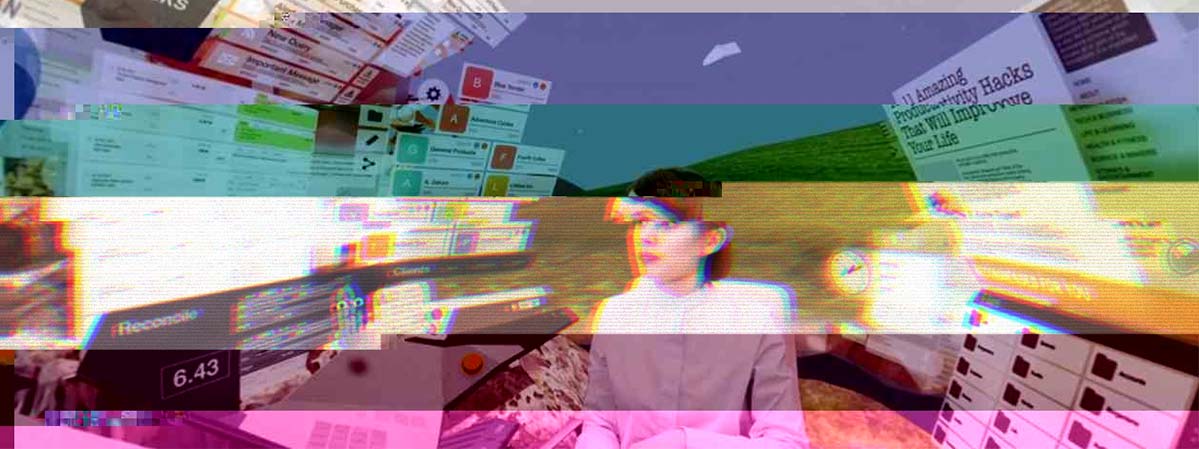
A still from the 360-degree video "Merger" by Keiichi Matsuda
“With automation disrupting centuries-old industries, the professional must reshape and expand their service to add value. Failure is a mindset. It is those who empower themselves with technology who will thrive.
“Merger is a new film about the future of work, from cult director/designer Keiichi Matsuda (HYPER-REALITY). Set against the backdrop of AI-run corporations, a tele-operator finds herself caught between virtual and physical reality, human and machine. As she fights for her economic survival, she finds herself immersed in the cult of productivity, in search of the ultimate interface. This short film documents her last 4 minutes on earth.”

I came across the most recent film by Keichii Matsuda which concerns a possible future of work, with the protagonist embedded in an (aesthetically Microsoft-style) augmented reality of screen-surfaces, and in which the narrative denouement is a sort of trans-human ‘uploading’ moment.

I like Matsuda’s work. i think he skilfully and playfully provokes particular sorts of conversations, mostly about what we used to call ‘immersion’ and the nature of mediation. This has, predictably happened in terms of human vs. AI vs. eschatology (etc etc.) sorts of narratives in various outlets (e.g. the Verge). The first time I encountered his work was at a Passenger Films event at which Rob Kitchin talked about theorisations of mediation in relation to both Matsuda’s work and the (original) Disney film ‘Tron‘.

What is perhaps (briefly) interesting here are two things:

  1. The narrative is a provocative short story that asks us to reflect upon how our world of work and technological development get us from now (the status quo) to an apparent future state of affairs, which carries with it certain kinds of ethical, normative and political contentions. So, this is a story that piggybacks the growing narrative of ‘post-work’ or widespread automation of work by apparently ‘inhuman’ technologies (i.e. A.I) that provokes debate about the roles of ‘technology’ and ‘work’ and what it means to be ‘human’. Interestingly, this (arguably) places “Merger” in the genre of ‘fantasy’ rather than ‘science fiction’ – it is, after all, an eschatological story (I don’t see this final point as a negative). I suppose it could also be seen as a fictional suicide note but I’d rather not dwell on that…
  2. The depiction of the interface and the interaction with the technology-world of the protagonist– and indeed the depiction of these within a 360-degree video –are as important as the story to what the video is signifying. By which I mean – like the videos I called ‘vision videos’ back in 2009/10 (and (in some cases) might be called ‘design fiction’ or ‘diagetic prototypes’) – this video is also trying to show you and perhaps sell you the idea of a technology (Matsuda recently worked for Leap Motion). As I and others have argued – the more familiar audiences are with prospective/speculative technologies the more likely we are (perhaps) to sympathise with their funding/ production/ marketing and ultimately to adopt them.

Call for papers: Geography of/with A.I

Still from the video for All is Love by Bjork

I very much welcome any submissions to this call for papers for the proposed session for the RGS-IBG annual conference (in London in late-August) outlined below. I also welcome anyone getting in touch to talk about possible papers or ideas for other sorts of interventions – please do get in touch.

Call for papers:

We are variously being invited to believe that (mostly Global North, Western) societies are in the cusp, or early stages, of another industrial revolution led by “Artificial Intelligence” – as many popular books (e.g. Brynjolfsson and McAfee 2014) and reports from governments and management consultancies alike will attest (e.g. PWC 2018, UK POST 2016). The goal of this session is to bring together a discussion explicitly focusing on the ways in which geographers already study (with) ‘Artificial Intelligence’ and to, perhaps, outline ways in which we might contribute to wider debates concerning ‘AI’. 

There is widespread, inter-disciplinary analysis of ‘AI’ from a variety of perspective, from embedded systematic bias (Eubanks 2017, Noble 2018) to the kinds of under-examined rationales and work through which such systems emerge (e.g. Adam 1998, Collins 1993) and further to the sorts of ethical-moral frameworks that we should apply to such technologies (Gunkel 2012, Vallor 2016). In similar, if somewhat divergent ways, geographers have variously been interested in the kinds of (apparently) autonomous algorithms or sociotechnical systems are integrated into decision-making processes (e.g. Amoore 2013, Kwan 2016); encounters with apparently autonomous ‘bots’ (e.g. Cockayne et al. 2017); the integration of AI techniques into spatial analysis (e.g. Openshaw & Openshaw 1997); and the processing of ‘big’ data in order to discern things about, or control, people (e.g. Leszczynski 2015). These conversations appear, in conference proceedings and academic outputs, to rarely converge, nevertheless there are many ways in which geographical research does and can continue to contribute to these contemporary concerns.

The invitation of this session is to contribute papers that make explicit the ways in which geographers are (already) contributing to research on and with ‘AI’, to identify research questions that are (perhaps) uniquely geographical in relation to AI, and to thereby advance wider inter-disciplinary debates concerning ‘AI’.

Examples of topics might include (but are certainly not limited to):

  • A.I and governance
  • A.I and intimacy
  • Artificially intelligent mobilities
  • Autonomy, agency and the ethics of A.I
  • Autonomous weapons systems
  • Boosterism and ‘A.I’
  • Feminist and intersectional interventions in/with A.I
  • Gender, race and A.I
  • Labour, work and A.I
  • Machine learning and cognitive work
  • Playful A.I
  • Science fiction, spatial imaginations and A.I
  • Surveillance and A.I

Please send submissions (titles, abstracts (250 words) and author details) to: Sam Kinsley by 31st January 2019.

A 2018 list: Four books I read, four books I wish I had

A painting of a boy reading, by Eastman Johnson

People publish lists at this time of year. So, here’s another. I’m not going to pretend I am someone I’m not though… so here’s two lists, really, one is books I enjoyed reading, the other is books I wish I’d read (for want of time) and hope to in 2019.

Read

Automating Inequality – Virginia Eubanks : A superbly detailed, very readable account of the ways in which automated systems carry assumptions from the policy makers and developers within them, even when they consciously try to avoid this, and how to think about studying such things. This really is a wonderful book. If you are interested in ‘algorithms’, AI’ and automation, especially in relation to bias and ethics you really ought to read this book. Likewise, if you are interested in studying welfare provision.

The Problem with Work – Kathi Weeks : A thoughtful, mostly conceptual (in a good way), engagement with what counts as work (or ‘waged labour’) and the ways in which it has become a given and removed it from critique. In concluding the book, Weeks stages a well-argued counter to the ‘work ethic’ (in the vein of Weber) as a ‘post-work politics’ – a mandate to ‘get a life’. This is wonderful piece of scholarship.

Working Bodies – Linda McDowell : I am slightly ashamed that I’d not read this before but McDowell’s book on ‘interactive service work’, ‘body work’ and emotional labour is a forceful, really engaging and superbly argued book about how work continues to be gendered in relation to idea(l)s around ‘care’. This is also a fantastic teaching resource, which I’ve made good use of in teaching a portion of  second year module on geographies of ‘work’.

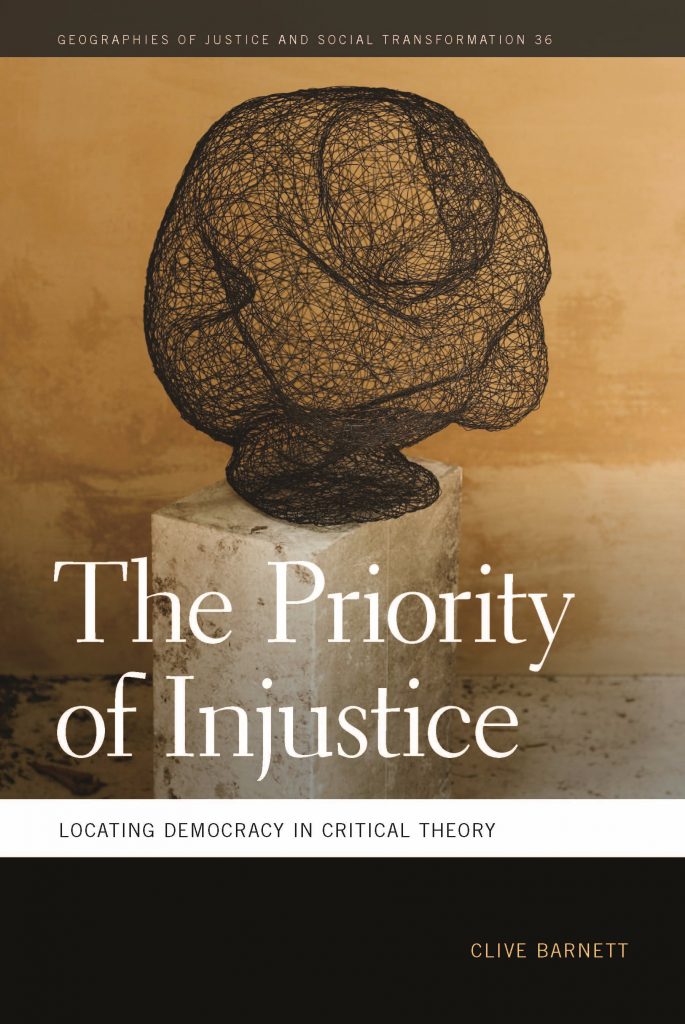
The Priority of Injustice – Clive Barnett

The Priority of Injustice – Clive Barnett : The subtitle –’Locating democracy in critical theory– captures the ambition of the book, which I think is fulfilled. This is a consummate and substantial theoretical (try to think of that word in a positive way here) investigation of the ways people in geographyland and the wider landscape of social theory conceptualise ‘democracy’ (often in relation to something called ‘justice’, which Clive rethinks). However, above and beyond this, what this book did for me is to further provoke a conscious rethinking of what it can mean to ‘do theory’ and to solidify a shift in my theoretical antennae. (Full disclosure: I work with Clive and I chaired an “author meets…” panel on this book at the 2018 RGS-IBG conference in Cardiff)

To Read

Programmed Inequality – Mar Hicks : A book tracing the crumbling of the British computing industry on the back of disastrous decisions made about the work-force involved, not least the pushing out of highly skilled women – what Hicks calls a ‘gendered technocracy’. I’ve read a few excerpts and related publications by Hicks on this topic, not least the excellent article in the ‘Fail’ issue of Logic, and the work is uniformly excellent. I am really looking forward to reading this.

Artificial Knowing – Alison Adam : Related to the above, this book by Adam looks fascinating – tackling ideas of a ‘knowing subject’ in relation to gender biases in AI work in the 1990s. The research is explicitly situated in relation to Haraway’s and Turkle’s feminist epistemologies. This seems like a really valuable book in getting to grips with some of the contemporary fascinations with AI.

Technology and the Virtues – Shannon Vallor : An examination of how to think about ethics/ morality in relation to technology design, use and regulation with a really substantial and well-argued engagement with virtue ethics. I came to this via John Danaher’s podcast conversation with Vallor – who was fantastic (listen here). This book looks really really interesting.

The New Enclosure – Brett Christophers : An examination of one of the most fundamental aspects of the Thatcherite programme of privatisation – the privatisation of land in the UK. This book looks like essential reading for geographers, especially those of us in the UK. I came to this via an excellent, two-part, podcast interview with Christophers on the brilliant City Road Podcast.

Half a world away – 18 December

Exhaustion takes many forms, some less destructive than others. With term over and many things left on a rather long ‘to do’ list I return to these ‘work notes’ with a sense of regret – that I did not manage to keep to my aim, to regularly write, and that quite so many things feel left undone. Nevertheless, I did not write for self-protection – to combat feelings of exhaustion. I was faced with it feeling like ‘yet another thing’. It may well be possible to turn that sense around and make it something productive but, honestly, it just felt pragmatically better to let some things slip. I am very tired, for a number of reasons, and I recognise exhaustion in many other colleagues (not just ‘academics’) across my institution and more broadly. Working in academia in the final month of 2018 is fraught, as many can attest and as documented by our trade union and in the pages of professional publications. As I reflect upon not maintaining these ‘work notes’ and on the final term of this calendar year I want to offer some thoughts about negotiating ‘exhaustion’ in academia.

A ‘permanent’ position in academia is a privilege, even when it (often) doesn’t feel like one. It brings choices and some freedoms, alongside (over time) growing responsibilities. When a university is functioning as we (historically) expect, we are, more-or-less, free to structure aspects of our work around our lives. For a number of reasons I chose to commit to commuting around 80-miles/ 1 ½ hours (each way). I am able to ask for timetable adjustments and to compress my hours to accommodate childcare. These are measures that are simply not widely available to other workers. There is no requirement to be in my office outside of term-time, or even outside of timetabled and/or contractually required commitments. Many of us work in all sorts of places. Nevertheless, such apparent freedom and choice comes with a host of accompanying issues that, if you are like me, can be quite hard to negotiate. I think I want to make two points about this privilege, and how ill-prepared I have felt to negotiate it, in relation to exhaustion. The first is in relation to how to choose and how this relates to the character of working as a lecturer. The second is in relation to commuting.

As I reflect upon now being in my current job for the longest period in my career so far, I cannot help thinking academics are really poorly prepared, in terms of professional development/ training, for the choices we are able and are required to make. My experience of academia is that you are largely left to get on with it, on your own. There is no ‘team’, in the sense of the other kinds of work I’ve done – in administrative office work (circa late-90s) and in web development (circa mid 00s). We do not necessarily have to regularly negotiate with colleagues about how to conduct work together, unless you do fairly involved team teaching. We have meetings, of course, but in my career to-date this does not appear to go hand-in-hand with weekly or monthly cycles of work in the way it can in other areas of work. So, we must make individual decisions about what to prioritise, what work to say ‘yes’ or ‘no’ to and in who’s interests we can or should act.

These sorts of issues tend to come out in relation to specific sorts of work when they’re discussed on blogs, in professional publications and so on. For example: much of the ‘how to write’ literature is concerned with time management and the sorts of choice we can or should make. The onus is often placed by commentators and advisors on the individual, even when, in the same argument, the evils of ‘neoliberalism’ or other articulations of individualism and self-interest/personal gain are bemoaned. Of course, it is true that much of the manner in which we are addressed by institutions, government policy and professional organisations is as autonomous individual academics – and, indeed, some of that involves pitting us against one another as ‘entrepreneurial’ competitors (for funding, status and so on). Nevertheless, it seems to me that we rarely talk about how to take decisions in solidarity, while attending to self-care and for a sustainable career. Choices, when faced alone, when required frequently, can be exhausting.

With a finite number of universities and jobs spread across them, we cannot always live and work in the same place. Academics are, in some senses, fortunate to be able to choose. Nevertheless, commuting is really tiring. Even when it does not involve driving and the public transport works, travel over a particular timeframe is tiring. You have to be prepared – you need to plan and be alive to timetables and so on. You have to give over a small amount of background concentration to your travel. In circumstances where your choice are limited – say: one train per hour – you have to make choices about contingency, how early should you be, just in case? When the transit systems are less than reliable it can mean carrying a permanent low-level anxiety about being able to get home for children and so on. When the systems do not function it can be very stressful – asking colleagues to apologise to students when you won’t be there on time, or not getting home til late take an emotional toll.

I have no easy answers about making productive or sustainable choices, beyond suggesting that I think we need to consciously make time for negotiating the choices we must make. Dealing with our autonomy, however free or restricted it might be, in academia is work – I have been slow to recognise this. Perhaps to do it effectively we need to actively acknowledge this, give it proper time and consideration and (kindly) hold ourselves to account for the choices we then make. To be ‘critical’, ‘radical’ or other flavours of autonomous and responsible intellectual workers (contra ‘neoliberalism’ etc etc.) should not, I suggest, mean to be in some way chaotic or to avoid choice. Neither should it mean that we take on more responsibility than we can or should be expected to handle (you can choose to say ‘no’ productively). Rather, I increasingly feel the need to find ways to make those choices in solidarity – in a way that minimises exhaustion, both for ourselves and for others. Perhaps this simply means we should allow ourselves to take time.

Half a world away – R.E.M