Bernard Stiegler on disruption & stupidity in education & politics – podcast

Bernard Stiegler being interviewed

Via Museu d’Art Conptemporani de Barcelona.

On the Ràdio Web Macba website there is a podcast interview with philosopher Bernard Stiegler as part of a series to ‘Reimagine Europe’. It covers many of the major themes that have preoccupied Stiegler for the last ten years (if not longer). You can download the pod as an mp3 for free. Please find the blurb below and a link.

In his books and lectures, Stiegler presents a broad philosophical approach in which technology becomes the starting point for thinking about living together and individual fulfilment. All technology has the power to increase entropy in the world, and also to reduce it: it is potentially a poison or cure, depending on our ability to distil beneficial, non-toxic effects through its use. Based on this premise, Stiegler proposes a new model of knowledge and a large-scale contributive economy to coordinate an alliance between social agents such as academia, politics, business, and banks. The goal, he says, is to create a collective intelligence capable of reversing the planet’s self-destructive course, and to develop a plan – within an urgent ten-year time-frame – with solutions to the challenges of the Anthropocene, robotics, and the increasing quantification of life.

In this podcast Bernard Stiegler talks about education and smartphones, translations and linguists, about economic war, climate change, and political stupidity. We also chat about pharmacology and organology, about the erosion of biodiversity, the vital importance of error, and the Neganthropocene as a desirable goal to work towards, ready to be constructed.

Timeline
00:00 Contributory economy: work vs proletarianization
05:21 Our main organs are outside of our body
07:45 Reading and writing compose the republic
12:49 Refounding Knowledge 
15:03 Digital pharmakon 
18:28 Contributory research. Neganthropy, biodiversity and diversification
24:02 The need of an economic peace
27:24 The limits of micropolitics
29:32 Macroeconomics and Neganthropic bifurcation
36:55 Libido is fidelity
42:33 A pharmacological critique of acceleration
46:35 Degrowth is the wrong question

Standing in the way of control – website issues

If you look at the dates of postings here, or if you happen to follow my posts, you may have noticed that there has been a longer-than-average silence. This has not only been due to being busy at work (though it has been a very busy term, with the commute more challenging than usual). I have also experienced some issues with this website (hence this post has happened twice – due to reverting to a backup) and in particular with WordPress that my wonderful hosting company – Reclaim – have been very kindly and expertly helping me with. I’m now able to post again but I think there will need to be a bit of spring cleaning behind the scenes in the near future!

I can’t speak highly enough of Reclaim Hosting – they have been a bit of a revelation to me. The support has been superb and the prices are very very reasonable (this is not an advert – I genuinely think these things 

I have a couple of bits of work-y news:

  • I have been promoted to ‘Senior Lecturer’, which is good. The paperwork took quite a while to complete and if anyone is in a similar position and would like to talk about it I’d be happy to do so… It is run in a fairly strange way where I work, insofar as it is almost a second probation, so it’s a relief that it’s done. I recognise how fortunate I am in my situation and will do my best to make the most of it.
  • I am still working on my book idea around the ‘automative imagination’. Unfortunately I was unsuccessful in my application for a BA ‘Mid-Career Fellowship’ to support this. I’m trying to make progress regardless. I’ve integrated some of the themes into my teaching and I have a loooong reading list, mostly physically located on a small table I have purloined for my office(!) If anyone reading this has any ideas about other avenues to explore for funding or support I’d really love to hear them! Likewise, if you’re interested in talking about ‘automation’ I would also welcome the opportunity to talk.
  • I’ve been involved in a sort of core curriculum review in my department this year (sadly without workload recognition) in which a group of us (who currently convene those modules) are redesigning our core methods modules. This has been really interesting. We have certainly had to consciously think through what a/our geography degree is for, and what sorts of things we should be inviting the students to learn.
  • I have put forward a double-session on ‘Geographies of/with AI’ for this year’s RGS-IBG annual conference, which hopefully will be accepted – still waiting to find out.

I would very much welcome anyone getting in touch to talk about automation, or any of the other things I tend to blog about, so please do feel free.

Standing in the way of control – The Gossip

“Ready Lawnmower Player Man One”, or VR’s persistent future

For the last couple of years I have given a lecture that takes the “Virtual/Real” distinction and deconstructs it using various bits of geographical theory. I also talk about the enduring trope of the sort of eschatological narrative of VR, tying it back to a little bit of history, mainly focusing on how this has been propagated in pop culture. This year, for fun, I have decided to be a little bit more creative than resorting to my usual trick of showing the trailer for Lawnmower Man or Ready Player One – I’ve made a quick mashup of the two, which I think show quite nicely how the underlying narratives of the ‘virtual’ somehow counterposed to the ‘real’ but also in some way ‘crossing over’ is an enduring theme.

The other enduring theme here is that the forms of gameplay drawn upon are characterised as highly masculine (and normatively heterosexual – no queering of the digital here, sadly), which is something I will try to also blog about sometime…

Other film examples might include:

“AI will displace 40 percent of world’s jobs in as soon as 15 years” – Kai-Fu Lee

Industrial factory robot arms

In a widely-trailed CBS ’60 minutes’ interview, the A.I-pioneer-cum-venture-capitalist Kai-Fu Lee makes the sorts of heady predictions about job replacement/displacement that the media like to lap up. The automative imagination of ‘automation as progress’ in full swagger…

We should perhaps see this in the context of, amongst other things, geopolitical machinations (i.e. China-USA) around trade and intellectual property; a recently published book; a wider trend for claims about robotic process automation (especially in relation to ‘offshoring‘); and a large investment fund predicated upon ‘disruption’.

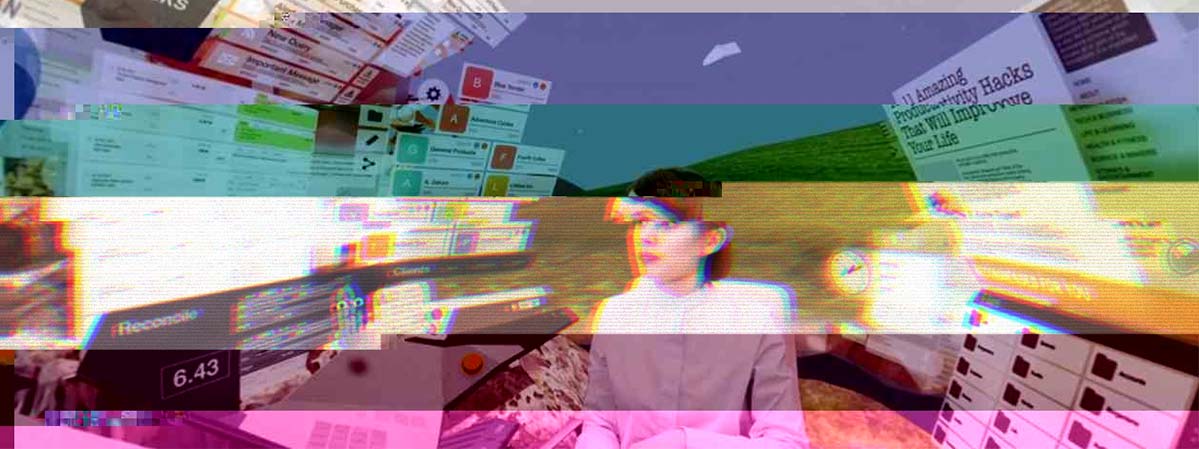
“Merger” by Keiichi Matsuda – automation, work and ‘replacement’

A still from the 360-degree video "Merger" by Keiichi Matsuda
“With automation disrupting centuries-old industries, the professional must reshape and expand their service to add value. Failure is a mindset. It is those who empower themselves with technology who will thrive.
“Merger is a new film about the future of work, from cult director/designer Keiichi Matsuda (HYPER-REALITY). Set against the backdrop of AI-run corporations, a tele-operator finds herself caught between virtual and physical reality, human and machine. As she fights for her economic survival, she finds herself immersed in the cult of productivity, in search of the ultimate interface. This short film documents her last 4 minutes on earth.”

I came across the most recent film by Keichii Matsuda which concerns a possible future of work, with the protagonist embedded in an (aesthetically Microsoft-style) augmented reality of screen-surfaces, and in which the narrative denouement is a sort of trans-human ‘uploading’ moment.

I like Matsuda’s work. i think he skilfully and playfully provokes particular sorts of conversations, mostly about what we used to call ‘immersion’ and the nature of mediation. This has, predictably happened in terms of human vs. AI vs. eschatology (etc etc.) sorts of narratives in various outlets (e.g. the Verge). The first time I encountered his work was at a Passenger Films event at which Rob Kitchin talked about theorisations of mediation in relation to both Matsuda’s work and the (original) Disney film ‘Tron‘.

What is perhaps (briefly) interesting here are two things:

  1. The narrative is a provocative short story that asks us to reflect upon how our world of work and technological development get us from now (the status quo) to an apparent future state of affairs, which carries with it certain kinds of ethical, normative and political contentions. So, this is a story that piggybacks the growing narrative of ‘post-work’ or widespread automation of work by apparently ‘inhuman’ technologies (i.e. A.I) that provokes debate about the roles of ‘technology’ and ‘work’ and what it means to be ‘human’. Interestingly, this (arguably) places “Merger” in the genre of ‘fantasy’ rather than ‘science fiction’ – it is, after all, an eschatological story (I don’t see this final point as a negative). I suppose it could also be seen as a fictional suicide note but I’d rather not dwell on that…
  2. The depiction of the interface and the interaction with the technology-world of the protagonist– and indeed the depiction of these within a 360-degree video –are as important as the story to what the video is signifying. By which I mean – like the videos I called ‘vision videos’ back in 2009/10 (and (in some cases) might be called ‘design fiction’ or ‘diagetic prototypes’) – this video is also trying to show you and perhaps sell you the idea of a technology (Matsuda recently worked for Leap Motion). As I and others have argued – the more familiar audiences are with prospective/speculative technologies the more likely we are (perhaps) to sympathise with their funding/ production/ marketing and ultimately to adopt them.

Call for papers: Geography of/with A.I

Still from the video for All is Love by Bjork

I very much welcome any submissions to this call for papers for the proposed session for the RGS-IBG annual conference (in London in late-August) outlined below. I also welcome anyone getting in touch to talk about possible papers or ideas for other sorts of interventions – please do get in touch.

Call for papers:

We are variously being invited to believe that (mostly Global North, Western) societies are in the cusp, or early stages, of another industrial revolution led by “Artificial Intelligence” – as many popular books (e.g. Brynjolfsson and McAfee 2014) and reports from governments and management consultancies alike will attest (e.g. PWC 2018, UK POST 2016). The goal of this session is to bring together a discussion explicitly focusing on the ways in which geographers already study (with) ‘Artificial Intelligence’ and to, perhaps, outline ways in which we might contribute to wider debates concerning ‘AI’. 

There is widespread, inter-disciplinary analysis of ‘AI’ from a variety of perspective, from embedded systematic bias (Eubanks 2017, Noble 2018) to the kinds of under-examined rationales and work through which such systems emerge (e.g. Adam 1998, Collins 1993) and further to the sorts of ethical-moral frameworks that we should apply to such technologies (Gunkel 2012, Vallor 2016). In similar, if somewhat divergent ways, geographers have variously been interested in the kinds of (apparently) autonomous algorithms or sociotechnical systems are integrated into decision-making processes (e.g. Amoore 2013, Kwan 2016); encounters with apparently autonomous ‘bots’ (e.g. Cockayne et al. 2017); the integration of AI techniques into spatial analysis (e.g. Openshaw & Openshaw 1997); and the processing of ‘big’ data in order to discern things about, or control, people (e.g. Leszczynski 2015). These conversations appear, in conference proceedings and academic outputs, to rarely converge, nevertheless there are many ways in which geographical research does and can continue to contribute to these contemporary concerns.

The invitation of this session is to contribute papers that make explicit the ways in which geographers are (already) contributing to research on and with ‘AI’, to identify research questions that are (perhaps) uniquely geographical in relation to AI, and to thereby advance wider inter-disciplinary debates concerning ‘AI’.

Examples of topics might include (but are certainly not limited to):

  • A.I and governance
  • A.I and intimacy
  • Artificially intelligent mobilities
  • Autonomy, agency and the ethics of A.I
  • Autonomous weapons systems
  • Boosterism and ‘A.I’
  • Feminist and intersectional interventions in/with A.I
  • Gender, race and A.I
  • Labour, work and A.I
  • Machine learning and cognitive work
  • Playful A.I
  • Science fiction, spatial imaginations and A.I
  • Surveillance and A.I

Please send submissions (titles, abstracts (250 words) and author details) to: Sam Kinsley by 31st January 2019.

A genealogy of theorising information technology, through Simondon [video]

Glitched image of a mural of Prometheus giving humans' fire in Freiberg

This post follows from the video of Bernard Stiegler talking about Simondon’s ‘notion’ of information, in relation to his reading of Simondon and others’ theorisation of technogenesis. That paper was a key note in the conference ‘Culture & Technics: The Politics of Du Mode‘, held by the University of Kent’s Centre for Critical Though. It is worth highlighting the whole conference is available on YouTube.

In particular, the panel session with Anne Sauvagnargues and Yuk Hui discussing the genealogy of Simondon’s thought (as articulated in his two perhaps best-known books). For those interested in (more-or-less) French philosophies of technology (largely in the 20th century) this is a fascinating and actually quite accessible discussion.

Sauvagnargues discusses the historical and institutional climate/context of Simondon’s work and Yuk excavates (in a sort of archeological manner) some of the key assumptions and intellectual histories of Simondon’s theorisation of individuation, information and technics.

Bernard Stiegler on the on the notion of information and its limits

Bernard Stiegler being interviewed

I have only just seen this via the De Montfort Media and Communications Research Centre Twitter feed. The above video is Bernard Stiegler’s ‘key note’ (can’t have been a big conference?) at the University of Kent Centre for Critical Though conference on the politics of Simondon’s Modes of Existence of Technical Objects. 

In engaging with Simondon’s theory (or in his terms ‘notion’) of information, Stiegler reiterates some of the key elements of his Technics and Time in relation to exosomatisation and tertiary retention being the principal tendency of an originary technics that, in turn, has the character of a pharmakon, that, in more recent work, Stiegler articulates in relation to the contemporary epoch (the anthoropocene) as the (thermodynamic style) tension between entropy and negentropy. Stiegler’s argument is, I think, that Simondon misses this pharmacological character of information. In arguing this out, Stiegler riffs on some of the more recent elements of his project (the trilogy of ‘As’) – the anthropocene, attention and automation – which characterise the contemporary tendency towards proletarianisation, a loss of knowledge and capacities to remake the world.

It is interesting to see this weaving together of various elements of his project over the last twenty(+) years both: in relation to his engagement with Simondon’s work (a current minor trend in ‘big’ theory), and: in relation to what seems to me to be a moral philosophical character to Stiegler’s project, in terms of his diagnosis of the anthropocene and a call for a ‘neganthropocene’.

Sophia – show robots and deception

Hanson Robotics' "Sophia"

…when first we practice to deceive…

Walter Scott

Prof Noel Sharkey has written a thoughtful, informative and entertaining piece for Forbes (so, for a general audience) that does some unpacking of ‘Sophia’ with reference to the history of ‘show robots’ (such as the Westinghouse show robots of the the mid-C20, like Elektro, and of course Honda’s Asimo). It’s worth reading the piece in full but here’s a couple of choice clips:

Sophia is not the first show robot to attain celebrity status. Yet accusations of hype and deception have proliferated about the misrepresentation of AI to public and policymakers alike. In an AI-hungry world where decisions about the application of the technologies will impact significantly on our lives, Sophia’s creators may have crossed a line. What might the negative consequences be? To get answers, we need to place Sophia in the context of earlier show robots.


The tradition extends back to the automata precursors of robots in antiquity. Moving statues were used in the temples of ancient Egypt and Greece to create the illusion of a manifestation of the gods. Hidden puppeteers pulled ropes and spoke with powerful booming voices emitted from hidden tubes. This is not so different from how show robots like Sophia operate today to create the illusion of a manifestation of AI.

For me, the biggest problem with the hype surrounding Sophia is that we have entered a critical moment in the history of AI where informed decisions need to be made. AI is sweeping through the business world and being delegated decisions that impact significantly on peoples lives from mortgage and loan applications to job interviews, to prison sentences and bail guidance, to transport and delivery services to medicine and care.


It is vitally important that our governments and policymakers are strongly grounded in the reality of AI at this time and are not misled by hype, speculation, and fantasy. It is not clear how much the Hanson Robotics team are aware of the dangers that they are creating by appearing on international platforms with government ministers and policymakers in the audience.

Sing the body electric… robots in music videos

Still from the video for All is Love by Bjork

I recently saw the Chemical Brothers new-ish video for the song “Free Yourself”, featuring androids/robots apparently going feral and raving in a warehouse and it made me consciously think about something I’ve known for some time – there are quite a few music videos with ‘robots’ in them. 

So, here’s a very partial collection: