Automating inequality – Virginia Eubanks and interlocutors [video]

Still from George Lucas' THX1138

This Data & Society talk by Virginia Eubanks on her book Automating Inequality followed by a discussion with Alondra Nelson and Julia Angwin is excellent. This seems like vital empirical analysis and insights that flesh out what is, perhaps, frequently gestured towards by ‘critical algorithm studies’ folks – ‘auditing algorithms’, analysing what’s in the black box, how systems function and what is their material and socio-economic specificity and what then can we learn about how particular forms of actually existing automation (and not simply abstract ideals) function.

Eubanks talks for the first 20-ish minutes and then there’s a discussion that follows. This is really worth watching if you’re interested in doing algorithm studies type work and in doing ‘digital geographies’ that don’t simply lapse into ontology talk.

‘An Encounter Between Don Ihde and Bernard Stiegler: Philosophy of Technology at the Crossroads Again’ Nijmegen 11-12 Jan. 2018

Glitched image of a mural of Prometheus giving humans' fire in Freiberg

Via Yuk Hui. Fascinating line-up of speakers:

International Expert Workshop: ‘An Encounter Between Don Ihde and Bernard Stiegler: Philosophy of Technology at the Crossroads Again’

Nijmegen, 11-12 January 2018Organized by Pieter Lemmens (Radboud University) and Yoni Van Den Eede (Free University of Brussels)

Quo vadis philosophy of technology? The defining moment in contemporary philosophy of technology has undoubtedly been the “empirical turn” of the 1990s and 2000s. Contra older, so-called essentialist approaches that saw technology as an all-encompassing phenomenon or force, the turn inaugurated more “micro-level” analyses of technologies studied in their specific use contexts. However, the empirical turn is now increasingly being called into question, with scholars asking whether the turn has not been pushed too far – certainly given recent technological developments that seem to give technology an all-encompassing or all-penetrating countenance (again): pervasive automation through algorithms and (ro)bots, nanoprobes, biotechnology, neurotechnology, etc. Also, the ecological urgency characterizing our “anthropocenic condition” appears to call for more broad-ranging perspectives than the mere analysis of concrete use contexts. At the same time, nevertheless, the “empirical attitude” keeps demonstrating its usefulness for the philosophical study of technologies on a day-to-day basis… Where do we go from here?

This two-day workshop will be dedicated to these questions by way of an encounter between two leading “streams” in philosophical thinking on technology today. Quite literally we organize an dialogue between two key figures, Don Ihde and Bernard Stiegler, and their respective frameworks: postphenomenology-mediation theory and techno-phenomenology-general organology. Together with these two thinkers and a select group of scholars, we will reflect upon the near-future form that philosophical thinking on technology should take in a world struggling with multiple global crises – the planetary ecological crisis being the gravest one.

Speakers: Prof. dr. Don Ihde (Stony Brook University), Prof. dr. Bernard Stiegler (University of Compiègne), Prof. dr. Mark Coeckelberg (University of Vienna), Dr. Yoni van den Eede (Free University of Brussels), Dr. Yuk Hui (Leuphana University), Dr. Pieter Lemmens (Radboud University), Dr. Helena de Preester (Ghent University), Prof. dr. Robert C. Scharff (University of New Hampshire), Dr. Dominic Smith (University of Dundee), Prof. dr. Peter-Paul Verbeek (University of Twente), Dr. Galit Wellner (Tel Aviv University)

Venue: Villa Oud Heyendael, Rene? Descartesdreef 21, 6525 GL Nijmegen (Campus RU)
Time: 11 and 12 January 2018, 10.00h – 17.30h

More information: http://www.ru.nl/ftr/actueel/agenda/@1134542/expert-seminar-philosophy-technology-at-the/

Made possible by the the Faculty of Science, the Institute for Science in Society, the Faculty of Philosophy, Theology and Religious Studies, the International Office of Radboud University and the Centre for Ethics and Humanism, Free University of Brussels (VUB)

The Guardian of automation

Still from the video for All is Love by Bjork

I have been looking back over the links to news articles I’ve been collecting together about automation and I’ve been struck in particular by how the UK newspaper The Guardian has been running at least one story a week concerning automation in the last few months (see their “AI” category for examples, or the list below). Many are spurred from reports and press releases about particular things, so it’s not like they’re unique in pushing these narratives but it is striking, not least because lots of academics (that I follow anyway) share these stories on Twitter and it becomes a self-reinforcing, somewhat dystopian (‘rise of the robots’) narrative. I’m sure that we all adopt appropriate critical distance when reading such things but… there is a sense in which the ‘robots are coming for our jobs’ sort of arguments are being normalised and sedimented without a great deal of public critical reflection.

We might ask in response to the automation taking jobs arguments: who says? (quite often: management consultants and think tanks) and: how do they know? It seems to me that the answers to those questions are pertinent and probably less clear, and so interesting(!), than one might imagine.

Here’s a selection of the Graun’s recent automation coverage:

John Danaher interview – Robot Sex: Social and Ethical Implications

Gigolo Jane and Gigolo Joe robots in the film A.I.

Via Philosophical Disquisitions.

Through the wonders of the modern technology, myself and Adam Ford sat down for an extended video chat about the new book Robot Sex: Social and Ethical Implications (MIT Press, 2017). You can watch the full thing above or on youtube. Topics covered include:

  • Why did I start writing about this topic?
  • Sex work and technological unemployment
  • Can you have sex with a robot?
  • Is there a case to be made for the use of sex robots?
  • The Campaign Against Sex Robots
  • The possibility of valuable, loving relationships between humans and robots
  • Sexbots as a social experiment

Be sure to check out Adam’s other videos and support his work.

Reblog> Author-Meets-More-or-Less-Friendlies: The Priority of Injustice at AAG 2018

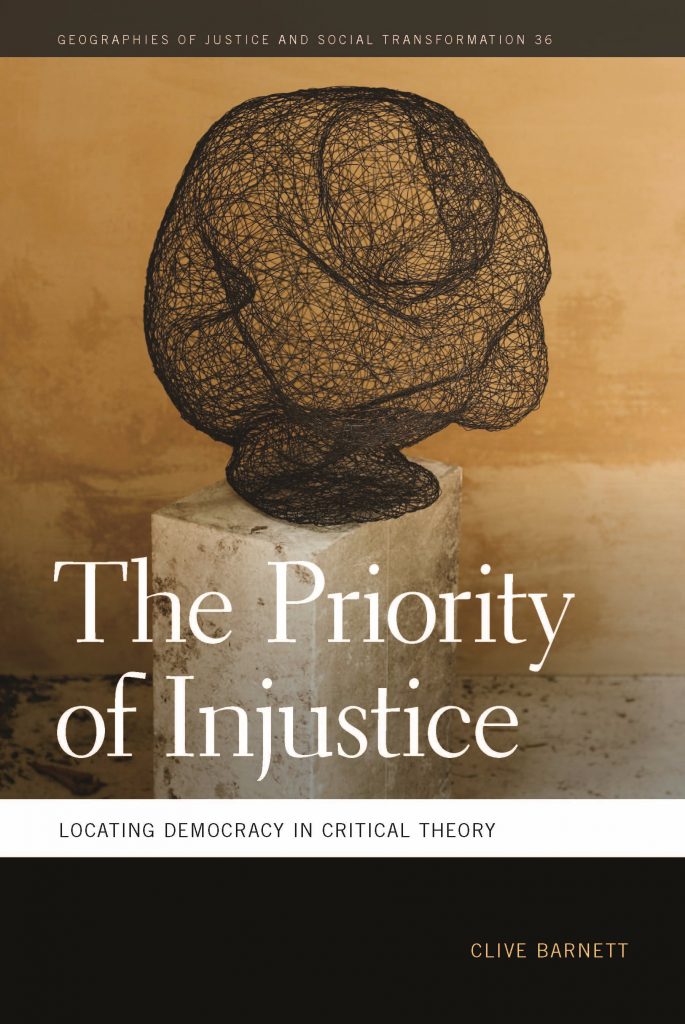
The Priority of Injustice – Clive Barnett

Via Clive. This will be worth going to if you’re going to the AAG in 2018…

Author-Meets-More-or-Less-Friendlies: The Priority of Injustice at AAG 2018

I’m delighted to announce that the very wonderful Michael Samers has arranged an Author Meets Critics session on The Priority of Injustice, my new book (did I mention that?) at the annual meeting of the Association of American Geographers in New Orleans in April. It’s a great panel, with Joshua Barkan (U. of Georgia), Jennifer Fluri (U. of Colorado, Boulder), Leila Harris (UBC), and Kirsi Kallio (University of Tampere) all commenting on the book. The session is sponsored by AAG’s Political Geography Specialty Group and Ethics, Justice, and Human Rights Specialty Group. There’s a nice symmetry about the prospect of discussing the book in New Orleans – the last time the conference was there, in 2003, I presented a paper on theories of radical democracy that was my first post-Culture and Democracy effort at articulating the limits of broadly post-structuralist approaches to that topic, an effort that led eventually to the shape of The Priority of Injustice (yes, I’m a slow thinker).

Reblog > The Priority of Injustice

The Priority of Injustice – Clive Barnett

My colleague Prof. Clive Barnett’s excellent new book is out. He introduces it in a recent blogpost:

The Priority of Injustice

So, finally, the book that I have been writing, on and off, for the last four years, The Priority of Injustice, has been published – or at least, it’s real, since the formal publication date is next month (so I reserve the right to blog further about it as and when). It arrived earlier this week – a rather hectic week, which has oddly meant I have been too busy to experience the strange sense of anti-climax that often accompanies the arrival of the finished form of something that you have been making for so long.

This is, in one sense, my Exeter book – the first thing I did in my very first week here, four years ago, was write the proposal and send it off to prospective publishers, It’s also, though, my Swindon book, a book which attempts to articulate an approach to theorising in an ordinary spirit which has been published just a few weeks after moving away from that very ordinary town where I have lived while writing it.

It’s a beautiful object, with a great cover image, by Helen Burgess (I bought one of her pictures once, in one of those open-house art trail events that you get in places like Bishopston in Bristol, so that’s why I knew of her work; it turns out she is part of a geography-friendly network of artists). And I am honoured and humbled to have the book published in University Georgia Press’s very excellent Geographies of Justice and Social Transformation series.

I’m now faced with the challenge of promoting the book. I’m quite fond of the Coetzee-esque principle that books should have to make their own way in the world without the help of the author; on the other hand, I have some sense of responsibility towards the argument made in the book, a responsibility to help project it into the world. I’ve already realised that it’s not the sort of book that lends itself to an easy press release – ‘THEORY COULD BE THEORISED DIFFERENTLY’, SAYS THEORY-BOY doesn’t really work as a headline, does it?.

Read the full blogpost.

The Economist ‘Babbage’ podcast: “Deus Ex Machina”

Glitched still from the film "Her"

An interesting general (non-academic, non-technical) discussion about what “AI” is, what it means culturally and how it is variously thought about. Interesting to reflect on the way ideas about computation, “algorithms”, “intelligence” and so on play out… something that maybe isn’t discussed enough… I like the way the discussion turns around “thinking” and the suggestion of the word “reckoning”. Worth a listen…

AI Now report

My Cayla Doll

The AI Now Institute have published their second annual report with plenty of interesting things in it. I won’t try and summarise it or offer any analysis (yet). It’s worth a read:

The AI Now Institute, an interdisciplinary research center based at New York University, announced today the publication of its second annual research report. In advance of AI Now’s official launch in November, the 2017 report surveys the current use of AI across core domains, along with the challenges that the rapid introduction of these technologies are presenting. It also provides a set of ten core recommendations to guide future research and accountability mechanisms. The report focuses on key impact areas, including labor and automation, bias and inclusion, rights and liberties, and ethics and governance.

“The field of artificial intelligence is developing rapidly, and promises to help address some of the biggest challenges we face as a society,” said Kate Crawford, cofounder of AI Now and one of the lead authors of the report. “But the reason we founded the AI Now Institute is that we urgently need more research into the real-world implications of the adoption of AI and related technologies in our most sensitive social institutions. People are already being affected by these systems, be it while at school, looking for a job, reading news online, or interacting with the courts. With this report, we’re taking stock of the progress so far and the biggest emerging challenges that can guide our future research on the social implications of AI.”

There’s also a sort of Exec. Summary, a list of “10 Top Recommendations for the AI Field in 2017” on Medium too. Here’s the short version of that:

  1. 1. Core public agencies, such as those responsible for criminal justice, healthcare, welfare, and education (e.g “high stakes” domains) should no longer use ‘black box’ AI and algorithmic systems.
  2. 2. Before releasing an AI system, companies should run rigorous pre-release trials to ensure that they will not amplify biases and errors due to any issues with the training data, algorithms, or other elements of system design.
  3. 3. After releasing an AI system, companies should continue to monitor its use across different contexts and communities.
  4. 4. More research and policy making is needed on the use of AI systems in workplace management and monitoring, including hiring and HR.
  5. 5. Develop standards to track the provenance, development, and use of training datasets throughout their life cycle.
  6. 6. Expand AI bias research and mitigation strategies beyond a narrowly technical approach.
  7. 7. Strong standards for auditing and understanding the use of AI systems “in the wild” are urgently needed.
  8. 8. Companies, universities, conferences and other stakeholders in the AI field should release data on the participation of women, minorities and other marginalized groups within AI research and development.
  9. 9. The AI industry should hire experts from disciplines beyond computer science and engineering and ensure they have decision making power.
  10. 10. Ethical codes meant to steer the AI field should be accompanied by strong oversight and accountability mechanisms.

Which sort of reads, to me, as: “There should be more social scientists involved” 🙂

Monday thought – OOOber?

statue of a man holding his head with his right hand

A thought experiment based upon flippant suggestion:

Object Oriented Ontology is to philosophy what Uber is to tech development.

Both ‘disruptive’, Uber and OOO have both expanded beyond their initial context, which is by several measures ‘success’. Both have become like discursive shortcuts for a particular set of ideas – ‘gig economy’ and ‘automation’ for Uber and ‘speculative realism’ and maybe even ‘metaphysics’ for OOO (and there’s possibly other associations for these terms too).

Neither OOO or Uber came up with the ideas they propound first, they ‘innovated’ from others (not necessarily a problem) and then made grand claims based on that (maybe a problem).

Neither of the groups involved in the development of Uber or OOO has acted especially ethically, although Uber is almost certainly significantly worse (this isn’t a like-for-like comparison). This is one of the other ways in which these words have become pregnant with meaning. Uber has been variously documented as having a problem with misogyny in the workplace and has also teetered on the edge of legality through ‘greyball’. Some of the proponents of OOO have been accused of bullying graduate students online and at conferences (I recognise gossip can be pernicious but I’ve heard this from several unrelated sources). It has also been suggested some of these folks are garnering a reputation for being somewhat ‘macho’ in attitude – it probably doesn’t help that the lead figures are all male, that they write lots of earnest manifestos or that they succumb to profiles in newspapers that call them “philosopher prophet“. Of course, neither OOO or Uber are unique in this, similar observations/ accusations have been made of antecedent tech firms and philosophical movements, one need only look to TV programmes like “Silicon Valley” or open up the ‘theory boy‘ can of worms.

Finally, there is also a sense that the success both Uber and OOO are easily co-opted into these (pejorative) narratives. There are grounds for this, well – certainly for Uber, but the visibility that success brings makes it easier to tell these stories. I have no doubt that such alleged behaviour is not limited to those involved in Uber or OOO. Likewise, those categories may be contested and we shouldn’t tar everyone who works for a company or does a particular branch of theory with the same brush. Goodness knows there are plenty of “tech bros” and, for want of a better term, “theory bros” outside of Uber and OOO.

Such a critique, however flippant, can come across as a bit pompous or sly. I cannot stand outside this, I am, to a degree, complicit. For example, the citational practices used by “theory bros”, cartel-like, are easy to slip into – many of us have succumbed. To recognise stupidity, as both Ronell and Stiegler point out, is to recognise my own stupidity – the lesson, perhaps the ‘ethic’, is to pass through it towards knowledge. Not the reproduction of the same knowledge (that’s patriarchy), and not always, I think, difference for it’s own sake (isn’t that what the “tech bros” call “disruption”? and doesn’t that always require being in a privileged position?) but perhaps a thoughtful defiance – not ‘laughing along’. This could mean more “no’s” (following Sara Ahmed). Maybe even something like a NO movement – “No Ontology”, at least the kinds of ontology that get used as authority in the kinds of theory top trumps that get played by some of us in the social sciences and humanities… of course this isn’t a novel suggestion either, it’s somewhat akin to feminist standpoint theory.

Perhaps I’m being unkind to OOO and those who do/use it. Success breeds contempt and all that… but the thought experiment was interesting to run through, in my own ham-fisted way…